Editor:
Brandon Sweet
University Communications
bulletin@uwaterloo.ca
What to remember when a campus fire drill takes place
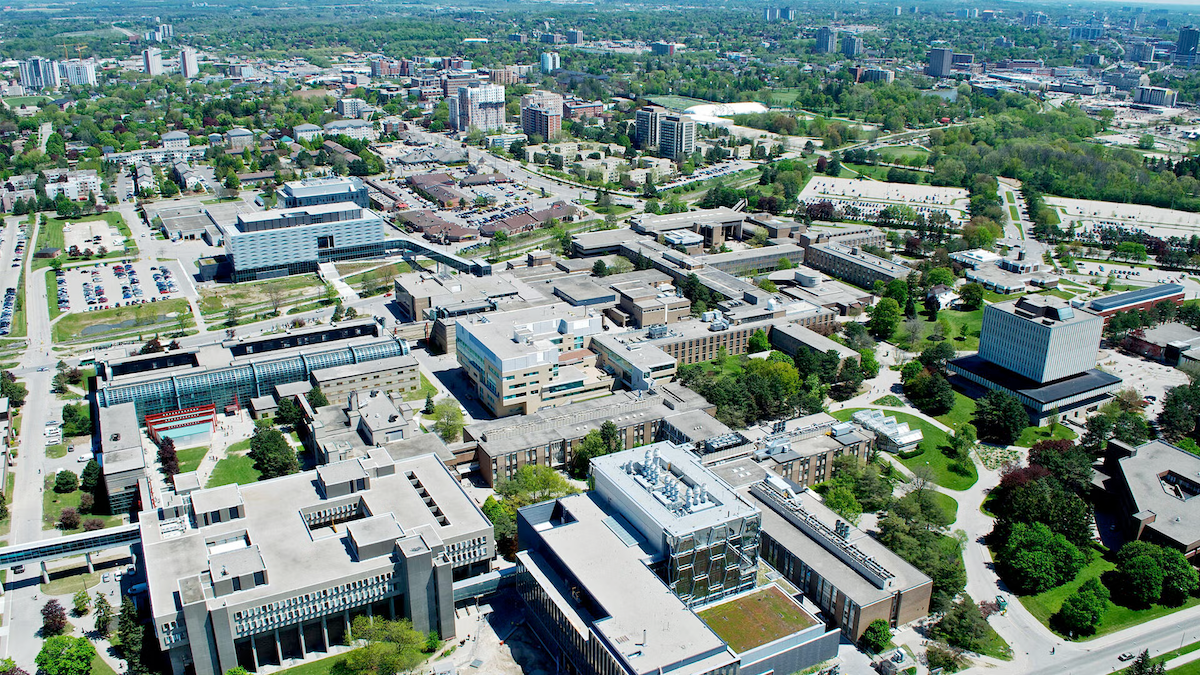
A message from the Safety Office.
Fire drills are an important part of keeping our campus safe and ensuring that everyone knows what to do in an emergency. Thank you to those who participated in the recent spring fire drills across campus. Overall, evacuations were completed efficiently and with minimal disruption. As with any drill, a few common challenges were identified, and these provide a helpful reminder of what to do when a fire alarm sounds.
Please remember:
- When a fire alarm sounds, everyone must evacuate the building immediately. This includes meetings, classes, labs, and offices. There are no exemptions.
- Use the nearest safe exit. Do not wait to finish work, collect belongings, or look for confirmation that it is “just a drill.”
- Once outside, move well away from the building and stay clear of exits and fire routes so others can evacuate and emergency responders have clear access.
- Do not enter a building while a fire alarm is active.
- Follow the direction of Emergency Wardens and Safety staff, who are there to help ensure a safe and orderly evacuation.
Most challenges observed during the drills involved hesitation to evacuate or people gathering too close to exits after leaving the building. These are exactly the behaviour that drills are designed to identify and improve before a real emergency occurs.
Fire drills are a shared responsibility, and individual actions play a key role in keeping everyone safe.
Interested in helping?
Emergency Wardens support safe evacuations during alarms and emergencies. If you are interested in becoming an Emergency Warden or learning more about the role, please visit the Safety Office website for details and training opportunities.
Thank you for your cooperation and support in helping maintain a safe campus.
Gautam Kamath receives 2026 Presburger Award
This article was originally published on the Cheriton School of Computer Science website.
Professor Gautam Kamath has won the 2026 Presburger Award. This prestigious honour recognizes his exceptional contributions to theoretical computer science, notably his pioneering work on computationally efficient algorithms for fundamental estimation tasks under robustness constraints.
Conferred annually since 2010 by the European Association for Theoretical Computer Science, the Presburger Award recognizes a young researcher for outstanding contributions to theoretical computer science, as documented by a paper or series of papers. The award is named in honour of Mojżesz Presburger, whose groundbreaking research on decidability of the theory of addition laid the foundation for what is now known as Presburger arithmetic.
“Congratulations to Gautam on receiving this year’s Presburger Award,” said Raouf Boutaba, University Professor and Director of the Cheriton School of Computer Science. “This prestigious honour reflects the depth and growing influence of his work. The award also adds to his growing list of professional accolades that includes an Ontario Early Researcher Award in 2025 and the Faculty of Mathematics Golden Jubilee Research Excellence Award in 2023, along with the 2024 Caspar Bowden PET Award and a recent best paper award at ICML.”
Gautam Kamath is an Assistant Professor at the Cheriton School of Computer Science, a Canada CIFAR AI Chair at the Vector Institute, and a member of Waterloo’s Cybersecurity and Privacy Institute. An expert in algorithms, statistics and machine learning, his research focuses on modern data analysis under constraints such as differential privacy and robustness.
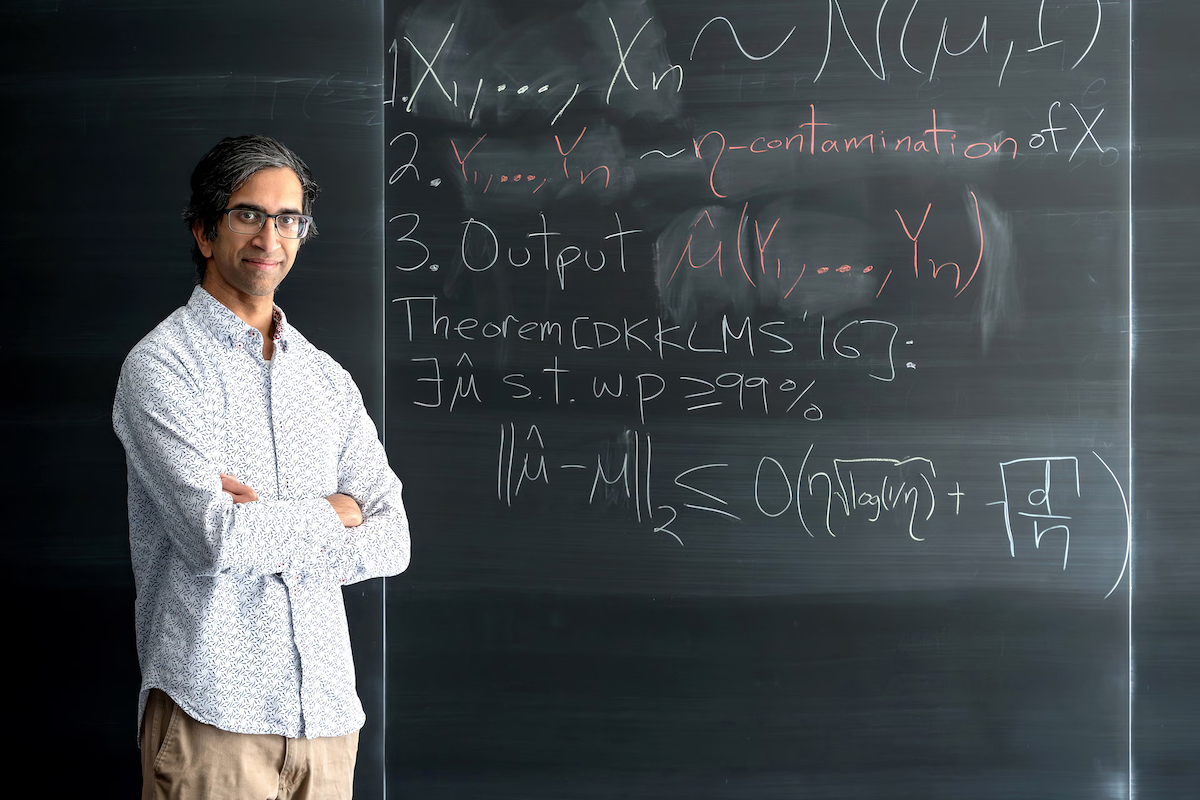
As of April 2026, his publications have been cited more than 6,800 times, with an h-index of 41, according to Google Scholar. His most highly cited paper, on efficient robust estimation, whose key ideas are illustrated on the blackboard, helped define a new area of study in high-dimensional statistics.
About Professor Kamath’s research
Professor Kamath has pioneered computationally efficient algorithms for fundamental estimation problems under robustness constraints. His seminal 2016 paper helped launch an entire research area, with a rapidly expanding frontier spanning topics such as list-decodable learning and differential privacy. Over the past decade, he has been a leading contributor to many of these developments.
Professor Kamath’s research begins with mean estimation, the most fundamental statistical question: Given n independent and identically distributed samples from a d-dimensional Gaussian distribution, how can the mean be estimated? The simple, efficient and optimal statistic is the empirical mean.
The question, however, becomes much more interesting when a portion of the data is corrupted (i.e., an η-fraction of the dataset), whether by model misspecification or a malicious adversary. The empirical mean can now be arbitrarily bad. In 2016, Professor Kamath and his collaborators resolved this classical problem by applying an algorithmic lens. They gave the first polynomial-time algorithm that achieves a dimension-independent 𝑂(η) excess error. Their main algorithm is an elegant application of the spectral method. By inspecting the top eigenvalue of the empirical covariance matrix, they can identify and prune outliers by inspecting the corresponding eigenvector direction, or certify that the empirical mean of the remaining points is accurate. He and his collaborators also give algorithms for Gaussians with unknown covariances and a host of other settings.
Their paper, Robust Estimators in High-Dimensions Without the Computational Intractability, was presented at FOCS 2016, the 57th Annual Symposium on Foundations of Computer Science. Highly acclaimed by the community, the paper was invited to several prestigious venues, among them the SICOMP Special Issue for FOCS 2016, Highlights of Algorithms 2017, and Communications of the ACM Research Highlights. As of April 2026, it has received more than 660 citations and remains the most cited paper from FOCS 2016 and onward.
Professor Kamath and his collaborators have produced several key works in this area subsequently, including algorithms operating under much weaker distributional assumptions at ICML 2017, the 34th International Conference on Machine Learning; improved algorithms for Gaussians at SODA 2018, the 29th ACM-SIAM Symposium on Discrete Algorithms; and algorithms for protecting machine learning models from data poisoning attacks at ICML 2019, 36th International Conference on Machine Learning. Beyond these contributions, his work has helped spark widespread interest across the algorithms community.
Meanwhile, Professor Kamath has made significant contributions to differential privacy. These papers include Privately Learning High-Dimensional Distributions (COLT 2019), The Discrete Gaussian for Differential Privacy (NeurIPS 2020), Locally Private Hypothesis Selection (COLT 2020), and Differentially Private Algorithms for Learning Mixtures of Separated Gaussians (NeurIPS 2019).
Differential privacy can be viewed as a form of robustness, requiring that an algorithm’s output remain stable under small changes to its input. A key open problem was to design efficient optimal algorithms for mean estimation. In Efficient Mean Estimation with Pure Differential Privacy via a Sum-of-squares Exponential Mechanism (STOC 2022), Professor Kamath and his collaborators solved the open problem, again using the algorithmic lens he pioneered in 2016. This connection is not incidental. In subsequent work, Robustness Implies Privacy in Statistical Estimation (STOC 2023), Professor Kamath and his collaborators showed that any robust estimator can be converted to a private one, evidence of deep algorithmic connections that underpin the field.
Beyond his research contributions, Professor Kamath is committed to advancing and sharing these ideas within the broader community. He co-organized workshops on robust and private estimation at the Fields Institute in 2022 and at the Toyota Technological Institute at Chicago in 2024, and authored a survey article on the broader landscape of robustness in algorithmic statistics published in IEEE BITS: The Information Theory Magazine.
Interactive exhibit delivers cold hard truth about glaciers

A special exhibit is coming to East Campus Hall's Artery Gallery this week.
The Life and Legacy of the Athabasca Glacier is an interactive exhibit that tells the story of one of Canada’s most iconic and rapidly disappearing glaciers. A bellwether of the accelerating effects of climate change, the Athabasca Glacier in Jasper National Park is projected to disappear within one generation. This series of art installations invites the audience to experience and reflect on the glacier’s fragile beauty and its role in our shared future.
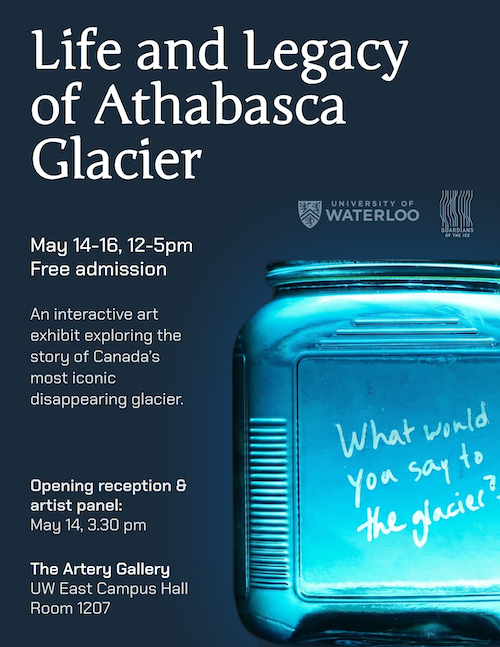
Incorporating award-winning photography by Guardians of the Ice, the three-chapter immersive experience allows visitors to journey through different phases of the glacier’s life. Contrasting the stark timescales of glacial growth (millennia) and disappearance (decades), the exhibit invites participants to leave a message in honour of the glacier’s legacy.
The Life and Legacy of the Athabasca Glacier is created by Maryia Markhvida, Michelle Rutty, Jayden Hsiao, Kathy Zhang, Dror Margalit (Artful), John Luo, Mave Rubiano, Elaheh Sanoubari, and Hewan Amare, in collaboration with Guardians of the Ice.
The exhibition runs from Thursday, May 14 to Saturday, May 16, from 12 noon to 5:00 p.m. An opening reception and artist’s panel event takes place on Thursday, May 14 at 3:30 p.m. in the Artery Gallery, ECH 1207.
The exhibit is presented with the generous support of the Waterloo Climate Institute, the Canadian Foundation for Innovation, the Cornfield Co-op Fellowship, the Bob Harding & Lois Claxton Humanities and Social Sciences Endowment Fund, Parks Canada, and UWaterloo’s Fine Arts department.
Tuesday's notes

Research Impact Canada's May Dr. RIC session takes place on Thursday, May 14, from 1:15 p.m. to 2:15 p.m. online. "Join us for the May Dr. RIC call, where Cara Evans and Arina Bogdan (Waypoint Centre for Mental Health Care) will share insights on STREAM Lab—a rapid evidence synthesis service that mobilizes knowledge on mental health and substance use to decision-makers across Ontario," says a note from the Office of Research. "We’ll also hear from Kathryn Dong (U Alberta) who will speak about social accountability and how it impacts the communities we serve."
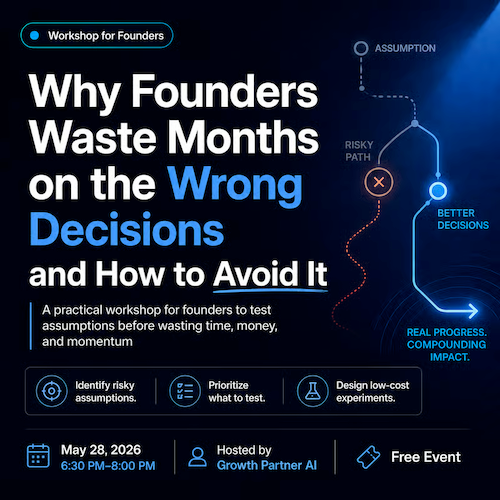
A practical founder working session for students, early-stage founders, and startup operators interested in entrepreneurship, customer discovery, positioning, pricing, sales channels, and go-to-market decisions will take place on Thursday, May 28.
"Why Founders Waste Months on the Wrong Decisions and How to Avoid It" focuses on a common founder problem: losing months by building, selling, or scaling around weak market signals. Participants will use real startup examples to learn how to identify high-risk decisions earlier, separate real market signal from polite feedback, and decide what to test before committing more time and resources.
The session is led by Vivian Wang, founder of Growth Partner AI, which was recently recognized as part of Scale Up Canada’s Waterloo 50.
Register on Luma.
Register for a Budget Q&A session
Two in‑person Q&A sessions will be held to discuss the 2026/2027 operating budget and related initiatives in May. Both sessions will be livestreamed. Please register for one of the following sessions:
-
Q&A Session 1, Thursday, May 14, 10:00 a.m. to 11:00 a.m, Humanities Theatre
-
Q&A Session 2, Friday, May 15, 9:30 a.m. to 10:30 a.m.
For more details, visit the Waterloo Budget Plan website.
Link of the day
When and where
The Campus Wellness Student Medical Clinic offers healthcare visits with Physicians and Nurse Practitioners to current undergraduate and graduate students. Services include: vaccinations, immunity testing, naturopathic services and more. Counselling Services offers appointments with counsellors in person as well as via phone and video. Students can book appointments for these services by calling Campus Wellness at 519-888-4096.
The privately-run Student Health Pharmacy (located in the lower level of the Student Life Centre) is now offering new COVID booster shots and flu shots. Covid booster shots are available by appointment only – please call ext. 33784 or 519-746-4500. The Student Health Pharmacy’s summer hours are Monday to Friday, 9:30 a.m. to 4:30 p.m. Naloxone kits are still available – pick them up in the pharmacy at no charge.
The Waterloo Eye Institute optometry clinics in Waterloo and downtown Kitchener offer comprehensive eye exams and eyewear, including glasses and contact lenses, with the Waterloo location offering various specialized services including urgent eye care. Discounts apply for University of Waterloo students and employees. The Waterloo Clinic is at a nearby interim location, 419C Phillip St, during construction at the School of Optometry and Vision Science. The Kitchener Clinic remains at the Health Sciences Campus, 10B Victoria St. S. Book online or by phone at 519-888-4062.
Warriors Summer Youth Camps, registration is now open for multi-sport and games, baseball, basketball, eSports, football and hockey camps for boys and girls ages 5 to 18. Register today!
Warrior Rec registration open, Tuesday, May 5 to Tuesday, May 19, 1:00 p.m. (intramurals) and Thursday, May 21, 12 noon (all other programming).
WIN Distinguished Lecture with Arben Merkoçi, "Coupling Nanomaterials with Sustainable Platforms for Next-Generation Point-of-Care Nanobiosensors," Tuesday, May 12, 11:00 a.m. to 12 noon, QNC 1501.
Performance Development Program: A Manager's Overview, Tuesday, May 12, 2:00 p.m. to 4:00 p.m., EC1 1023.
Public Lecture by P. Whitney Lackenbauer, “Canada’s Arctic is Under Threat: Clarifying Security Threats Through, To, and In the Arctic,” Tuesday, May 12, 7:00 p.m., Notre Dame Chapel, St. Jerome’s University. Refreshments will be served.
Seedling Swap Drop-Off, drop off on Wednesday, May 13, 8:00 a.m. to 4:00 p.m. and Thursday, May 14, 8:00 a.m. to 10:00 a.m., CPH 2385.
WICI Complexity Day: From Particles to Markets: Complex Systems Across Disciplines, Wednesday, May 13, 11:30 a.m. to 5:00 p.m., PSE 7303.
SEE Canada Grant information session, Wednesday, May 13, 12 noon to 1:00 p.m., online.
Hallman Lecture featuring Clara Hughes: Open Heart, Open Mind, Wednesday, May 13, 5:30 p.m. to 7:30 p.m., Humanities Theatre, Hagey Hall.
Faculty of Arts presents The Gaza Doctrine: Implications for International Law and the future of the Middle East featuring guest speaker Neve Gordon, Wednesday, May 13, 7:00 p.m., Fed Hall and online. Please register.
The Life and Legacy of the Athabasca Glacier interactive art exhibit, Thursday, May 14 to Saturday, May 16, 12 noon to 5:00 p.m., The Artery Gallery, ECH 1207
Spring Athletics & Recreation Open House, Thursday, May 14, 11:00 a.m. to 2:00 p.m., PAC/SLC Atrium..
Seedling Swap, Thursday, May 14, 12 noon to 2:00 p.m., EV3 Foyer.
Anti-Racism Reads Series: Algorithms of Oppression, Thursday, May 14, 12 noon to 1:00 p.m., Dana Porter Library Room 338.
NEW - Research Impact Canada May Dr. RIC, Thursday, May 14, 1:15 p.m. to 2:15 p.m., online. Contact Nadine Quehl to receive the Zoom link.
Celebration of Life for Professor Wayne Chang, Thursday, May 14, 2:00 p.m. to 4:00 p.m., PSE event space. RSVP.
The Life and Legacy of the Athabasca Glacier interactive art exhibit opening reception and artist panel, Thursday, May 14, 3:30 p.m., The Artery Gallery, ECH 1207.
Performance Development Program: A Manager's Overview, Friday, May 15, 9:30 a.m. to 11:30 a.m., EC1 1023.
Take Teaching Outdoors!, Tuesday, May 19, 11:30 a.m. to 5:00 p.m., EV3 lobby.
Distinguished Lecture Series featuring Margaret-Anne Storey, Canada Research Chair in Human and Social Aspects of Software Engineering, University of Victoria, How Generative and Agentic AI is Disrupting Software Development, Wednesday, May 20, 10:0 a.m., DC 1302 and online.
From Research to Policy: A panel session on enhancing research impact in the policy arena registration deadline, May 21.
NEW - Teaching Dossiers and Philosophy Statements (CTE9914), Thursday, May 21, 10:00 a.m. to 12 noon, MC 2036.
NEW - Turtle Island Indigenous Science Conference 2026, Sunday, May 24 to Tuesday, May 26.
PhD oral defences
Physics and Astronomy. Matthew Duschenes, “Effects of Noise on Optimization, Statistics, and Simulation of Quantum Systems.” Supervisors, Dr. Roger Melko, Dr. Juan Carrasquilla. Visit the Faculty of Science Thesis Submission Notices website for details on requesting a copy to review. Oral defence Friday, May 29, 9:30 a.m., QNC 2101.
Physics and Astronomy. Leonardo Almeida Lessa, “Order in the Open: Symmetries and Entanglement of Many-Body Mixed States.” Supervisors, Dr. Anton Burkov, Dr. Chong Wang. Visit the Faculty of Science Thesis Submission Notices website for details on requesting a copy to review. Oral defence Monday, June 1, 1:00 p.m., remote via MS Teams.
Physics and Astronomy. Amirreza Negari, “Phases of matter in quantum information and error correction.” Supervisors, Dr. Roger Melko, Dr. Timothy Hsieh. Visit the Faculty of Science Thesis Submission Notices website for details on requesting a copy to review. Oral defence Tuesday, June 2, 1:00 p.m., remote via MS Teams.
Global Governance. Jacob Benjamin, “Internal conflict within Asian security arrangements.” Supervisor, Dr. David Welch. Available upon request from the Faculty of Arts, Graduate Studies and Research Officer. Oral defence Wednesday, June 3, 10:00 a.m., BSIA 1-23 and hybrid.
Upcoming service interruptions
Stay up to date on service interruptions, campus construction, and other operational changes on the Plant Operations website. Upcoming service interruptions include:
-
REV South-East Quads water tank replacement, Wednesday, May 6 to Friday, August 14, hot water will not be available in the south-east quad affecting washrooms.
-
Math 4 crane dismantling, Tuesday, May 12, 7:00 a.m. to 5:00 p.m. (rain day Wednesday, May 13), William Tutte Way between Ring Road and Math 3 will be closed to pedestrian traffic.
-
Physical Activities Complex, Student Life Centre, RAC 1 and 2, Federation Hall fire alarm testing, Wednesday, May 13, 6:30 a.m. to 8:15 a.m.
-
School of Architecture fire alarm testing, Friday, May 15, 6:30 a.m. to 8:15 a.m.
-
Aberfoyle - BioRem fire alarm testing, Friday, May 15, 10:00 a.m. to 11:00 a.m.
-
Stratford School of Interaction Design and Business fire alarm testing, Friday, May 15, 12 noon to 1:00 p.m.
-
Fire Research Facility fire alarm testing, Friday, May 15, 1:00 p.m. to 2:00 p.m.