Submit content for the Daily Bulletin through the Daily Bulletin intake form.
For all other requests, please contact communications@uwaterloo.ca.
Faculty invited to submit proposals for the WIL Authorship Collaborative
By: Matthew King (he/him).
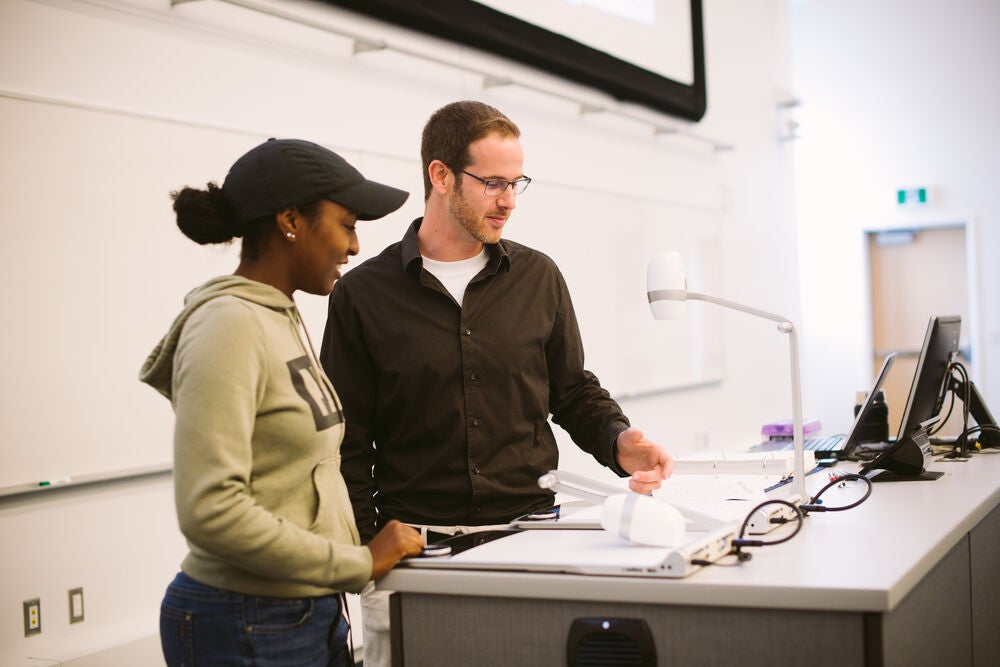
The Centre for Work-Integrated Learning (WIL) is now accepting proposals for the next phase of the WIL Authorship Collaborative connected to Societal Futures and the future of work. The initiative brings together faculty, staff, graduate students and curriculum experts to translate Waterloo knowledge and research to co-create student-facing content used in WIL programming.
“This year’s focus on societal futures explores how workplaces can build cultures of trust, responsibility and informed decision-making,” says Erin Jobidon, Senior Manager, WIL Curriculum. “We’re looking for campus expertise that can help students think critically about topics such as social impact, ethical information and data use, communication across disciplines and Indigenous ways of knowing as they prepare for an evolving world of work.”
Through the collaborative, selected contributors work alongside the Centre for WIL curriculum team to help shape learning goals, identify key themes and provide research-informed insights that the team can integrate into digital learning assets. These materials are integrated into Centre for WIL courses and programming that reach hundreds of students across faculties and disciplines.
The WIL Authorship Collaborative also serves as a knowledge mobilization opportunity, helping faculty extend the reach of their research into an accessible, practice-oriented curriculum that can impact hundreds of students each term.
Those faculty interested in participating can learn more about proposal requirements, timelines and submission details through the Centre for Work-Integrated Learning Authorship Collaborative page.
FIFA World Cup 2026: Waterloo experts discuss impacts beyond the games

This article was originally published in Waterloo News.
As Canada prepares to host matches during the 2026 FIFA World Cup, excitement is building for one of the world’s most celebrated sporting events. The tournament will bring billions of fans together in a shared global moment, but beyond the spectacle, it will also place extraordinary demands on host cities and their communities.
At the University of Waterloo, researchers are examining what the World Cup will mean not just for sports fans, but for infrastructure, the environment and society at large. Their insights reveal that while the event promises unforgettable moments on the field, its impacts off the field are far more complex.
For Dr. Jeff Casello, a researcher in the Faculty of Engineering and Faculty of Environment, transportation will be one of the most immediate pressure points. Toronto’s transit system already struggles to meet everyday demand, and the influx of visitors will only intensify the strain.
“Toronto is already experiencing challenges in handling the existing demand on a day-by-day basis, so when you suddenly introduce 30 or 40 per cent more transportation activity, it’s going to exacerbate the situation,” he says. “It's therefore critical to get people to rethink how they travel and avoid using their car. Metrolinx and the TTC are ramping up service, so people who would normally drive into the city should consider transit — or even working from home.”
For those navigating the system during the games, the experience itself will be noticeably different.
Read the full article on Waterloo News.
Waterloo honours exceptional leaders at Spring 2026 Convocation
This article was originally published on Waterloo News.
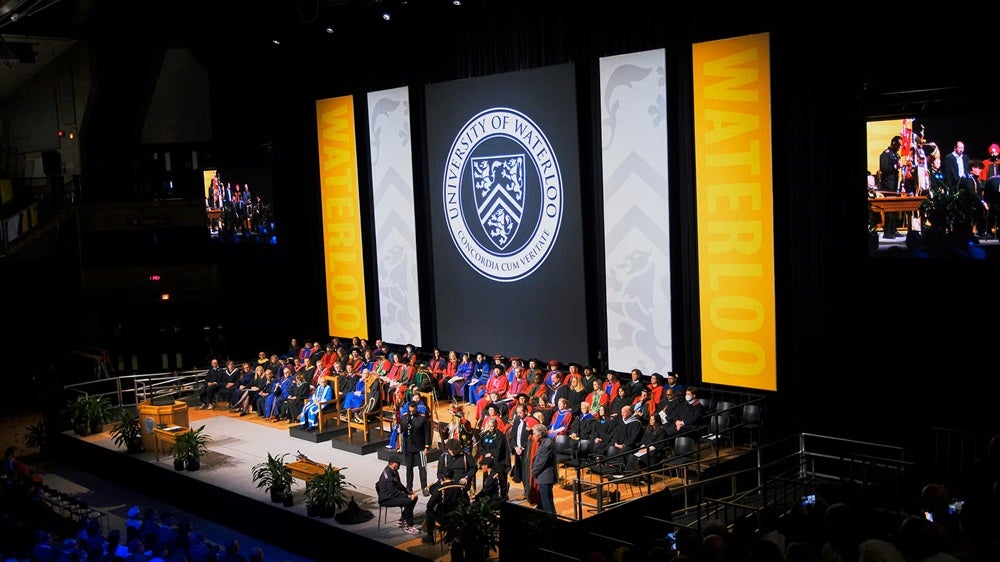
The University of Waterloo is proud to award nine honorary doctorates at Spring 2026 Convocation, the highest honour conferred by the University.
Honorary doctorates recognize individuals whose outstanding achievements and contributions have had a meaningful impact on the University, their communities, their fields and the world. Recipients are celebrated for excellence across disciplines including research, scholarship, the arts, professional achievement and voluntary service.
The honorary doctorate recipients recognized this year have made remarkable contributions in mathematics, physics, archaeology, business, engineering and science.
“This year’s honorary doctorate recipients exemplify the impact that comes from curiosity, collaboration and excellence,” says Dr. Vivek Goel, President and Vice-Chancellor of the University of Waterloo. “We are proud to recognize their achievements and celebrate the meaningful contributions they have made to society.”
Learn more about this year’s honorary doctorate recipients and their extraordinary accomplishments.
Celebrating the career of Andrew Barker
A message from the Office of the Vice-President, Research and International.
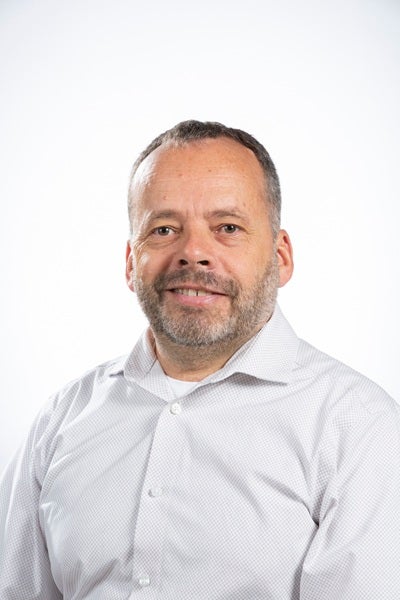
Andrew first arrived at the University of Waterloo in 1983 as an undergraduate student, where he became interested in low‑income housing policy and international development. Like many students, he began working on campus—notably, on SSHRC‑ and CMHC‑funded research projects examining neighbourhood gentrification. For one early project, he hand‑delivered introductory letters featuring his photo so residents would recognize him when he knocked on their doors a week later. His supervisor noted that this approach produced “the highest response rate ever” for household surveys. Strangely, the approach never caught on; regardless, these experiences cemented his desire to work in research.
In 1986, during his 4th year, a three‑month reading‑course adventure in India ignited a lasting passion for international development. He later secured a CIDA scholarship to conduct a gender‑based analysis of low‑income housing policy in India for his graduate work. After completing his master’s, he returned to India for several years, contributing to multiple projects, including serving as Project Manager for an IDRC‑funded training initiative. Falling in love with its culture – and people – he returns there every five years to visit life-long friends.
Andrew returned to Waterloo in 1991 for a series of full‑time contracts. During this period, the university had just appointed its first Vice‑President, Research, Carolyn Hansson, who attempted to bring him on permanently—though, as we know, that takes time…. A turning point came when the VPR asked him to collaborate with the US‑based company, Community of Science, to develop researcher expertise profiles linked to a funding database (now Pivot‑RP). Invited to a workshop in Baltimore, he unknowingly found himself in a job interview and two months later, he had relocated to the US to manage the database’s international content. Some of his closest friends are from those days, where he led an ‘outdoor adventurers’ club.
Three years later, Dr. Hansson called with a job offer, and in October 1998 Andrew returned to Waterloo permanently to join the newly formed Institutional Programs unit, responsible for CFI. He began as a Coordinator and will retire as Director on August 1, 2026—just shy of 28 years of permanent service, more than 32 years including contracts. His early years were spent working directly with faculty, a part of the job he remembers fondly. And as programs multiplied and the team expanded, he shifted to supervisory responsibilities, addressing what he preferred to call “interesting challenges” rather than “problems”.
In retirement, he plans to master the arts of relaxing, puttering, and claiming the Wi‑Fi is down whenever someone tries to reach him.
Please join us in celebrating Andrew at his retirement party. It will be held Friday June 12th, East Campus 5, Second Floor, Room 2301, from 1:00 to 4:00 p.m.
When and Where
The Campus Wellness Student Medical Clinic offers healthcare visits with Physicians and Nurse Practitioners to current undergraduate and graduate students. Services include: vaccinations, immunity testing, naturopathic services and more. Counselling Services offers appointments with counsellors in person as well as via phone and video. Students can book appointments for these services by calling Campus Wellness at 519-888-4096.
The privately-run Student Health Pharmacy (located in the lower level of the Student Life Centre) is now offering new COVID booster shots and flu shots. Covid booster shots are available by appointment only – please call ext. 33784 or 519-746-4500. The Student Health Pharmacy’s summer hours are Monday to Friday, 9:30 a.m. to 4:30 p.m. Naloxone kits are still available – pick them up in the pharmacy at no charge.
The Waterloo Eye Institute optometry clinics in Waterloo and downtown Kitchener offer comprehensive eye exams and eyewear, including glasses and contact lenses, with the Waterloo location offering various specialized services including urgent eye care. Discounts apply for University of Waterloo students and employees. The Waterloo Clinic is at a nearby interim location, 419C Phillip St, during construction at the School of Optometry and Vision Science. The Kitchener Clinic remains at the Health Sciences Campus, 10B Victoria St. S. Book online or by phone at 519-888-4062.
Warriors Summer Youth Camps, registration is now open for multi-sport and games, baseball, basketball, eSports, football and hockey camps for boys and girls ages 5 to 18. Register today!
Celebrating Indigenous Authorship: Ojistoh publishing author event, Thursday, June 11, 1:30 to 3:00 p.m., Dana Porter Library main floor (in front of Indigenous mural).
2026 Lupina Foundation Postdoctoral Research Showcase, Friday, June 12, 10:00 a.m. to 12:00 p.m., PAS 2464
Celebration of Life: Dr. Ron Mullin, Saturday, June 13 from 2:00 to 5:00 p.m. in the Fireside Reception room at Erb & Good Family Funeral Home at 171 King Street South, Waterloo.
Generative AI Tools for Research: Responsible Use, Monday, June 15, 1:30 to 3 p.m., Hybrid, LIB 329.
Anonymity, Consent, And Other Noble Lies: An Empirical Study of The Data Economywith Dr. Joel Reardon, Associate Professor, Department of Computer Science, University of Calgary, Monday, June 15, 2:30 to 4:00 p.m., Enterprise Theatre
Convocation ceremonies, Tuesday, June 16 to Saturday, June 20.
Distinguished Lecture Series, featuring Gilles Brassard, Professor and 2025 ACM A. M. Turing Laureate, Alan Turing and me, Tuesday, June 16, 11:00 a.m. to 12:30 p.m., DC 1302 and online via Zoom.
Knowledge Mobilization Networking Mixer, for members or future members of the Waterloo Wellington Knowledge Mobilization Community or the Waterloo Knowledge Mobilization Community of Practice, Tuesday, June 16, 12:30 to 2:00 p.m., ENV 1 Courtyard; Please bring a bagged lunch, and register as soon as possible as space is limited.
Accessible Teaching Support for Instructors Part 2: uWaterloo Course Accessibility Guide - Online (CTE7051) Wednesday, June 17, 1:00 to 2:30 p.m., online.
Anti-Racism Reads: One Day, Everyone Will Have Always Been Against This, Thursday, June 18, noon to 1:00 p.m., LIB 338
MMIWG2S Art Unveiling and Dialogue with Shay Herold, Monday, June 22, 11 a.m. to noon, LIB main floor lobby.
Pride in STEM Panel, Monday June 22, 4:30 to 6:00 p.m., DC
Research Talks: Water Crisis in Waterloo Region, Tuesday, June 23, 6:00 to 8:30 p.m., Kitchener Public Library, 85 Queen Street North, Kitchener
WUSA Bike Auction, Wednesday, June 24, noon to 2:00 p.m., SLC Green
Using GenAI to Enhance Student Learning - In Person (CTE7552) Thursday, June 25, 11:00 a.m. to 12:30 p.m., MC 2036
Pride in Film Movie Night, Thursday June 25, 4:30 to 7:00 p.m., MC Comfy
Upcoming service interruptions
Stay up to date on service interruptions, campus construction, and other operational changes on the Plant Operations website.