Lire en Français
Detailed manuscript information (based on Roman de la Rose: digital surrogates of medieval manuscripts and Anton von Euw and Joachim M. Plotzek, Die Handschriften der Sammlung Ludwig, Cologne: Schnügen-Museum, 1979-85, vol. 4:228-239.)
Parchment, measure: 372x258mm, 138 folios, two columns, 44 lines.
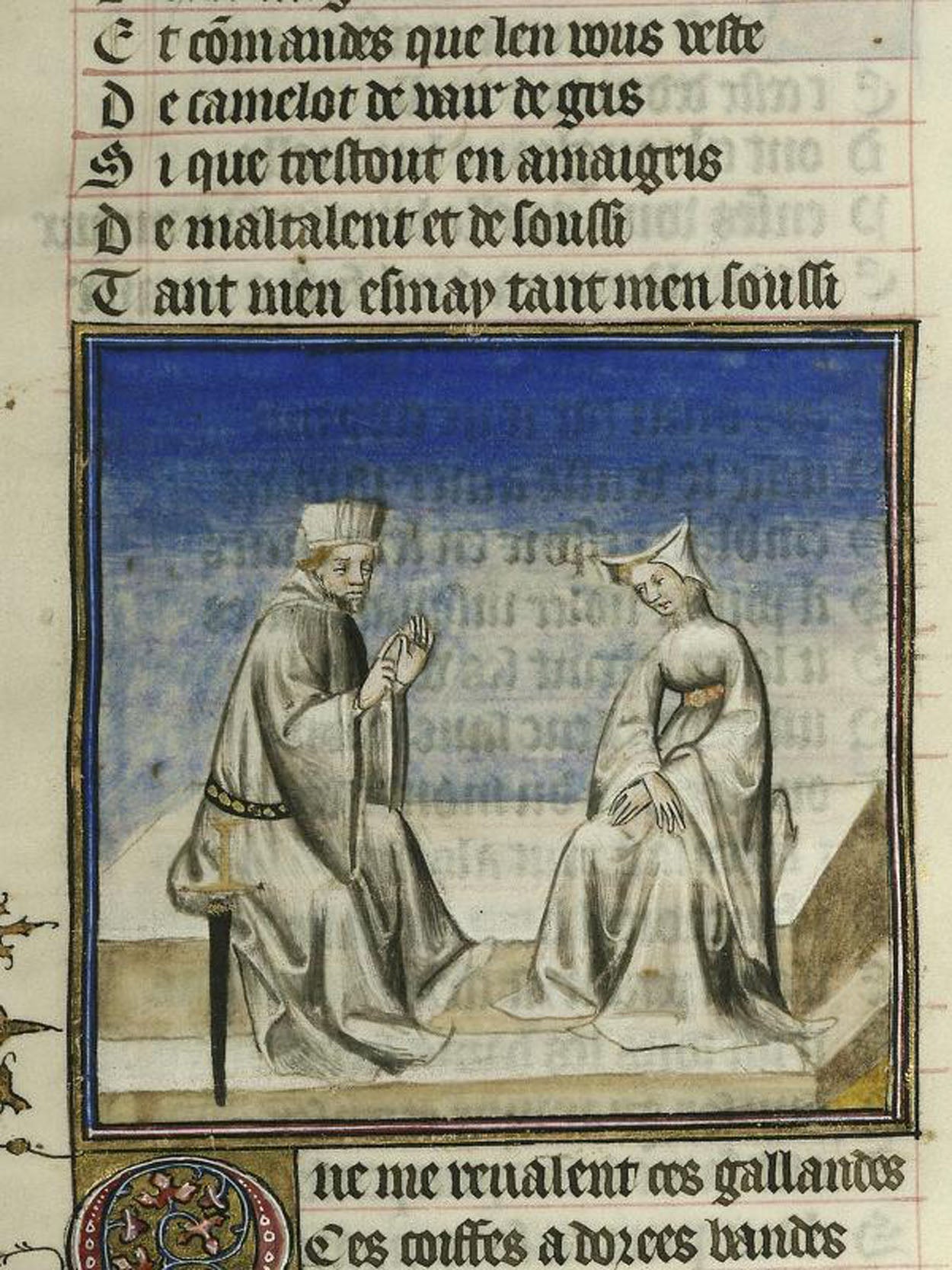
Scene depicted
Jealous husband speaks to his wife about vanity.
Ex-libris
- On the recto of the first flyleaf: The owner is probably Jean du Rueil (1474-1537) according to an erased entry, read as J Duryeil.
- On the verso of the same leaf: A medieval entry reading (La) mauie and F. Lorris (?).
- Louis-Jean Gaignat (1697-1768).
- Charles-Adrien Picard. Philippe l'Ain, Marseille (glued on the recto of the 2nd overleaf, the text from the auction catalog of his manuscripts).
- Possible owners of the manuscript: Claude-Joseph Clos (1812); Probably Count MacCarthy-Reagh (1744-1811); William Beckford, Fonthill (1759-1844), bought Oct. 1814 from Auguste Chardin, Paris; in Beckford's inventory of the year 1844, it carried the no. 36; Alexander, 10th Duke of Hamilton (1767-1852); he inherited the manuscripts of his father-in-law, William Beckford (on the recto of the 1st overleaf in pencil HB no. 427); Berlin, Graphiksammlung of the Königlich-Preußisches Museum. Albert de Naurois (his ex libris with the motto "Tantum prodest quantum prosunt" in the inner front cover); Edouard Rahir, Paris (1862-1924); Adolphe Bordes; Jacques Guérin.
The manuscript belongs to the most beautiful of the approximately three hundred extant Roman de la Rose manuscripts. Furthermore it is, with its 101 column-wide miniature paintings, one of the most richly decorated copies of the text that was so popular from its emergence into the 16th century.

© The J. Paul Getty Museum
This work is licensed under a Creative Commons Licence © 2012