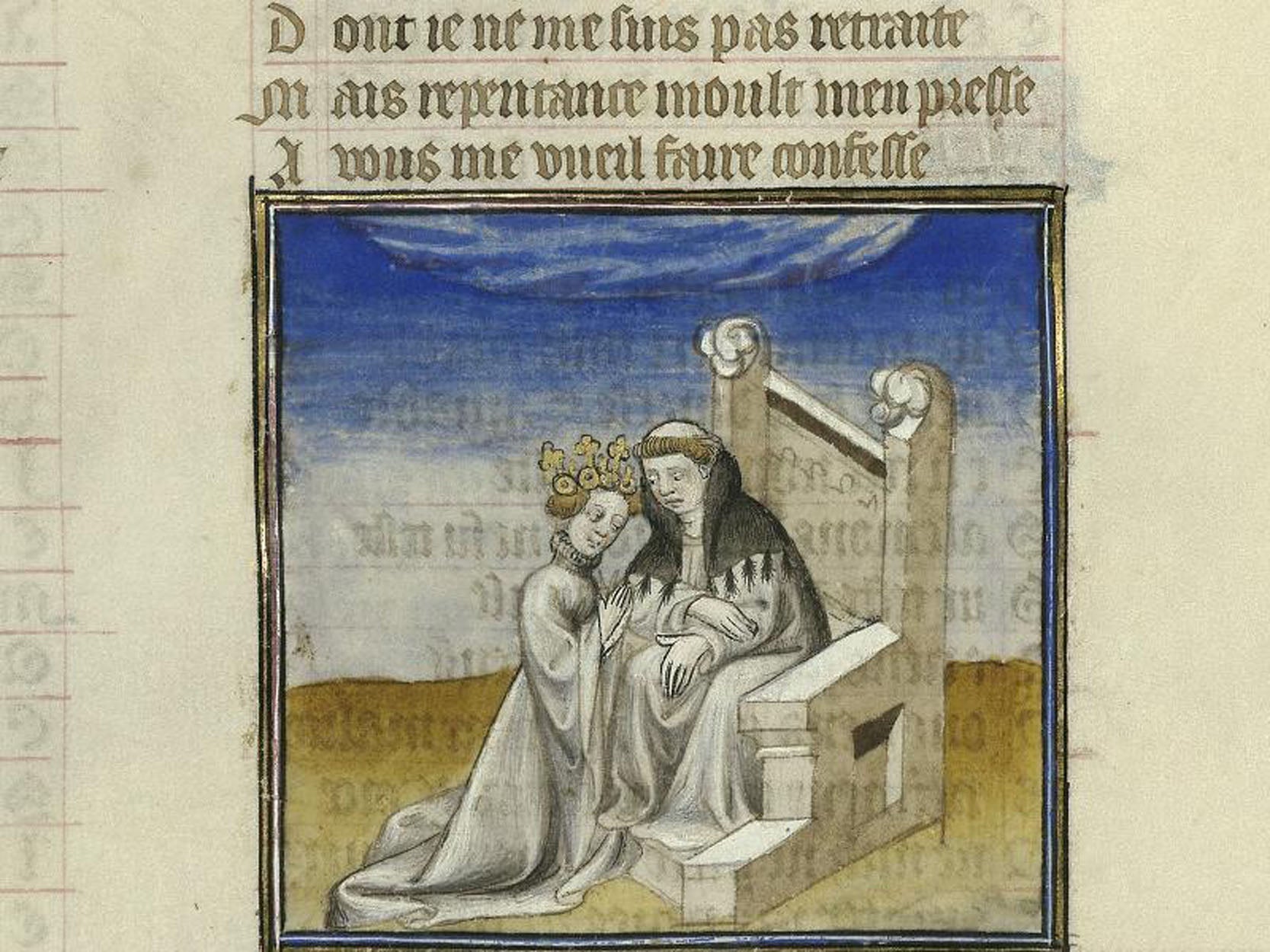
J. Paul Getty Museum, MS. Ludwig XV 7, fol. 103r, 1405

Lire en Français


Folio 103r

Detailed manuscript information (based on Roman de la Rose: digital surrogates of medieval manuscripts and Anton von Euw and Joachim M. Plotzek, Die Handschriften der Sammlung Ludwig, Cologne: Schnügen-Museum, 1979-85, vol. 4:228-239.)

Parchment, measure: 372x258mm, 138 folios, two columns, 44 lines.


Scene depicted

Nature's confession to Genius

Miniature description

Size: 
372x258mm
Column miniature
Height: 12 lines
 
Materials and colours:
Parchment
Gold leaf, blue, black, grey
 
Frame:
Simple gold leaf exterior frame, with a thin blue and white inner border 
 
Landscape:
There is a rudimentary attempt to create atmospheric perspective. The ground looks like sand or beige-coloured dirt.  Above the ground the sky opens up from light to dark with a cloud on top.
 
Placement of miniature:
Directly before priest's response
 
Place of Production of the Miniature:
Paris, France
 
Date of Production of the Miniature:
1405
 
Similarities to other images from the corpus:
Similar gestures can be seen in the following manuscriptsBNF, Ms. fr. 12595, fol. 121r; PML, Ms. M. 132, fol. 121v; BNCF, Cod. Laur. Acq. e Donin 153, fol. 200v; Fitzwilliam Museum, Ms. 169, fol. 105v, BimUM, Ms. H245, fol. 102v.
 
Secondary Sources:
Euw, Anton von and Joachim M. Plotzek. Die Handschriften der Sammlung Ludwig. Cologne: Schnütgen-Museum, 1979-85, vol. 4: 228-239.

Detailed description

Allegories: 
Lady Nature is on left.
Genius (monk) is on right.
 
Clothing and other features:
*Semi-grisaille (figures are in grisaille, but landscape is in colour).
1. Lady Nature
  • Houppeland with high collar
  • Blonde hair in an elaborate hairdo
  • Gold crown
2. Genius (dressed as a monk)
  • Long white robe
  • Short black cape with tassels
  • Short brown tonsured hair  
 
Gestures:
Lady Nature is on her knees, her hands joined in prayer and her head bowed to the monk.  The monk is sitting down, with his left arm resting on his lap and his right arm crossed over his left arm.  He is looking down at Lady Nature, listening to her confession.
 
Objects:
Genius is sitting in a large grey stone chair with flourishes at the top. This chair might be the representation of a cathedra, which would make this monk also a bishop. 

Ex-libris

  1. On the recto of the first flyleaf: The owner is probably Jean du Rueil (1474-1537) according to an erased entry, read as J Duryeil.
  2. On the verso of the same leaf: A medieval entry reading (La) mauie and F. Lorris (?).
  3. Louis-Jean Gaignat (1697-1768).
  4. Charles-Adrien Picard. Philippe l'Ain, Marseille (glued on the recto of the 2nd overleaf, the text from the auction catalog of his manuscripts).
  5. Possible owners of the manuscript: Claude-Joseph Clos (1812); Probably Count MacCarthy-Reagh (1744-1811); William Beckford, Fonthill (1759-1844), bought Oct. 1814 from Auguste Chardin, Paris; in Beckford's inventory of the year 1844, it carried the no. 36; Alexander, 10th Duke of Hamilton (1767-1852); he inherited the manuscripts of his father-in-law, William Beckford (on the recto of the 1st overleaf in pencil HB no. 427); Berlin, Graphiksammlung of the Königlich-Preußisches Museum. Albert de Naurois (his ex libris with the motto "Tantum prodest quantum prosunt" in the inner front cover); Edouard Rahir, Paris (1862-1924); Adolphe Bordes; Jacques Guérin.

The manuscript belongs to the most beautiful of the approximately three hundred extant Roman de la Rose manuscripts. Furthermore it is, with its 101 column-wide miniature paintings, one of the most richly decorated copies of the text that was so popular from its emergence into the 16th century.


Creative commons licence logo

© The J. Paul Getty Museum

This work is licensed under a Creative Commons Licence © 2012