
Tuesday, July 21, 2015
Engineering Science Quest has been sparking imaginations for 25 years


The term ‘plug and play’ — which suggests various pieces of computer hardware can be snapped together with ease — had a dubious history in the technology industry. What’s often described as plug and play turns out to be more difficult to use than expected. If Calvin Chu is successful, however, people will soon be combining technology in ways that make Lego pieces look complex in comparison.

Although texting, emailing and streaming movies wirelessly may all seem to hinge on highly-powerful and efficient technology, today’s wireless systems actually have much in common with low-tech walkie-talkies. They either send or receive data—never at the same time, which means they are one-way.

First came the laptop, which we could close by folding down the screen. Then came smartphones and tablets, which fit into many pockets and bags. The next stage, according to Elahe Jabari, are electronic devices that act much more like paper and can be folded, rolled up or even crumpled up in a ball, potentially changing what we mean when we describe technology as “portable.”

March 2011. Sunnybrook Hospital, Toronto. A surgical oncology team is working to remove a complex tumour entwined around the patient’s adrenal glands and pancreas.
At one point in the delicate procedure, Dr. Calvin Law puts down his scalpel, turns to a computer screen displaying an image of the tumour and, without touching anything, makes a gesture with his gloved hands. The image rotates, and three Waterloo Engineering grads in the operating room exhale in unison.

Systems design engineering professor John Yeow is driven to solve real-world problems that lie deep within the human body. As the Canada Research Chair in Micro and Nanodevices, much of his work focuses on technology aimed at diagnosing and treating diseases like cancer. And the smaller the technology, the better.
When Ben Gaffney signed on to participate in the EcoCAR 2 competition, he couldn’t have predicted the kick start it would give his career in automotive engineering. Two years later, and deep into the vehicle re-design process for EcoCAR 3, Gaffney is completing his master’s in mechanical engineering and was recently named General Motors (GM) Canada’s first hire among 100 new engineering recruits.

Splitting a pill in two usually means cutting its strength in half as well. But what if the active ingredient was dispersed improperly and concentrated on only one side? That half pill could either be rendered inert or worse, poisonous.
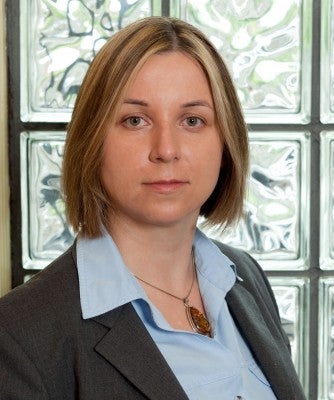
Systems design engineering graduate Olga Pawluczyk is the president and CEO of P&P Optica Inc., a company that develops advanced spectrometers for biomedical and other purposes.

When it comes to lifting the veil on computer technology, Stephanie Rozek isn’t playing games. That is, unless she is.
Rozek, who graduated with a Waterloo electrical engineering degree in 2000, is the co-founder and CEO of Hackademy Canada, a company that demystifies technology by teaching computer game design, coding, programming, and even interactive hardware classes in the Kitchener-Waterloo region.

Jeffrey Azzolin has been hitting the ice almost as long as he’s been hitting the books.
The mechanical engineering grad (BASc ’13) first laced up as a minor hockey player in grade school. He spent his elementary and high school years playing rep hockey in Ajax, Ontario. At Waterloo, he was part of an intramural team.