Introducing Ahmad
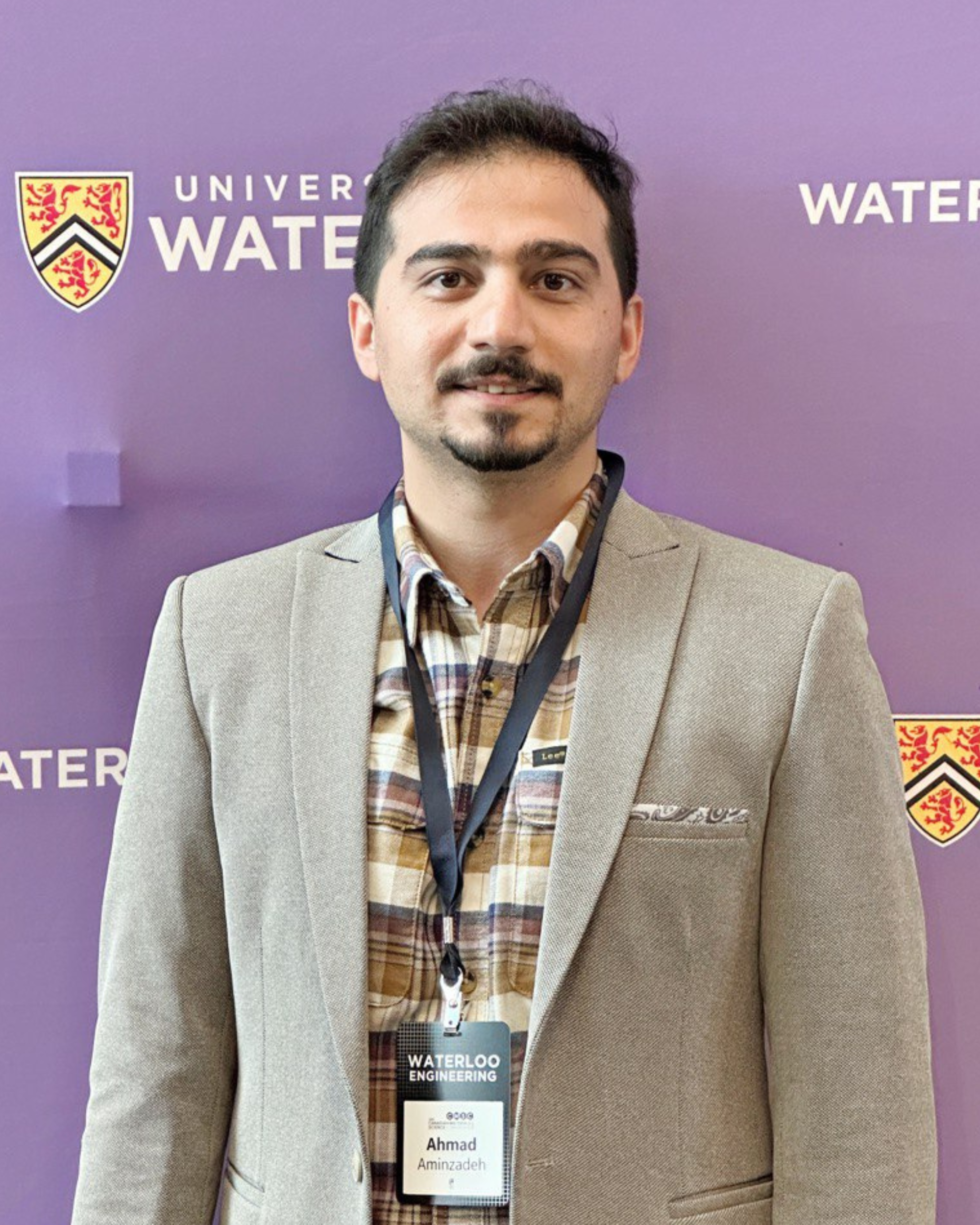
Ahmad holds a bachelor’s degree in mechanical engineering with a specialization in manufacturing and production, as well as a master’s degree in mechanical and manufacturing engineering from the University of Tehran. He earned his PhD from the University of Quebec in Canada and is currently a postdoctoral fellow in the Department of Mechanical and Mechatronics Engineering at the University of Waterloo.
Beyond his academic research, Ahmad is an active member of the Canadian Welding Bureau (CWB) and serves on the Canadian Council of the International Institute of Welding (CCIIW).
Research at Waterloo
Welding and Joining play a critical role in ensuring vehicles are safe, strong, and lightweight. However, as modern automotive designs increasingly incorporate advanced materials, conventional welding methods face new challenges. Ahmad’s research focuses on advancing welding technologies—such as laser welding, resistance spot welding, and AI-driven predictive methods—to deliver faster, more reliable, and defect-free results. By integrating cutting-edge innovations, researchers like Ahmad are helping manufacturers, including Honda and the A/SP Partnership, produce more efficient vehicles while minimizing defects and reducing production downtime.
Ahmad was pleasantly surprised by the strong culture of interdisciplinary collaboration and the openness of industry partners at Waterloo. “Waterloo offers a rare ecosystem where cutting-edge research and industrial application meet seamlessly,” he notes. “The synergy between the Centre for Advanced Materials Joining (CAMJ), industrial collaborators like Honda and A/SP, and the AI research community at Waterloo provides a unique environment where fundamental research directly translates into real-world applications. Whether it’s optimizing weld quality through machine learning or streamlining manufacturing processes, this ecosystem enables rapid innovation and impactful solutions.”
During his time at Waterloo, Ahmad has been able to enhance his skills in AI-driven process modelling, collaborative research management, and high-fidelity experimental design. “Being part of CAMJ has also expanded my perspective on translating research into scalable, industry-ready solutions through close academic-industry partnerships.”
Advice to postdocs
One piece of advice is to get involved! Ahmad says, “I have found great value in mentoring graduate students, participating in grant applications, and being part of knowledge mobilization activities, all of which have enriched my postdoctoral journey.”
If you are also doing research and development in materials joining, Ahmad recommends checking out CAMJ’s facilities on campus and the technical expertise available to those in engineering through the Engineering Machine Shop. “For postdocs wanting to go into industry, I recommend gaining experience in applied projects, learning agile documentation practices, and networking at cross-sectoral conferences. Show that you can solve real problems, not just publish papers.” Lastly, for collaborative writing or research version needs, Ahmad recommends checking out tools like Overleaf and GitHub.
Relevant resources
-
The Office of Research supports researchers through the many phases of research, including ethics review and managing funds.
-
The Engineering Machine Shop on campus offers support in equipment training, research initiatives, mechanical prototypes, and more.
-
The Centre for Advanced Materials Joining (CAMJ) trains postdocs and aims to develop new and innovative technologies for materials joining.