Professors Michel Gingras and Zoya Leonenko from the Physics & Astronomy Department have recently started a new research effort in Quantum Neuroscience. With their colleagues Professors Michael Beazely (School of Pharmacy) and John Mielke (School of Public Health and Health Systems), they are combining their expertise in physics, biology and neuroscience with the ambitious goal to discover novel quantum effects in neuroscience, an exciting direction within the growing field of quantum biology.
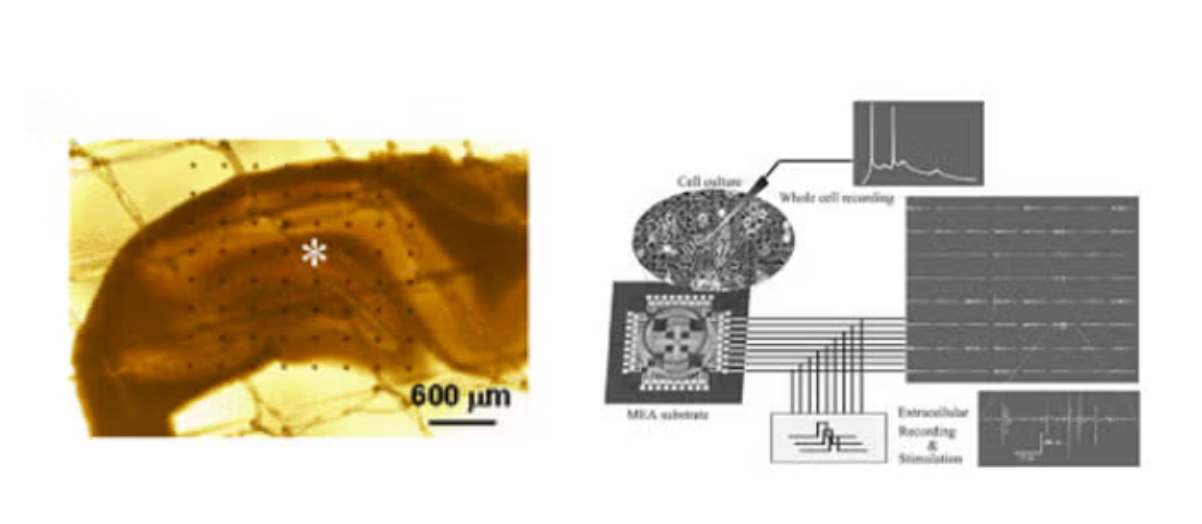
Experiments involve measuring electrical activity in animal brain tissue: Typical example of a rat brain (hippocampal) slice deposited on an 8 x 8 multielectrode array (MEA) chip (dark black dots). One electrode (marked by an asterix) is used for the electrical stimulation of the tissue slice. The other 63 electrodes on a chip pick up the local electrical response distributed over the slice (so-called field excitatory postsynaptic potential, or f-EPSP), which allows to record electrical activity in a living tissue for up to 8 hours. Image taken from Zhao et al., Molecular Pain 5, 55 (2009); https://doi.org/10.1186/1744-8069-5-55.
At Waterloo, Beazely, Gingras, Leonenko and Mielke and their team of graduate and undergraduate students are now investigating some of those puzzling isotope results using a variety of experimental approaches. For example, the team is currently investigating whether there is a lithium isotope effect in neurobiological processes and is interested in studying the effect of Xe isotopes in the mechanism of anesthesia.
Lithium is an approved medication for the treatment of mood disorders, in particular bipolar disorder. Yet, despite thousands of papers over the past fifty years, the mechanism of its action is not well understood. Strikingly, earlier experiments in the mid 1980s reported dramatically different effects of lithium-6 and lithium-7 isotopes on animal behaviour. The Waterloo team is currently working to record electrical activity in animal brain tissues using a multi-electrode array in order to elucidate the effect of lithium isotopes on neuronal functions. They are also investigating the effect of the two lithium isotopes on biochemical reactions involved in neuronal signaling. This will help to clarify whether Li isotopes are influencing the fast electrochemical or slow biochemical signal processing in the brain.
The Waterloo team is now in the process of exploring these isotopes effects and recently acquired research finds from the Transformative Quantum Technologies – Quantum Quest Seed Grant at the University of Waterloo as well as a New Frontiers in Research Fund Exploration Grant that supports high-risk/high-reward research projects across Canada.