Developing hybrid quantum systems is essential to harnessing the complementary advantages of different quantum technology platforms. This necessitates the successful transfer of quantum information between platforms, which can be achieved, e.g., by harnessing magnons, or spin wave excitations, in magnetic materials. Decoherence due to uncontrolled coupling of qubits to the environment remains a fundamental challenge in many current platforms but can be potentially overcome by harnessing magnon Bose-Einstein condensates (BECs) and non-Abelian Majorana fermion excitations that arise from a Kitaev quantum spin liquid (QSL). The goals of this project are (1) to generate and detect coherent magnons in 2D magnets for quantum magnonics; and (2) to induce collective quantum states in 2D magnets (magnon BECs and Kitaev QSLs), which can provide an alternative route to defeat quantum decoherence. 2D magnetic insulators interfaced with topological semimetals will be fabricated to generate and detect coherent magnons, magnon BECs and QSLs. Radio- frequency (RF) current driven through the metallic layers will yield a spin and/or anomalous Hall current that will exert torques and excite spin waves in the magnetic layers. The excited magnons will be detected using electron tunnelling. Success in these experiments will allow for alternative qubit implementations, which can significantly benefit the quantum technology sector, including mediating quantum information transfer in hybrid quantum systems and potentially being used as a platform for noise-tolerant quantum computing.
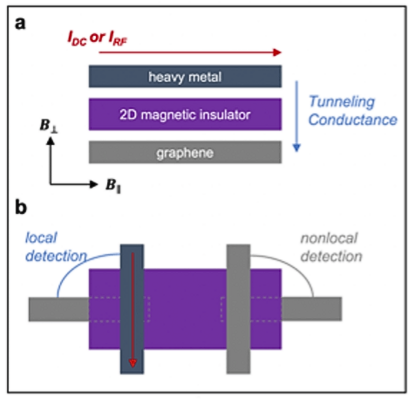
Figure 1: Device schematic for coherent magnon generation in 2D magnets via spin currents and tunneling detection. The side view is shown in (a), and the top view showing local and nonlocal measurement geometries is in (b).