Classical game theory – conducted at the interface between economics and computer science – has found applications in topics ranging from networking and security to online markets. Despite over 20 years of research into connections between game theory and quantum information, we have yet to see any significant implications of quantum information when applied to game theory. This project brings a reformulation of quantum game theory as a mathematical theory of strategic interactions involving quantum information among rational decision-making agents. We focus on computational complexity aspects as a means to redevelop quantum game theory and tackle four challenge areas that include non-interactive games, interactive games, correlated (and entangled) equilibria, and cooperative quantum strategies. This reformulation of quantum game theory holds promise for enabling new mathematical techniques in quantum information science (e.g., communication protocols) and new applications of quantum devices. Finally, as we consider the fundamental aspects of quantum games, we are bound to discover interesting new mathematical structures that may find uses in other areas of quantum information science.
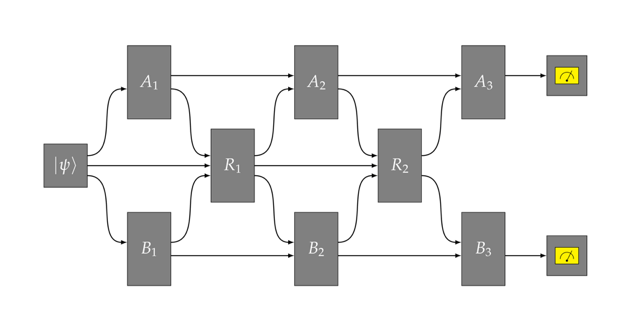
Figure 1. An illustration of a multiple-turn, abstract game involving three agents who exchange and process quantum information.