Eye diseases such as macular degeneration can have a devastating impact on quality of life. Early detection and treatment are thus crucial for preventing irreversible vision loss. A previous study found that the human eye can detect differences in ‘structured’ light beams. Such light beams are composed of a coherent superposition of differently polarized planar and helical waves. This structured light can be created by coupling polarization and orbital angular momentum to form spin-orbit states with space- varying polarization profiles. The original study determined that a healthy human eye can discriminate between two different spin-orbit states by observing distinct images (i.e., the number of azimuthal fringes) induced by viewing each state. These findings will be expanded to further explore the limits of human perception of structured light. A strong association between an individual’s perception of a structured light beam and the imaging data collected from their eye with the same beam is expected. The possibility of using structured light beams to image ocular structures, including the macular pigment, the cornea, and the retina, will be investigated. Ocular imaging using structured light beams has the potential to detect subtle changes in macular pigment and other ocular structures that occur before macular degeneration progresses to the point of vision loss. Such new sensing tools could enable the early detection and treatment of macular degeneration and reduce the significant societal burden of the disease.
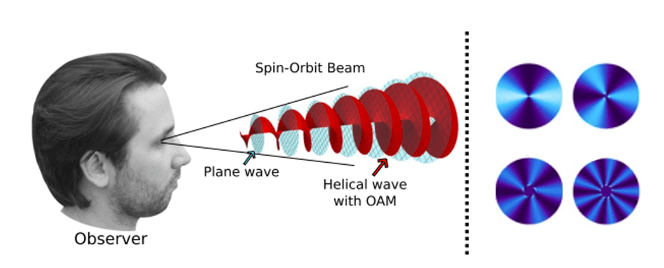
Figure 1. (Left) Representation of a spin-orbit beam composed of a coherent superposition of planar and helical polarized states. (Right) The number of fringes that the eye sees when viewing the spin-orbit beams.