News

Filter by:

Limit to news where the title matches:
Limit to items where the date of the news item:
Date range
Limit to news items tagged with one or more of:
Limit to news items where the audience is one or more of:

Lisa Baer-Tsarfati successfully defended her thesis entitled, "Condemnation and Control: Ambition in Scotland, 1550–1625," on Wednesday, December 17, 2025. Her dissertation examines ambition as an historically contingent moral and political concept not a transhistorical psychological trait.

Congratulations Dr. Baer-Tsarfati!

Elizabeth Spence graduated in September 2025 with an MA in History from Wilfrid Laurier University. She received a gold medal for academic excellence as one of the top Master's students in a research-intensive or professional master's program. To meet the reward requirements, Elizabeth surpassed the minimum GPA with an 11.75 (A+), a minimum of A- in any course, and her examination committee commended her research paper as outstanding.

Elizabeth's Major Research Paper examined the development of the Pine Point lead-zinc mine in the Northwest Territories as a case study in postwar northern expansion, infrastructure development, and Cold War–era Canadian nationalism.

Learn more about her research and her experience in the Tri-U History program.
Wednesday, November 26, 2025

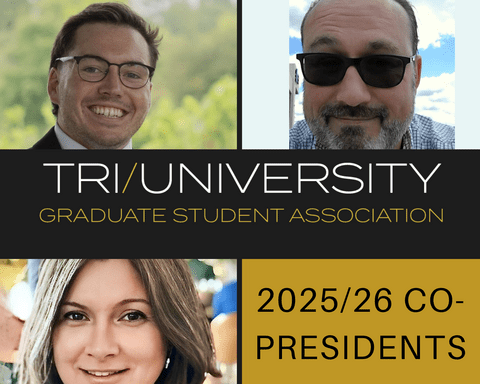
2025-26 TUGSA co-presidents announced

Recently, Tri-U students held their annual election. Aidan Hughes, PhD candidate at Guelph, Brian Gibbs, PhD student at Laurier, and Vera Zoricic, PhD candidate at Waterloo became the 2025-26 co-presidents. They organize events and encourage community-building among Tri-U students. Check out their bios.

Megan Blair, successfully defended her thesis entitled, "Teenage Feminists: High School Students and the Women's Movement in Ontario, 1968-1980," on Wednesday, May 28 at the University of Waterloo. Her dissertation was accepted "as is and without any revisions."

Congratulations, Dr Blair!

Dr. Jamie Zettle successfully defended his dissertation on April 30, 2025, at Waterloo. Entitled "Evidence of an Emerging Homosexual Subculture during World War II in Case Studies of Queer Clandestine Agents," Zettle's work traces the uneven emergence of a distinct homosexual subculture during World War II through case studies of two queer clandestine agents operating in France from the Special Operations Executive and the United States Army Military Intelligence organization.