News
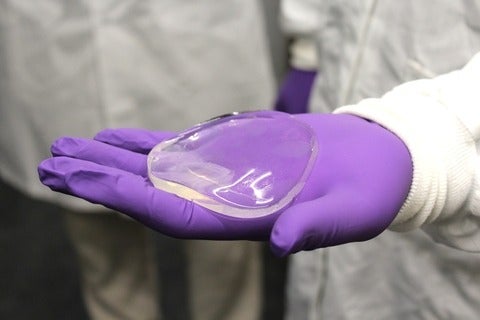
Sea cucumber-inspired hydrogel shows promise for tissue repair
Taking inspiration from nature, Water Institute researcher Yimin Wu, Professor and Tang Family Chair in New Energy Materials and Sustainability, and his research team have developed a hydrogel that mimics sea cucumbers’ ability to change stiffness to help repair damaged tendons and other soft tissues. The material provides temporary support for new tissue growth, then gradually breaks down and is absorbed by the body.
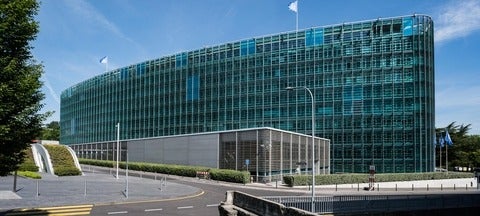
Breaking down barriers to better water data
More than 120 members of the global water community came together on October 1 for an international webinar exploring how organizations can make hydrological data easier to discover, access, share and reuse across different systems and jurisdictions.
The webinar, “Unlocking the Power of Hydrological Data: Empowering People, Enabling Applications, Informing Policy, and Protecting the Environment,” was organized by the World Meteorological Organization (WMO) in collaboration with the University of Waterloo’s Water Institute, Global Water Futures Observatory, DataStream, the Consortium of Universities for the Advancement of Hydrologic Science (CUAHSI) and government partners.

Beyond infrastructure: The link between water access and gender-based violence in Ghana
For many Canadians, turning on a tap or accessing a washroom is an unremarkable part of daily life. Yet water researchers increasingly recognize that access to water is closely tied to dignity, health, and social equity. New research led by Julius Jebuni suggests that, in some parts of the world, the consequences of water insecurity extend even further: into the realm of gender-based violence.
Events
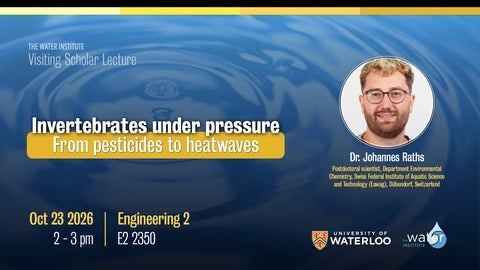
Invertebrates under pressure: From pesticides to heatwaves
October 26: Visiting Scholar Lecture
Invertebrates under pressure: From pesticides to heatwaves
November 12, 2026 Workshop
Bioaccumulation in Aquatic Organisms - From One-Compartment Toxicokinetic Models to Real-World Complexity
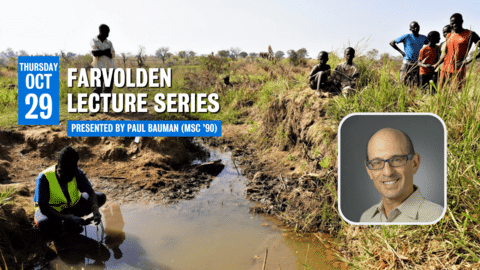
Farvolden Day 2026
Join the Department of Earth and Environmental Sciences for our annual Farvolden Day lecture, in honour of Dr. Robert N. Farvolden. This year, we welcome Science alum Paul Bauman (MSc '90), Geophysicist at BGC Engineering Inc., to deliver his lecture "Water in a World Without: A Geophysical Search through Drought, Famine and War."
WaterLeadership | Sharing Science: Effective Presentations
As part of the Water Institute's WaterLeadership training series, the Water Institute presents, Sharing Science: Effective presentations..