The study of physics with respect to health-related disciplines.
Biological and Medical Physics used to be called Life Physics in earlier years.
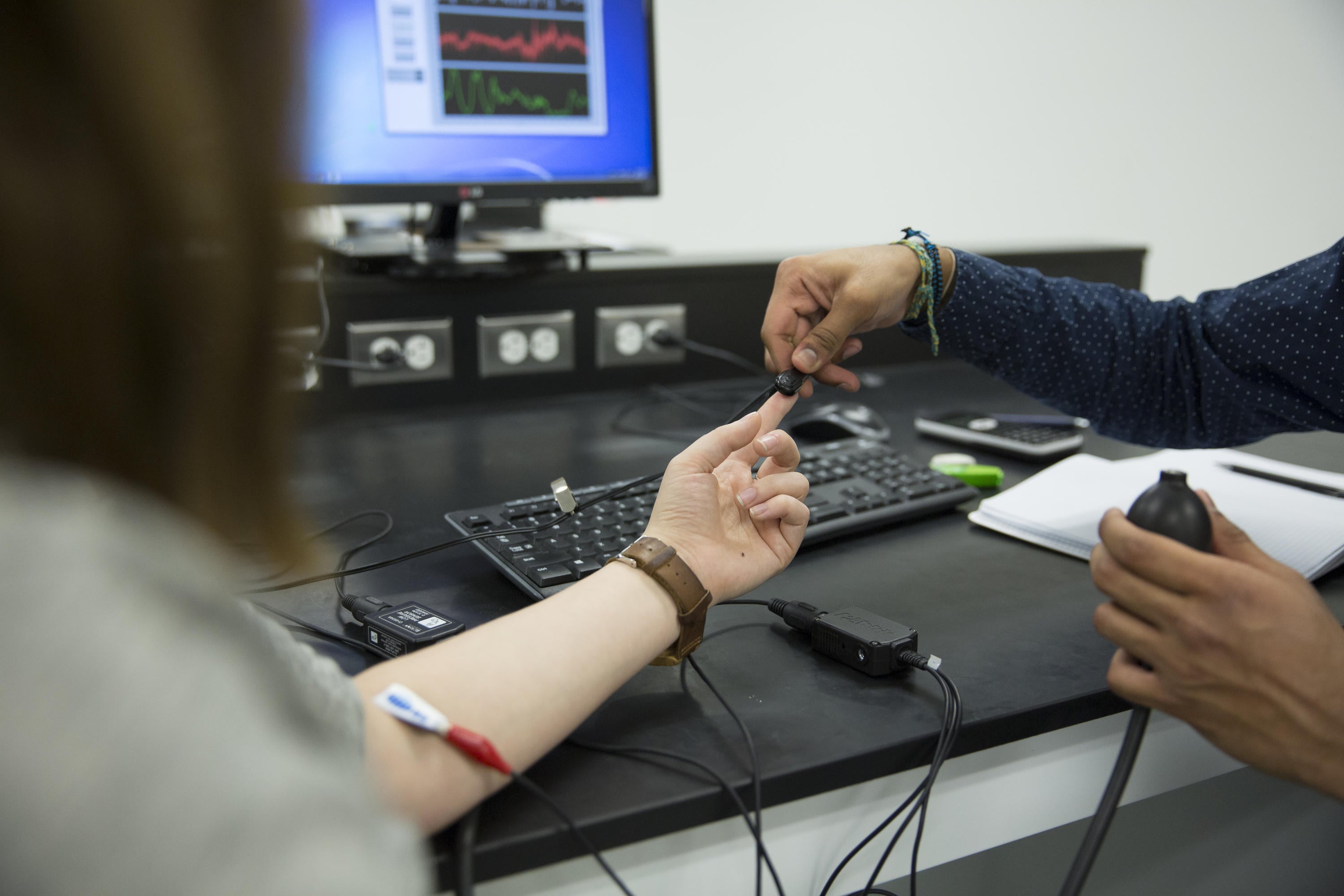
As an experiment in your labs, you'll learn about how data, transmitted from the sensor on a patient's fingertip, is used to evaluate the instantaneous heart rate. You'll evaluate and plot the data to see how it varies with time and physical activity.
It's going tibia okay.
Harness the power of physics and apply it to biological systems. Be prepared for entering health-related professional schools, like medical school, by combining your passion for physics with the renowned world of life sciences. Discover the latest in biophysics and medical physics by taking courses related to these fascinating subjects.
By accessing our state-of-the-art labs and applying your knowledge through experiential learning, you’ll be prepared to work in the fast-evolving and interdisciplinary fields of health technology, like radiation oncology and medical imaging.
Biological and Medical Physics Ambassadors* - We'd love to meet you!
Find out more about life as a Waterloo Biological and Medical Physics student. Come in for a tour or to one of our open houses and you might even meet us in person!
*Biological and Medical Physics used to be called Life Physics in earlier years.
This major is available in the co-op and regular stream of study
Options and Minors
Explore all minors, options and specializations available in Waterloo Science.
Bioinformatics Options
IT'S ALL IN THE CODE! You've decided that pursuing a degree in science makes sense for you - but what if you want something that takes you to the next level in DNA technologies? Our Bioinformatics Option might be what you're looking for. You'll learn how to take vast amounts of scientific and biological data that would take years to sort through manually, and process it in computational terms in just a matter of minutes. Talk to an academic advisor in second year to add this to your degree. This option is open to all Faculty of Science students.
SOME OF THE SKILLS ATTAINED WITHIN THIS MAJOR
- Quantitative and analytical thinking in biology and health-related professions
- Statistical and analytical problem solving in life sciences
- Modeling clincal procedures with scientific methods
- Integrated laboratory methodologies in biology, chemistry, and physics
- Technical skills to implement experiments in life and medical physics

RESEARCH OPPORTUNITIES AND RECENT PROJECTS
- Imaging effects of malaria in the eye
- Polarization imaging in Alzheimer's disease
- Imaging of the human eye for treating potential blindness
- Properties of amyloid beta
- Chromosome biophysics
Explore other Biological and Medical Physics-related programs
Learn more
- Apply via Physical Sciences on the Ontario Universities' Application Centre (OUAC).
- Learn about our minors available to Faculty of Science students.
- Learn more about co-op.
- See more in the science careers list.