Events

Filter by:

Limit to events where the title matches:
Limit to events where the first date of the event:
Date range
Limit to events where the type is one or more of:
Limit to events tagged with one or more of:
Limit to events where the audience is one or more of:
Wednesday, May 21, 2025 11:30 am - 12:30 pm EDT (GMT -04:00)

Astroseminar - Veronika Dornan

"The Evolution of Galaxies as Told through Their Globular Cluster Systems"

Veronika Dornan is a final-year PhD candidate in the Department of Physics and Astronomy at McMaster University. Her research uses observations of galaxies' globular star cluster systems as tracers of their evolutionary histories. She is particularly interested in studying the globular cluster system mass - halo mass scaling relation and understanding what drives this relation from dwarf galaxies to massive ellipticals galaxies.

Our knowledge and understanding about the Universe at present day brings together various famous discoveries made by astronomers. Many of these discoveries were made by women who never became household names. In this month’s KPL astronomy talk, Lammim Ahad will discuss some of the important work done by women who contributed significantly to astronomy and astrophysics, but whose contributions were often underappreciated or unrecognized at the time.

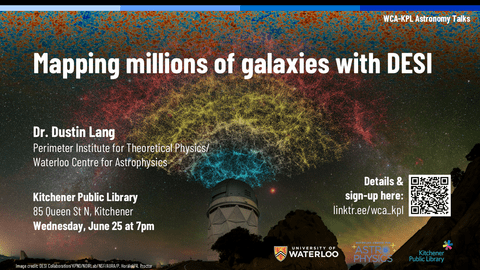
Wednesday, June 25, 2025 7:00 pm - 8:00 pm EDT (GMT -04:00)

WCA-KPL Public Talk - Mapping Millions of Galaxies with DESI (Dustin Lang)

The Dark Energy Spectroscopic Instrument (DESI) is helping scientists to produce the largest and most comprehensive map of galaxies ever seen. This map is then being used by cosmologists to understand the growth of the Universe over cosmic time. In this month’s KPL astronomy talk, Dustin Lang will discuss the technology behind this innovative experiment, and how these advances have allowed cosmologists to make insights that change our view of the Universe.

Tuesday, August 12, 2025 7:30 pm - 11:00 pm EDT (GMT -04:00)

Perseids Sky-watching Party and Astronomy Lecture 2025

Perseids Sky-watching Party and Astronomy Lecture 2025

Explore the night sky with astronomers from the Faculty of Science and Royal Astronomical Society of Canada. We will meet first at 7:30pm in the nearby Optometry building for a short lecture by the Waterloo Centre for Astrophysics' Dr. Lisa Dang. The Perseids meteor shower will be at its most spectacular this evening, so let's gather to learn something and then enjoy the view! 

Wednesday, September 3, 2025 11:30 am - 12:30 pm EDT (GMT -04:00)

Astroseminar - Antón Baleato-Lizancos

"Better together: insights and tools for joint analyses of clustering and lensing in cosmology"

Antón is a cosmologist and BCCP postdoctoral fellow at UC Berkeley and LBNL. His research lies at the interface of CMB and large-scale structure, combining theoretical work with data analysis of to try to understand what drove the accelerated expansion of the Universe at the earliest and most recent of times. He is heavily involved in the DESI and Simons Observatory collaborations, with a focus on developing and exploting synergies between the two.

Wednesday, September 10, 2025 11:30 am - 12:30 pm EDT (GMT -04:00)

Astroseminar - Lisa Dang

"Mapping Alien Worlds: from Infernal to Habitable Worlds"

Lisa Dang is an Assistant Professor in the Physics and Astronomy Department of the University of Waterloo. She uses various telescopes, including the James Webb Space Telescope, to study the diversity of exoplanets and their climates. Her work involves mapping atmospheric temperature structures and constituents of exoplanets, with a particular focus on lava worlds. She also has experience in planetary microlensing and is involved with the Ariel Mission conduct population-level analysis of exoplanet atmospheres. Previously, she was a Banting Postdoctoral Fellow at the Institute for Research on Exoplanets (iREx) at the University of Montreal, specializing in exoplanet and exoplanetary atmosphere research. Lisa earned her PhD in physics from McGill University, where she also completed her undergraduate degree. During her graduate studies, she held a visiting research fellowship at Caltech/IPAC to work on the Spitzer Microlensing Campaign.

Wednesday, September 17, 2025 11:30 am - 12:30 pm EDT (GMT -04:00)

Astroseminar - Tomás Cassanelli

"Canadian-Chilean array for radio transient studies (CHARTS)"

Tomás Cassanelli is an astronomer and assistant professor specializing in astronomical instrumentation at Universidad de Chile. He holds a PhD in Astronomy & Astrophysics from the University of Toronto, where he focused on fast radio burst (FRB) localization at the time of detection using very-long-baseline interferometry (VLBI). His research spans radio astronomy, including analog and digital components, as well as fast optical astronomy with fast photon counters. Tomás' scientific interests lie in the rapidly varying transient sky such as pulsars, FRBs, and long period transients, and interferometric methods across radio to optical wavelengths.

Wednesday, September 24, 2025 11:30 am - 12:30 pm EDT (GMT -04:00)

Astroseminar - Jiaming Pan

Jiaming Pan is a Ph.D. candidate in Physics at the University of Michigan. His research focuses on constraining modified gravity and dark energy to understand the physical origin of cosmic acceleration. He is an active member of the Dark Energy Spectroscopic Instrument (DESI) collaboration, where he has contributed to analyses of dark energy and tests of gravity, including extended dark energy analysis with BAO measurements and modified gravity constraints from full-shape clustering. He is also developing methods to use gravitational-wave “standard sirens,” particularly through cross-correlation with galaxy surveys, as independent probes of the Hubble constant.

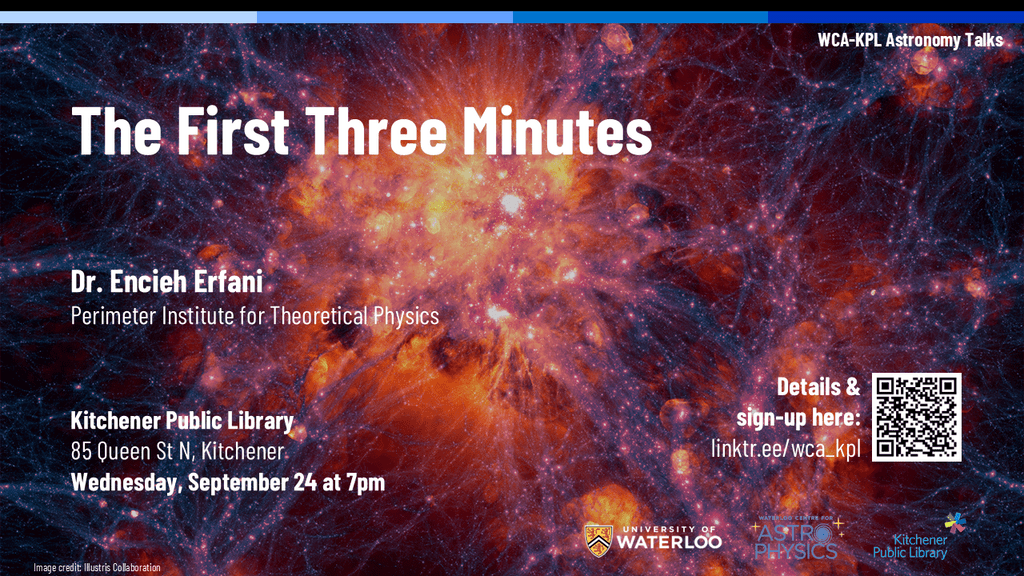
Wednesday, September 24, 2025 7:00 pm - 8:00 pm EDT (GMT -04:00)

WCA-KPL Public Talk - The FIrst Three Minutes (Encieh Erfani)

The first three minutes after the Big Bang shaped the entire history of our Universe. In this month’s KPL astronomy talk, Encieh Erfani (Perimeter Institute) will take us on a journey back to these formative moments, exploring how matter, light, and the building blocks of today’s cosmos first emerged, all in just 180 seconds of cosmic history.