


The Biomechanics of Human Mobility Laboratory is home to a team of innovative researchers who aim to improve people's quality of life by studying how balance, mobility, and joint mechanics interact with disease state, occupational exposures, environment, and aging.
Our research focuses on two main themes:
- Knee mechanics and osteoarthritis
- Occupational biomechanics
We use a variety of biomechanical tools to study the mechanics of human movement. The laboratory infrastructure includes a suite of six optoelectronic motion capture camera banks (Optotrak, Northern Digital Inc.), force plates, wireless Electromyography (EMG), accelerometers, and exercise machines.
Seeking participants
Our graduate student researchers will soon be starting a number of exciting research studies which can be viewed on our projects page. Each study will list the principle investigator, who you can contact to find out more and to see if you are eligible. To join our participant pool for future projects, please complete our volunteer form.
By participating in our research you will be making an important contribution to our efforts to better understand the biomechanics of human mobility.
News
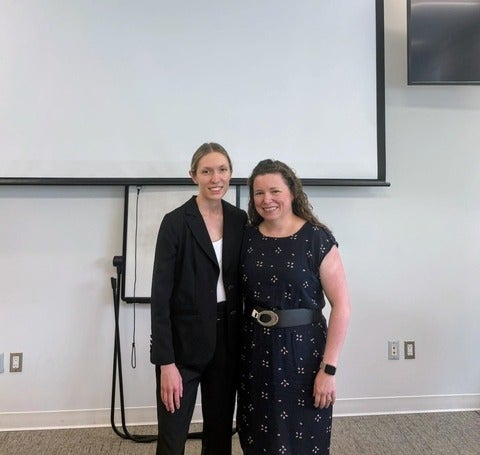
Sarah Hallan Defends Her Masters Thesis
M.Sc student Sarah Hallman defending her thesis "Strength Influences on Peak knee and Low Back Loading and Lift Strategy: A Comparison of Freestyle, Squat, and Half-Kneel Lifts".

Sarah Hallman Preseting at WCB 2026
Sarah Hallman presented a poster titled "Associations Between Changes in Knee Gait Mechanics and Changes in Frontal Plane Laxity After Sustained Kneeling" at the 10th World Congress of Biomechanics in Vancouver, British Columbia, on July 13th, 2026.
New Publication on Gait and Posture
The BOHM lab has a new publication! MSc student Sarah Hallman was the first author on "Reliability and minimal detectable change of knee mechanics during gait and squatting, using markerless motion capture in the workplace", published in Gait and Posture.