Introduction
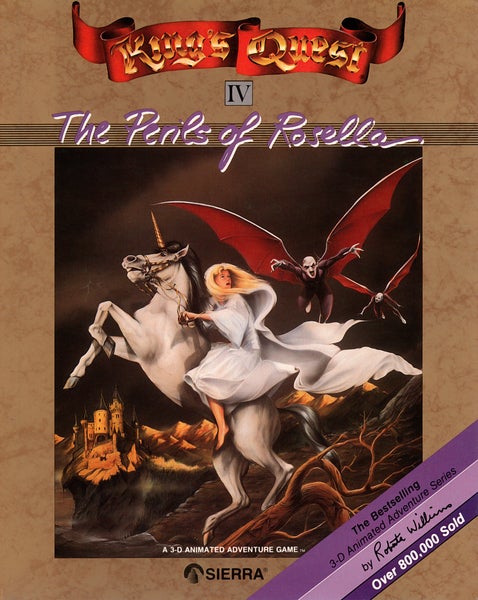
As the Computer Museum Assistant, I am surrounded by historical technology and early video games, which gives me the opportunity to experience software that I wouldn't have otherwise. One game that stood out to me recently was King’s Quest IV: The Perils of Rosella, which I played on the Atari 1040ST. This game is an adventure point and click game that focuses on narrative and puzzle solving. It follows Princess Rosella on her journey to the land of Tamir in search of a magical fruit that can save her father, King Graham, from a fatal illness.
As someone who has enjoyed many modern story based games like The Last of Us, Life is Strange, and Dispatch, it was exciting to see an early version of this genre and experience how storytelling in games worked decades ago.
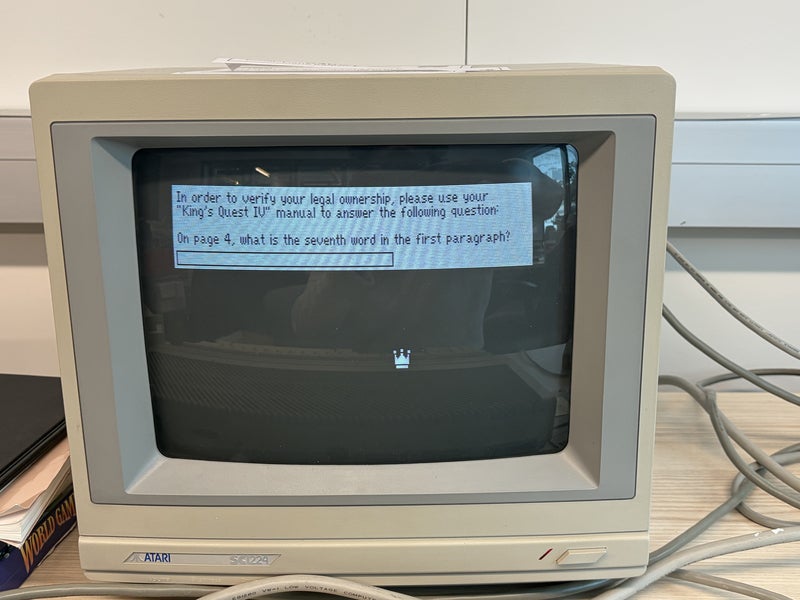
While loading the game to play, something unexpected happened. Before gameplay started, the game asked me to enter a specific word from the printed game manual. The prompt asked for the seventh word from the first paragraph on page four. Only after entering the correct word would the game start. This was very interesting to me because I hadn't seen a prompt like this in modern games. It felt unusual but also intentional, making the manual an important part of the experience.
Early Game Protection
It was interesting for me to learn that in the 1980s, there was not much digital protection for games at all. Most games were sold on floppy disks, which were very easy to copy and share with other people. For game companies, selling a game also meant trusting the player to not duplicate it and give it to others. Developers had to trust their players to not copy their games, even though many people still did.
Since they could not stop copying digitally, companies created simple ways to check if the player actually owned the game. Sierra, the company behind King’s Quest, did this by using the game manual. Players had to look up certain words, symbols, or spells in the manual before the game would start. If you didn't have the manual, you couldn't play the game. To me, this shows how important the physical parts of the game were at the time. The floppy disk by itself wasn't enough. The box, the manual, and the printed pages were all needed for the game to work properly. These methods also made players care more about the materials that came with the game, because they were necessary to play it.
Anti Piracy Campaigns
There was also a rise of public anti piracy campaigns. In 1992, one of the most well known was the “Don’t Copy That Floppy” campaign, which was aimed largely at youth and home computer users. These campaigns framed piracy as a moral issue rather than just a legal one, encouraging people to view copying software as harmful to developers and the industry.
Some games attempted to discourage copying through creative in-game systems. The space trading game Elite is one example. Like King’s Quest, Elite used copy protection that required players to look up information from the printed manual before the game could be played. At the Computer Museum, Elite was recently found and loaded by the high school co-op student Joshua Ensley. In order to run the game on the Atari, he copied it onto a floppy disk so it could be played, which is quite ironic. A game originally made to prevent copying had to be copied in order to be preserved and experienced today. This made me think about the shift in how piracy and copying are understood. What was once regarded as theft is now sometimes necessary for preservation and access.

The "Disk Protector" man showing the title of the campaign during the rap portion of the "Don't copy that floppy" advertisment
Why Piracy Exists
Piracy has existed since the early days of personal computing, mostly because copying software was simple and storage was physical. Today, piracy continues for different reasons, like preservation.
A study by the Video Game History Foundation found that 87% of classic games released before 2010 are critically endangered and unavailable on modern platforms. This means that most older games are no longer sold digitally and can't be legally purchased without finding original hardware and physical copies. As a result, players who want these games often rely on piracy as the only option.
There's also a lack of availability in modern digital stores. Even popular systems like the PlayStation two or the Game Boy have only a small portion of their original libraries available today. Companies tend to re-release only their most successful titles, while many less popular but historically important games stay inaccessible. Physical deterioration adds another challenge. Cartridges and disks degrade over time, and the hardware required to play them becomes harder to maintain. Even if a player owns an original copy, there is no guarantee it will continue to function properly. Piracy has therefore become a way to preserve games that would otherwise disappear completey.
King’s Quest IV in Context
Learning more about piracy and early copy protection changed how I see King’s Quest IV. At first, I didn't think too much about being asked to enter a word from the manual, but now I see that it represents a history of how games were treated, shared, and protected in the past. It was interesting to look at how early developers tried to protect their work while still trusting players, and how those ideas of piracy have shifted over time.
About the Author
Mary-Ann is the Welcome Centre and Computer Museum Assistant and for the Winter 2026 term, and is a 4th year student in the Global Business and Digital Arts program.