The Origins of Social Simulation
Why are video games so popular? Since the 1950s, people have loved playing, watching, or learning about video games as production, storytelling, and gameplay have evolved. In the past, when everything about creating video games was new and complex, developers did not have the tools to reach different audiences. This is why many of the first games were simple shooting styles, which were fast and fun to play. After the gaming industry experienced a major increase in its sales and production in the late 70's and early 80's, more people became interested in programming and developing their own games.
Gossip
In 1983, a developer named Chris Crawford created a game for Atari 8-bit computers called Gossip, which would later be labelled as one of the first social simulation games. In Gossip, the player must choose between seven characters to call into their office, then select another character to gossip about, which could result in five different reactions based on the character's opinion of the person being discussed. Gossip was never listed in any official catalogues, indicating the game might not have been published or very successful. Yet Crawford always emphasized the importance of human interaction: his dream was for the industry to create "games for people, not things", as he mentioned in his famous Dragon Speech from 1992. Driven by his passion for change in the game industry and his belief in the potential of video games, he challenged the designers and developers present, ending his speech by wearing medieval clothes, galloping, and shouting "For truth! For beauty! For art! Charge!".
Crawford’s idea of designing games focused on humans and their emotions resonated in many people’s minds. Games like Little Computer People, released in 1985 by David Crane, and The Sims 1, released in 2000 by Maxis, popularized this idea, turning it into a game genre called "Social Simulation Games". Over time, social simulation games have been defined as "anything that allows social interactions with or between NPCs (non-playable characters) to meaningfully affect the outcome of a situation". However, this genre is broad and diverse, with multiple subtyped and approaches. The three main categories include emergent, autonomous, and authored simulations, which are just different design approaches.

GIF made by author
Emergent Simulation
Games that involve complex interactions between various characters and the player that are not pre-scripted; it happens according to each charas ter's traits, emotions, and needs.
Autonomous Behaviour
Games where NPCs make their own decisions regardless of the player's control. These characters are independent and have their own personality, impacting their behaviour.
Authored Simulations
Games that have a pre-written story-line, where the player's choices lead to different outcomes. These are also known as "Choose Your Own Adventure" games.
Exploring Social Behavior Through Games
With a better understanding of how social simulation games are created, let's explore six unique programs that showcase different ways of simulating social interaction, emotions, and decision-making from the University of Waterloo Computer Museum Catalogue:
1. The Sims 1
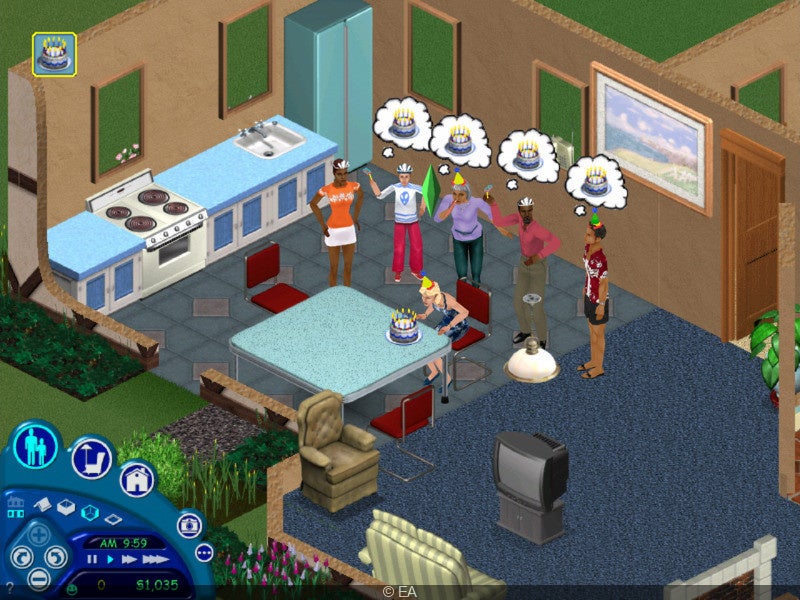
Screenshot from the 2000 video game The Sims. Image: Sortir à Paris.
Computer Museum ID: 2016.5.1 (The Sims Box)
Release Date: February 4th, 2000
Developer: Maxis
Initial Platform: Microsoft Windows
Subtype: Emergent Simulation
Emulator: The Sims 1 Emulator
The Sims 1 is an emergent life simulation game developed by Maxis and published by Electronic Arts in 2000. In the game, players create and control digital characters called “Sims,” customizing their traits, appearance, and skills. As one of the best-selling computer games of all time, The Sims 1 played a major role in popularizing the social simulation game genre. A 2025 evaluation made by psychologist Dr. Audrey Tang highlights how The Sims helps players to understand the impact emotions have on both individuals' health and social interactions. It reminds players of the importance of taking care of ourselves and the people around us during tough times.
2. Lemmings
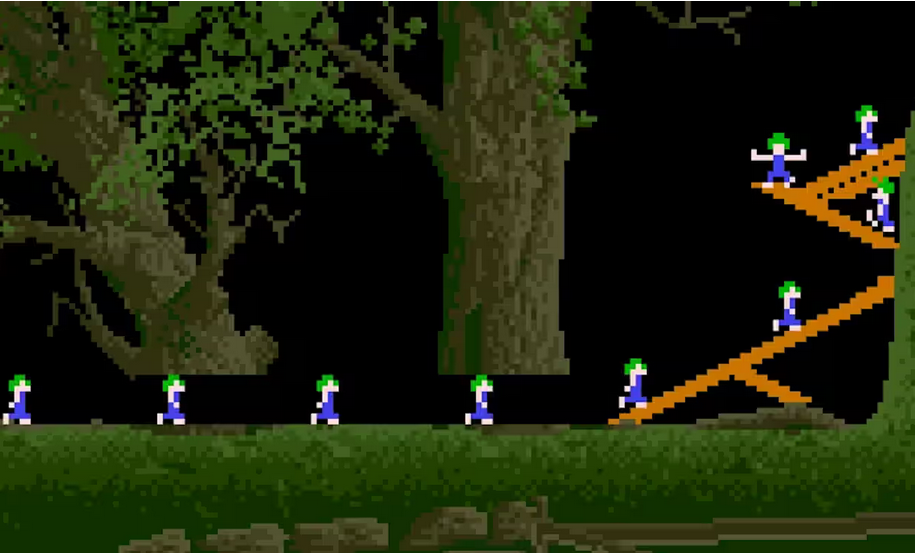
Screenshot from the 1991 video game Lemmings. Image: The Guardian.
Computer Museum ID: 2014.9.16 (Lemmings)
Release Date: February 14th, 1991
Developer: DMA Design
Initial Platform: Amiga
Subtype: Autonomous behaviour
Emulator: Lemmings Emulator
Summary: Lemmings is not a traditional social simulation game, but it explores themes like group behaviour and coordination. In this 1991 puzzle-strategy game, your goal is to guide a group of lemmings to the exit safely by assigning them roles –such as digging and climbing– that help them face the obstacles found on various levels. This game was one of the most acclaimed video games during the early 1990s, receiving multiple awards for its unique gameplay. This game reminds the player to think logically when guiding the lemmings effectively, mirroring how our society relies on cooperation, morals, and teamwork.
3. Oh No! More Lemmings: (Expansion Disc/Pack)

Screenshot from the 1991 Oh No! More Lemmings. Image: World of Sam.
Computer Museum ID: 2014.9.17 (Oh No! More Lemmings)
Release Date: December 1991
Developer: DMA Design
Initial Platform: Amiga
Subtype: Autonomous behaviour
Emulator: Oh No! More Lemmings Emulator

Summary: Oh No! More Lemmings is an expansion pack for the original Lemmings, also released in 1991. Its gameplay was the same, guiding a group of lemmings to the exit safely. This version included a hundred new challenging single-player levels, ten two-players levels, and six soundtracks. Just like the original game, the lemmings do not have personality or social interactions. Instead, they react autonomously according to the role they were assigned by the player, making this expansion also an example of autonomous behavior in social simulation games.
4. SimCity Societies

Screenshot from the 2007 video game SimCity Societies. Image: GameSpot.
Computer Museum ID: 2024.36.25 (SimCity Societies)
Release Date: November 13th, 2007
Developer: Tilted Mill Entertainment
Initial Platform: Windows
Subtype: Emergent simulation with some autonomous behaviour
Emulator: SimCity Societies Emulator
Summary: SimCity Societies is a game developed by Tilted Mill Entertainment and published by Electronic Arts on November 13, 2007. Like other games from the SimCity series, you play as a city builder in this construction simulation game. In contrast, SimCity Societies explore the player’s vision of a perfect society and the interactions it takes to build it, where each building constructed has an effect on citizens’ behaviour. Throughout the game, citizens react to the player’s choices and their consequences over time, making it fit into the emergent simulation category, while also demonstrating autonomous behaviour, since the citizens act independently based on the city’s socioeconomic values.
5. Myst

Screenshot from the 1993 Myst. Image: Atlas Obscura
Developer: Cyan
Initial Platform: Apple Macintosh
Subtype: Authored simulation
Emulator: Myst Emulator
Summary: Myst is a 1993 adventure game developed by Cyan and published by Broderbund. As a player, you travel to a mysterious island called Myst through a book, where you solve puzzles, interact with different objects, and meet the game characters. By solving those puzzles, you unlock other worlds, revealing different characters' backstories. At the end of the game, the player must make a choice to save a character--or not at all! Myst is an example of an authored social simulation game, where even with a pre-written story, the player's choices determine the end of the story.
6. Neural Networks
Date: 1991 experiment
Developer: Researched by Randall Beer and tested by Pat and Greg Williams.
Platform: DOS
Subtype: Autonomous behavior
Summary: In 1991, researchers conducted an experiment with the goal of teaching a machine how to behave like a living creature using a type of artificial intelligence called a neural network. By applying this technology to a virtual cockroach, it was able to recognize and respond to different sensors such as odor and hunger. While this simulation did not involve humans, it demonstrates how early autonomous behavior can be simulated in artificial environments. This type of artificial intelligence helps video games demonstrate more realistic emotions, choices, and reactions based on a character’s environment and needs.
If you are interested in learning more about this experiment, read the full article.
Emotions & Human Connection
Video games can be more than just entertainment; they can be a source of knowledge, emotional learning, and a reflection of the society we live in. This is the perspective that social simulation programs bring to us. There are many approaches when developing video games with the goal of making people reflect on how they feel, think, and interact with others. We can see this through emergent social simulation in The Sims 1, where players control and create unscripted character, and through authored simulation in the game Myst, where the players’ input is limited to three different choices that affect the story’s outcome.
A 2024 research study published in volume 33 of Interactive Learning Environments highlights how asymmetric VR, a type of virtual reality where each player has a different role, can positively influence both neurotypical and neurodivergent children from six to twelve years old. The study found that this approach, through making children work together to solve challenges, increases collaboration, empathy, and the ability to see things from another person’s perspective.
This and other research prove how video games and technology can shape the way we process our emotions and communicate. When games are created with a purpose, they become tools of education in decision-making and relationships. With that in mind, early games like The Oregon Trail, an educational strategy video game developed by the Minnesota Educational Computing Consortium (MECC) in 1985, were designed to teach students about real-life challenges in an engaging way, making it popular within schools during that time. The way we act online often reflects how we behave in real life, and video games can reveal both our strengths and weaknesses. That is why it is essential for human development to create “games for people, not things”, games that encourage critical thinking, human connections, and emotional awareness. This became a concern during the late 1980’s and 1990’s, when many acts of violence, such as the 1999 Columbine High School shooting, were linked to individuals who frequently played violent video games, raising concerns about the influence video games could have on people.
These experiences remind us of our morals, values, and the countless challenges we face throughout life, but also that we have the ability to overcome them. Humanity is complex and cannot be represented by a single program, but by exploring different perspectives through games, we learn more about ourselves and others, becoming more compassionate and thoughtful individuals.

Screenshot from the 2016 video game Stardew Valley. Image: Stardew Valley Wiki
About the Author
Beatriz is an incoming Grade 12 student at Resurrection Catholic Secondary School and the Computer Museum’s high-school co-op student for Summer 2025. She enjoys all kinds of games—such as board games, video games, and sports—and also loves playing the guitar and singing.