New paper presents experiment and modeling results on effects of water table fluctuations on naphthalene degradation
A new paper published in the Vadose Zone Journal investigated the effects of water table fluctuations (WTFs) on the aerobic and anaerobic petroleum hydrocarbon (PHC) biodegradation pathways using a combined experimental and model approach. The paper is authored by Mehdi Ramezanzadeh, a former Master’s student in the Ecohydrology Research Group. Co-authors from the Ecohydrology Research Group include Fereidoun Rezanezhad, Stephanie Slowinski, Jane Ye, Marianne Vandergriendt, and Philippe Van Cappellen. Additional co-authors are David Rudolph from the Department of Earth and Environmental Sciences and Neil Thomson from the Department of Civil and Environmental Engineering at the University of Waterloo.
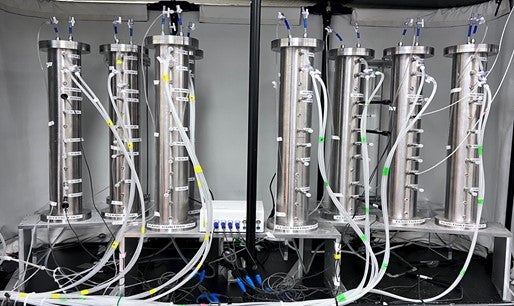
In this study, a 10-month-long soil column experiment and a reactive transport model were used to better understand how WTFs modulate soil geochemistry, methanogenic naphthalene biodegradation, and CO2 and CH4 effluxes in PHC-contaminated soils. The experiment and the numerical simulation showed that WTFs accelerate organic carbon degradation and greenhouse gas (GHG) production compared with static conditions. The transitions between oxic and anoxic phases promoted both aerobic and anaerobic processes, enhancing naphthalene and ethanol degradation but also increasing cumulative CH4 and CO2 emissions. This study provided a mechanistic framework for evaluating the coupled effects of WTFs and redox variability on contaminant degradation and GHG dynamics, contributing to a better understanding of how hydrological forcing influences the natural attenuation potential of PHC-impacted sites.
Read the full paper here: https://acsess.onlinelibrary.wiley.com/doi/10.1002/vzj2.70081