New Publication Examines Hydro-Physical Properties and Pore Structure to Investigate Peatland Recovery Following Rewetting
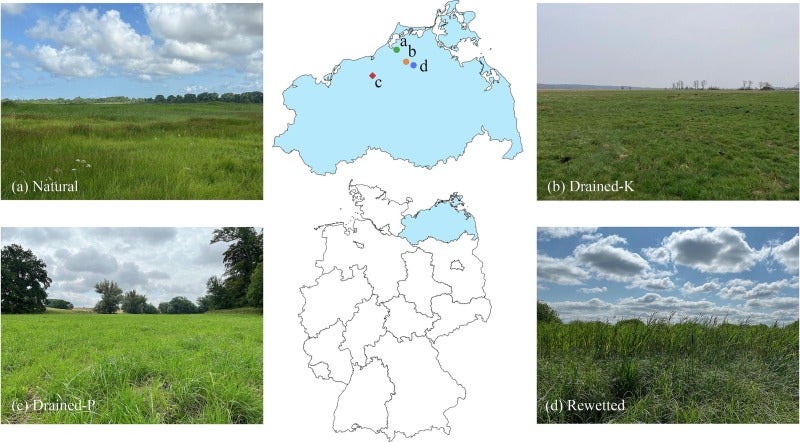
A new study has found that long-term rewetting can substantially restore the hydrological function of degraded fen peatlands, offering encouraging evidence for peatland restoration efforts aimed at reducing carbon loss and improving ecosystem resilience. Researchers compared near-natural, drained, and rewetted fen sites and found that while rewetting did not fully restore peat composition, it successfully recovered key hydro-physical properties such as macroporosity, water transmission capacity, and saturated hydraulic conductivity.
Using X-ray computed tomography, the team showed that drainage disrupts connected pore networks essential for water movement, whereas rewetting promotes the re-establishment of larger, more connected macropores through root growth and new peat accumulation. The study also identified drainable porosity as a strong predictor of water conductivity, suggesting a practical tool for assessing peatland recovery. The findings highlight pore-network connectivity as a key driver of ecosystem restoration and demonstrate that restoring high water tables can rebuild critical soil functions even before peat soils fully return to their natural state.
Fereidoun co-authored the paper with colleagues from the University of Rostock, Leibniz University Hannover, Aarhus University, University of Greifswald, Ludong University, Henan University of Economics and Law, Chinese Academy of Sciences, and the German Centre for Integrative Biodiversity Research.
Link: https://doi.org/10.1016/j.geoderma.2026.117885