New study investigates the factors affecting the spatial and temporal distributions of reactive oxygen species in riparian zones
A new paper published in Environmental Science & Technology describes the results of an experiments carried out in a two-dimensional flume system mimicking the dynamic redox conditions in a riparian aquifer during discharge-recharge cycles. As a representative reactive oxygen species (ROS), hydrogen peroxide (H2O2) was used. A reactive transport model was developed to reproduce the results and unravel the underlying processes regulating ROS behavior. The paper’s fist author is Xiaochuang Bu, currently a postdoctoral fellow in the Ecohydrology Research Group. Co-authors include Philippe Van Cappellen and colleagues from the China University of Geosciences, Wuhan, where the experiment was conducted. The paper can be accessed at: https://doi.org/10.1021/acs.est.5c07921
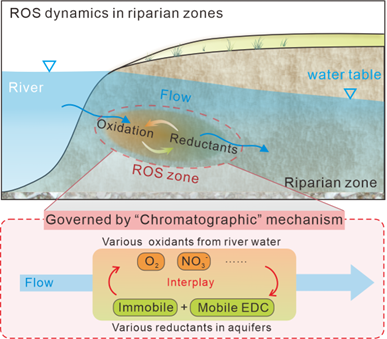
Bu X., Tong M., Zhang C., Dai H., Zhang P., Van Cappellen P., Yuan S. (2025) Reactive oxygen species production in riparian zones governed by a flow-induced chromatographic separation process. Environmental Science & Technology 59, 22599-22609, https://doi.org/10.1021/acs.est.5c07921