Lecture

Thursday, December 2, 2021 12:00 pm - 1:30 pm EST (GMT -05:00)

Decolonizing Qualitative Approaches

The Faculty of Environment invites you to attend a special Speakers Series on Decolonizing Methodologies for Respectful Sustainability Research. Sessions will take place during the last week of each month.

The third session, featuring Professor Saran Stewart from Neag School of Education, University of Connecticut, is on December 2nd from 12:00 - 1:30 pm.

Thursday, November 18, 2021 7:00 pm - 7:00 pm EST (GMT -05:00)

Life Upstairs: Brubacher House Digital Exhibit Launch

"What would it be like to live in a museum?"

Join us for an evening of storytelling and conversation with past and present Brubacher House Hosts in celebration of the new LIFE UPSTAIRS digital exhibit.

This free online community event will take place over Zoom. Register in advance to receive event details.

Feel free to contact Brubacher House with any questions about the event: 519-886-3855 or bhouse@uwaterloo.ca.

Thursday, October 28, 2021 4:00 pm - 4:00 pm EDT (GMT -04:00)

Page to Pitch - Storytelling

Professors Dr. Lennart Nacke and Dr. Daniel Harley will present a lively introduction to storytelling in design. You’ll gain valuable insights into how engaging narratives can be used to create empathy, make connections, clarify meaning, and enhance audience experiences in pitch competitions using design and storytelling.

Monday, November 8, 2021 5:00 pm - 5:00 pm EST (GMT -05:00)

Critical Tech Talk presents Nicole Aschoff

Silicon Valley companies have brought digital technology into every sphere of modern life. But while Big Tech garners unprecedented power and profits, everyday existence becomes ever more deeply enmeshed in the circuits of capital. To what end? What are the limits of the digital frontier?

Speaker Nicole Aschoff is an editor, writer and public sociologist focused on technology, labour, politics, feminism, the economy, and the environment. Her recent book is The Smartphone Society: Technology, Power, and Resistance in the New Gilded Age.

Thursday, October 21, 2021 5:30 pm - 5:30 pm EDT (GMT -04:00)

Finding Your Triple Bottom Line

The Problem Lab and the Faculty of Environment present an information session on the concept of the triple bottom line. A panel of speakers and subject matter experts will speak about the importance of social and environmental considerations that companies can build into their organizations. Using case studies and real-world examples, you will understand how companies can apply the triple bottom line to enhance people's lives and the well-being of the planet.

IQC presents Chanda Prescod-Weinstein in conversation with Kayleigh Platz In The Disordered Cosmos: A Journey into Dark Matter, Spacetime, & Dreams Deferred, Chanda Prescod-Weinstein shares her love for physics, from the Standard Model of Particle Physics and what lies beyond it, to the physics of melanin in skin, to the latest theories of dark matter—all with a new spin informed by history, politics, and the wisdom of Star Trek. Join us to hear Chanda Prescod-Weinstein discuss her debut book with Kayleigh Platz.

This virtual talk is free, however registration is required.

Tuesday, October 26, 2021 12:00 pm - 1:30 pm EDT (GMT -04:00)

Indigenous Research & Indigenous Environmental Justice

The Faculty of Environment invites you to attend the second session of a Special Speakers Series on Decolonizing Methodologies for Sustainability Research.

The second session is titled "Indigenous Research & Indigenous Environmental Justice" and will feature Prof. Deborah McGregor from York University.

Thursday, October 21, 2021 10:00 am - 11:00 am EDT (GMT -04:00)

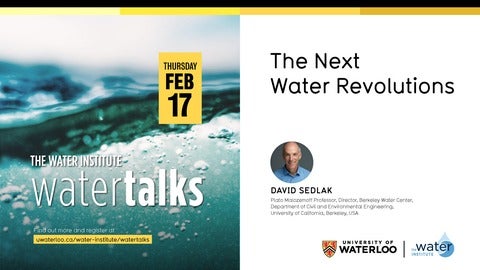
WaterTalk: Water Resources and Food Supply Chains

As part of the Water Institute's WaterTalks lecture series, Megan Konar, William J. and Elaine F. Hall Faculty Fellow, Associate Professor, Civil and Environmental Engineering, University of Illinois at Urbana-Champaign, USA, presents, "Water Resources and Food Supply Chains."

Megan will discuss two recent papers related to her work assessing water resources and food supply chains

Part #1. Groundwater depletion embedded in domestic transfers and international exports of the United States

Part #2. Food flows between counties in the United States