
Editor’s note: I am happy to welcome Sue Schappert as a guest contributor to OHA+M. Susan Schappert, CAHP, RPP, MCIP is a municipal heritage planner with over 20 years experience. She has worked for several municipalities across Ontario, including the City of Peterborough and Town of Oakville and is currently Senior Policy Planner – Heritage with the City of Waterloo. She has served as Chair and Vice-Chair of the Canadian Association of Heritage Professionals and has presented at numerous conferences and workshops on topics ranging from cultural heritage landscapes to financial incentives for heritage properties. Susan has extensive experience in researching cultural heritage and writing about cultural heritage values. She considers herself to be a true heritage geek and enjoys long walks in historic cemeteries and staring up at building cornices from the middle of the sidewalk.
Sue and I would love to hear your comments on the article (susan.schappert@waterloo.ca or danschneider@live.ca).
Introduction
A few years back (ok, so almost ten years ago now, but who’s counting?), Dan wrote a series of blog posts [1] about how heritage easement agreements (“HEAs” or “easements”) evolved within the Ontario policy context. From their origins in Ontario with the passage of the Ontario Heritage Act (OHA) in 1974 and the acquisition of the first easement fifty years ago in 1976 [2], HEAs have become an important tool now regularly used by a variety of organizations including municipalities, conservation authorities and land trusts.
HEAs under section 37 of the OHA are generally a familiar alternative to designation under section 29 (“designated properties” or “heritage designations”). Here’s a refresher on the biggest differences between the two:
- Easements require the voluntary participation of both the property owner and the easement holder (in this case, a municipality), whereas heritage designation does not require owner approval;
- Heritage designations have required content (statement of cultural heritage value or interest, heritage attributes) and must meet at least two of the criteria of Ontario Regulation 9/06, whereas the content of an HEA is completely up to the parties signing the easement, so long as it relates to the conservation of property of cultural heritage value or interest;
- Easements tend to include more prescribed direction about how change will be managed on the property, as the properties are not subject to the same processes for alteration and demolition as designated properties;
- Once registered on title, there is no process to remove an HEA without the permission of both parties or to appeal decisions by the easement holder, as opposed to the processes set out in the OHA for designated properties.
For decades, HEAs were used in Ontario as a substitute for, or supplement to, heritage designation and were generally intended to “run with the land” in perpetuity. More recently, the relative freedom of what an easement can include has given rise to the use of HEAs as a temporary protection tool, typically during development.
Easements as Temporary Protection Tools
So why use an HEA as a temporary measure? I think the easiest answer is that municipalities needed a way to require specific and unique conservation measures while balancing the practical requirements of growth and development. Over the past 10-20 years, southern Ontario especially has seen rapid growth in the development of green space and intensification of existing low-density areas. This growth of development projects has exponentially impacted heritage resources – either designated properties or properties “listed” under section 27 of the OHA.
An HEA is helpful in the situation where there are conditions to any kind of approval, whether it be for a planning application or a heritage permit application. I think of them as “if-then” trade-offs. If a developer wants to develop a historic farm property into a new subdivision, then they need to conserve the heritage resource on said property. The HEA provides the certainty that the “then” work is completed when the “if” happens.
My experience as a municipal heritage planner has been that conservation of heritage resources is easier for developers to agree to when they are permitted to balance the cost of conservation against larger developments that generate large amounts of income. And because an HEA requires the voluntary participation of both parties in this if-then scenario, the balance of power is shared and any issues need to be worked out to a jointly beneficial result. Roles and responsibilities are agreed to up front and made clear. Financial securities are generally required to be held while the conservation work is being completed in case of unforeseen difficulties, which most developers understand as the cost of doing business.
And written into the easement is the mechanism by which it can be released from title, usually when the work has been completed and approved and securities returned. The release of the easement ensures the developer or future owners are free and clear of the obligations imposed by the easement. It’s not uncommon for a designation by-law to then be placed on a (typically) smaller parcel of land where the heritage resource is located.
Examples

2467-2477 Old Bronte Road. Photo source: https://www.oneurban.ca/communities
2467 Old Bronte Road, Oakville
When a demolition application was submitted for this property, the Town of Oakville issued a Notice of Intention to Designate that was appealed by the owner. Through ongoing discussions between the owner and Town staff, a compromise was arrived at – the building could be carefully dismantled and stored, and then a portion would be rebuilt into the new eight-storey condominium on the site. The details were agreed upon in an HEA that included a plan for dismantling, storage and reconstruction, as well as staggered collection of securities and milestones for partial release of securities.
The compromise encapsulated in the HEA has retained a part of the cultural heritage of the former village of Palermo and created a more unique and interesting building than developer One Urban originally proposed. (The question of facadism that this project raises can be discussed later.…)
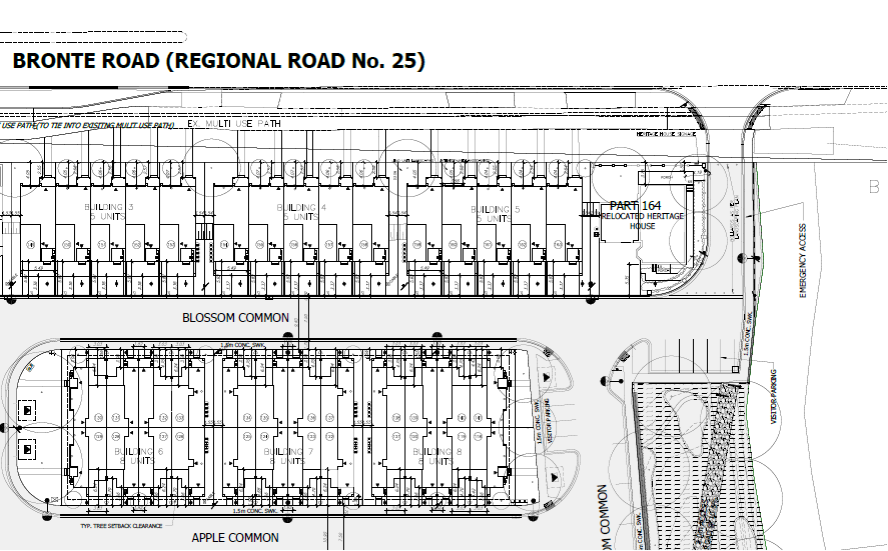
Site Plan, Bronte River development – red box indicates new location of historic house. Source: https://www.oakville.ca/getmedia/42d80ff3-cae1-49a5-a769-8cbdb15314bb/sp-153100401-SitePlan-S1.pdf
1326 Bronte Road, Oakville
The owners of this property were proactive in identifying the heritage resource on the site and made plans for its incorporation into the planned subdivision on its own new lot, retaining frontage on Bronte Road. As the property developers were willing to work with Town staff from the get-go, plans for relocation of the house and its restoration and addition moved along relatively quickly. The HEA was formalized once the renovation plans for the house were completed. The property owner retained not only a heritage expert, but also a heritage building restoration company to assist with the plans. The project is still in progress and relocation of the house to its new foundation will be happening shortly.
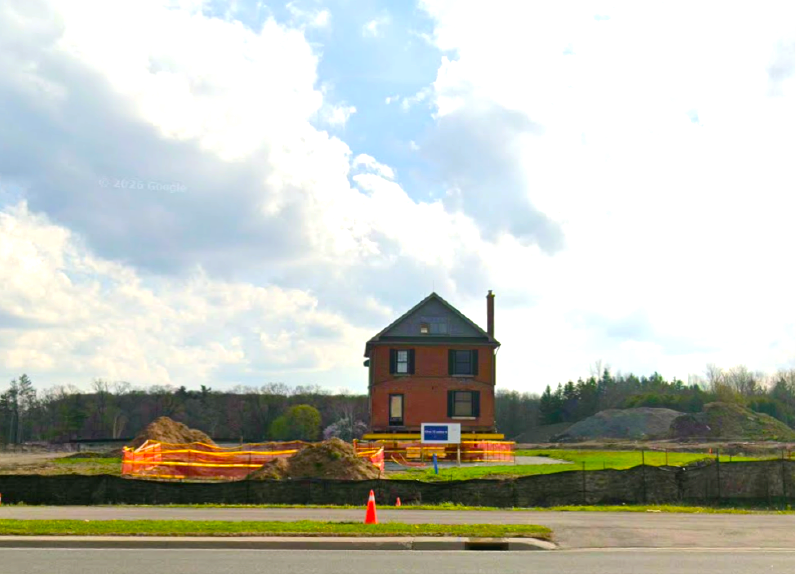
Historic house on moving supports in temporary location on site. Source: Google Maps, Google Street View, May 2025
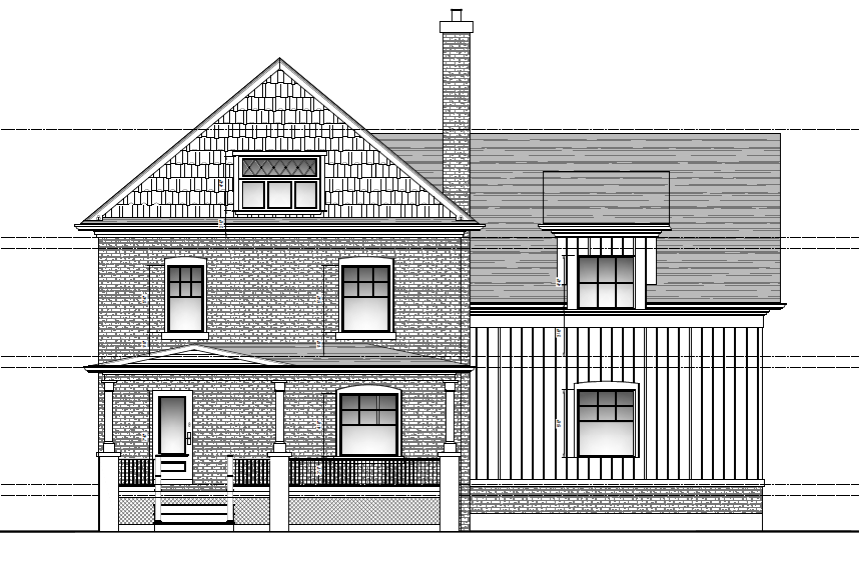
Front elevation drawing showing restored front porch and new side addition. Source: https://www.oakville.ca/getmedia/676954bc-d103-4fe6-8e5d-3dca2c042cc8/da-153103-ScopedHeritageImpactAssessement-2023Apr.pdf
Challenges
Sounds pretty good, right? So, what’s the downside here?
The reality is that an HEA can take some time to get hammered out. Both sides should be prepared to have some flexibility and an awareness of how priorities are being balanced. It’s a good idea for both parties to have their own heritage experts reviewing the drafts to ensure clarity and accuracy. And if you don’t have someone who is willing to sit down at the metaphorical table with you, an HEA isn’t going to work (or is it? See below for further discussion on that point).
Sometimes, the issue can be the securities. If you’re talking enough money to rebuild a house or relocate it to a new foundation, the amount isn’t going to be negligible. You may need to consider staggering the collection of the securities to coincide with particular development points and, conversely, partial releases for completion of specific phases of work.
Recent OLT Decision in Kitchener
A recent Ontario Land Tribunal (OLT) case regarding an appeal of a conditional approval of a heritage permit has raised some interesting points. The City of Kitchener made an HEA part of the conditional approval of a heritage permit to allow removal of some features of a designated property while requiring restoration of a heritage attribute. The property owner appealed the conditional heritage permit and a hearing was held in April 2026.
The decision came down fairly quickly. [3]
I encourage you to read the decision for yourself but here is my summary. The OLT ruled that the conditions of the heritage permit approval were upheld and, specifically, that the OLT has the power to require a property owner to enter into an easement agreement with the municipality. This conclusion was based on the statutory power on appeal under subsection 34.1(5) of the Act that includes jurisdiction to impose “terms and conditions.” If a municipality can require an easement as a condition of permit approval, then the OLT can too.
Although I’ve been saying that HEAs are a collaborative process, maybe I should clarify that the contents of the HEA can be debated, but the requirement to enter into one may not be.
The property owner in Kitchener still has an option: if the property owner doesn’t want to complete the work that they proposed in the heritage permit application, then they wouldn’t have to enter into the HEA. The OLT in the Kitchener case appears to have agreed that permitting removal of some features with the caveat of restoration of one significant feature was a fair and balanced way to manage change on the designated property and that an HEA was an appropriate vehicle to effect this.
Conclusion
While the use of a HEA as a temporary conservation measure may not have been the original intent of easements enabled through the OHA, they are a helpful tool to ensure heritage conservation goals are met while permitting change and/or development. HEAs make it clear to both parties what their roles and responsibilities are and the ability to register HEAs on title ensures that the responsibilities are binding on new property owners.
Don’t want that HEA on title for your future owners? Great, complete the work that was agreed to! Those (optional) securities can also provide good incentive to complete work in timely fashion. In the end, HEAs are very appropriate for the current planning environment that prioritizes new housing by ensuring that heritage resources are conserved during new developments.
If you’re a municipal heritage planner and not familiar with these tools, ask your neighbouring colleagues for examples – I, for one, am happy to help.
Notes
Note 1: See “Heritage easements 101: Easements come to Ontario” , the first of four consecutive articles on the history of heritage easements in the province.
Note 2: The first heritage easement in Ontario was signed on June 22, 1976 by the Ontario Heritage Foundation and the owner of the Newburgh Academy in Newburgh, near Napanee.
Note 3: The decision is here.