Twenty-five years ago, in 2001, the (then) Ministry of Tourism, Culture and Recreation was in the middle of wrapping up a provincial grant program called the Heritage Challenge Fund.
There was cause to celebrate. The $10-million Heritage Challenge Fund (HCF), announced by the Mike Harris government in the 1999 Ontario Budget and launched in February 2000, had been wildly successful. In fact, almost too successful — the program had to close its doors to applications early, at the end of January 2001, as demand outstripped its available funds.
The HCF consisted of two $5-million components. The public component, the HCF Community Program, was directed to communities — including eligible non-profit organizations and municipalities — “to preserve, restore and maintain their heritage properties.” (Seed money for endowment funds was also provided to help communities meet the ongoing costs of maintaining these properties and encourage long-term stewardship.) [Note 1]
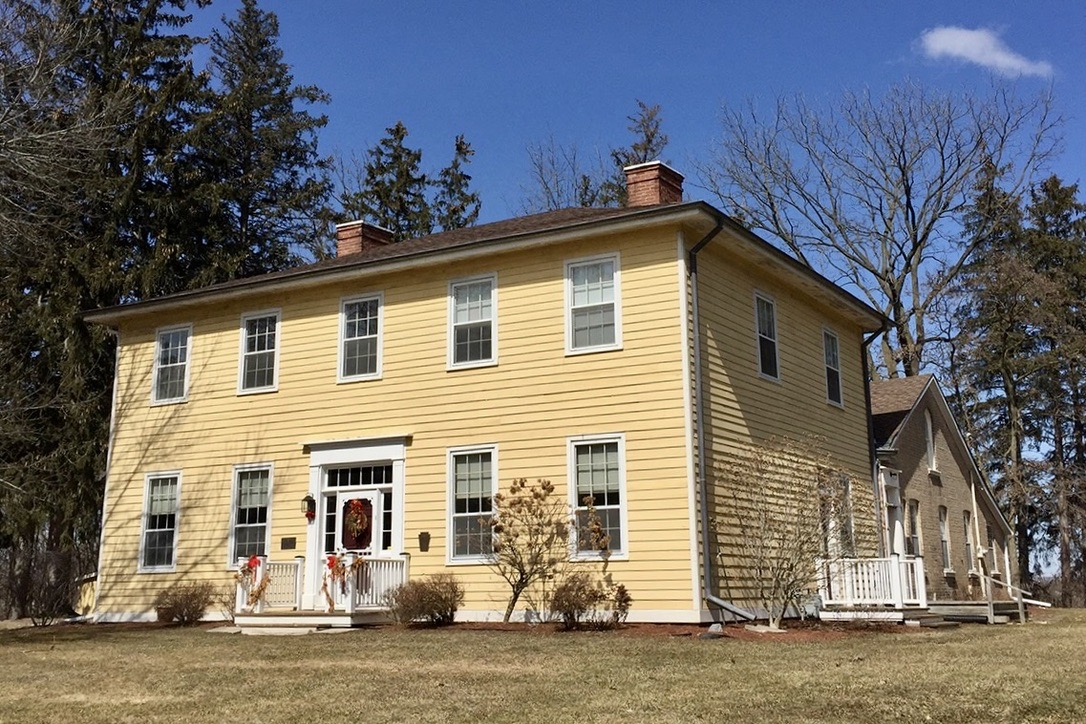
Myrtleville House Museum, Brantford, received a $35,000 matching grant from the Heritage Challenge Fund
The HCF Community Program was aimed at local heritage properties such as recognized heritage churches, house museums, town halls, libraries, and other historic properties. Private sector owners were not eligible. The actual use to which the property would be put was not a major criterion in assessing applications.
From MTCR’s final report on the HCF [Note 2]:
The program has been very successful. The $5 million provided by the province was quickly matched by communities, leveraging matching dollars and encouraging new partnerships. The program originally was to have received applications until the end of March 2002; but, because of the large number of excellent applications received, the Ministry announced … that the program would close early and the deadline was changed to January 31, 2001.
According to the report, the $5M of public funds resulted in:
- 80 projects (68 capital projects and 12 endowments) funded
- total funding: $5,050,893 (original $5M plus accrued interest) going to capital projects except for $900,000 slated for endowments
- total project costs/budgets for approved projects: $65,232,169
Bottom line: 80 projects funded and over $60M leveraged from a $5M provincial investment. That’s a 12 times return!
Despite the success of the HCF, it was not renewed. Instead, later in 2001, the new Ernie Eves government, largely at the urging of the City of Toronto, launched a different kind of program — to incentivize the conservation of heritage sites through tax reductions rather than direct grants. Known as Heritage Property Tax Relief (HPTR), the measure enabled Ontario municipalities to provide property tax rebates for heritage properties of 10-40 percent, with most of the cost borne by the municipality.
While HPTR still exists and has been adopted by many municipalities, take-up has been sluggish from the start and the effectiveness of the program has been limited. [Note 3]
For the last quarter century Ontario has been the only province in Canada without a dedicated provincial heritage grant program. When it comes to cultural heritage, Ontario’s governments since 2001 have been focussed on legislation and regulation rather than incentives. While many changes (major and minor, good and not-so-good) have been made to the Ontario Heritage Act and the heritage policies in the Provincial Planning Statement, the “carrots” side of the equation has been woefully neglected.
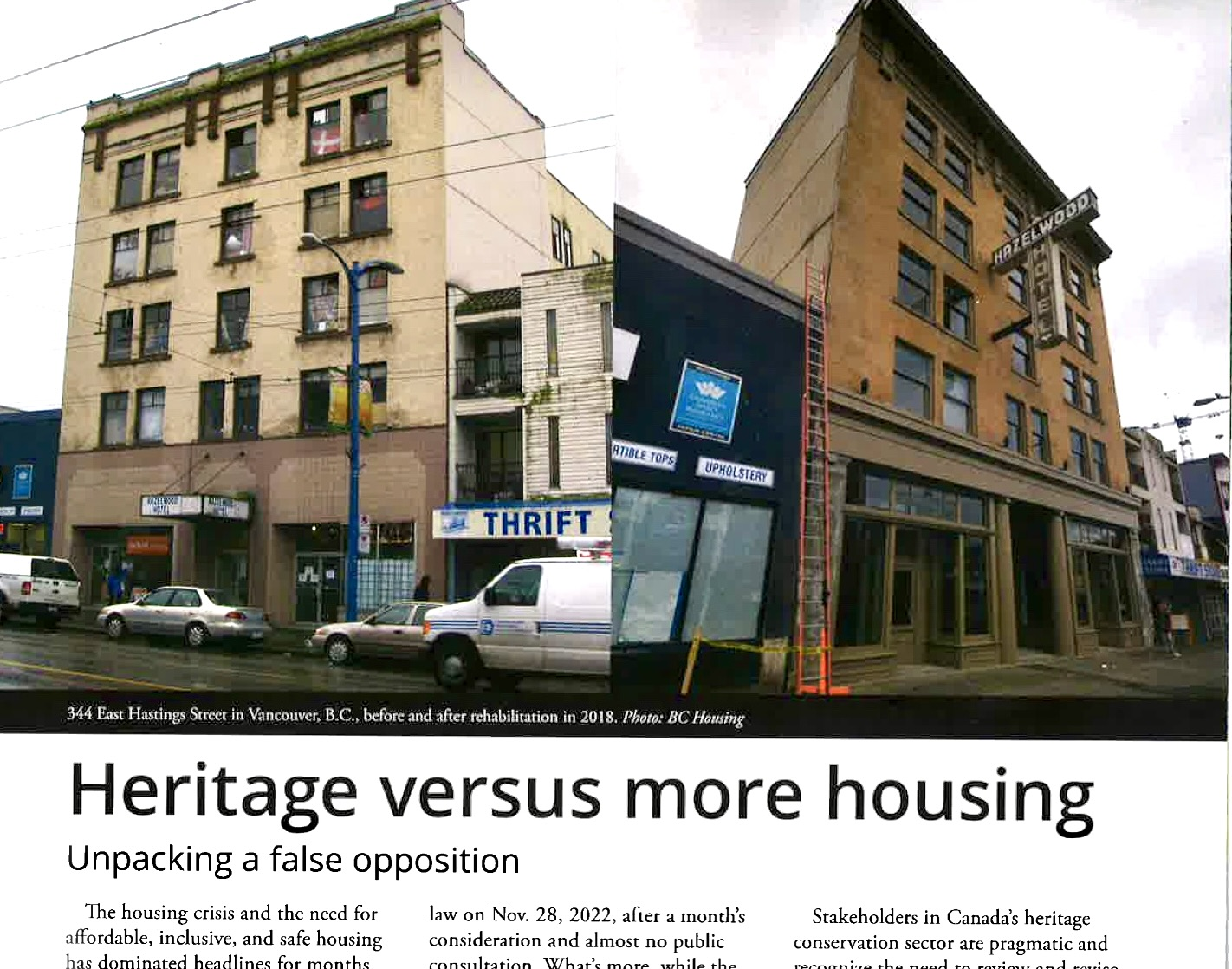
Courtesy the National Trust for Canada
Heritage in Ontario, like elsewhere, has always been seen in some quarters as a barrier to progress, as the past standing in the way of the future. But, in recent years, as Ontario’s housing crisis has captured the headlines and the province’s attention is drawn to solutions, a variation on the old story, though more subtle and damaging, has taken hold, at least among many leaders at Queen’s Park: that heritage and heritage protections have become a hindrance — worse, a threat — to achieving our housing goals.
The reasons for this are complex and outside the scope of this discussion. Suffice to say that the development industry, and home builders especially, have been pushing a one-sided, anecdotal, and ultimately misleading narrative that heritage equates to less housing.
It’s time to challenge — and change — the narrative.
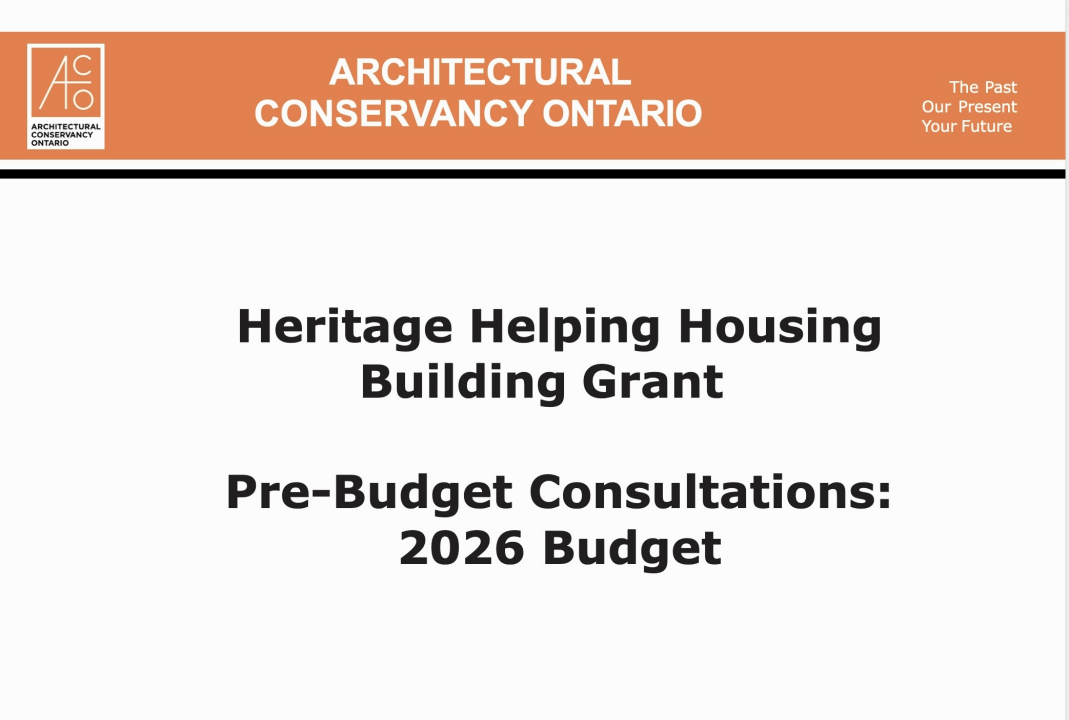
A proposal by Architectural Conservancy Ontario (ACO) would do just that. [Note 4] ACO is urging the government to create a new, application-based, matching grant program of $10M/year. The program — called Heritage Helping Housing (HHH) — would incentivize owners and smaller-scale developers to keep, fix, and renovate/reuse heritage buildings to create new housing.
The program is based on the premise that, with an aging building stock, tens of thousands of Ontario’s existing buildings, including heritage structures, are not utilized to full capacity or to their maximum extent. Often these buildings and their underused spaces are hiding in plain sight.
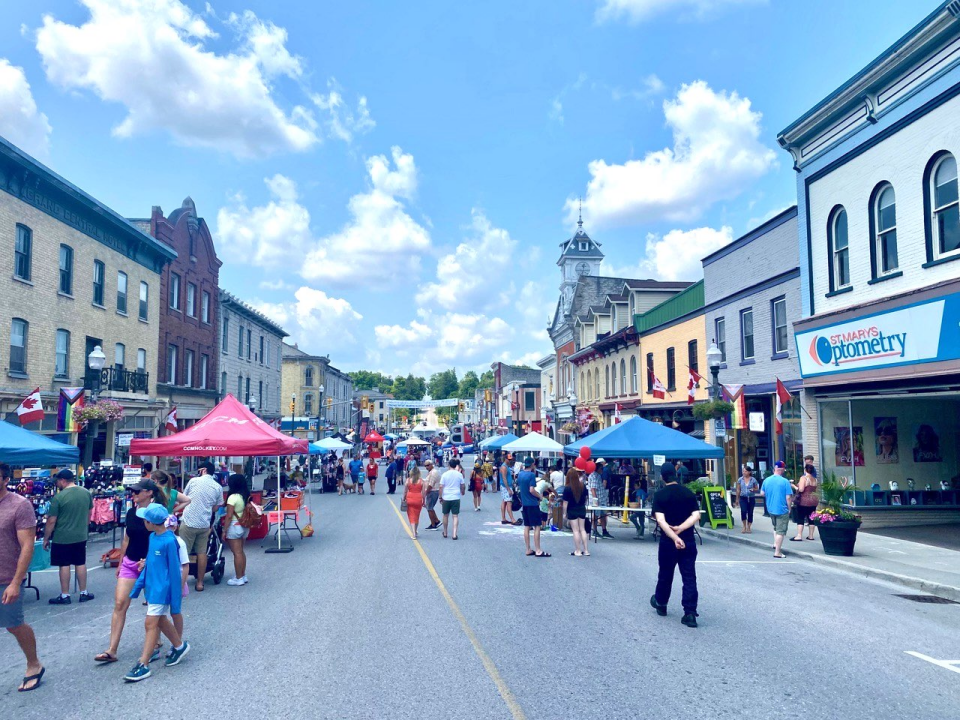
Queen Street in St. Marys, like most Ontario main streets, has many vacant and underutilized spaces in second and third stories above storefronts.
ACO summarizes the benefits of a housing-focussed heritage building incentive:
- Increased housing;
- Reuse of existing buildings, minimizing use of infrastructure, such as sewer and water;
- Rehabilitation of older buildings, which is generally less expensive, uses more local resources and creates more local jobs;
- Keeping older buildings helps a community remain visually richer and enhances identity while building its tourism brand and appeal;
- Alternative to the Ontario heritage property tax relief program, which has limited impact on developers and reduces municipal revenues;
- Simpler and more direct way for heritage building owners to fund renovations or conservation;
- Incentive for owners to work with their municipality to have historic places recognized under the Ontario Heritage Act;
- Like the Alberta program on which it is modelled, HHH has a simple application p
 rocess that provides half the grant up front (both elements are popular with developers).

That’s quite a list!
Unlike the Heritage Challenge Fund of 25 years ago, the program would target the private sector — particularly the owner or small-scale developer for whom modest funding assistance could make all the difference.
But like the Heritage Challenge Fund, the relatively small provincial stimulus could have a significant accelerator effect, catalyzing private sector enthusiasm and leveraging an outsized private investment in heritage-to-housing projects. [Note 5]
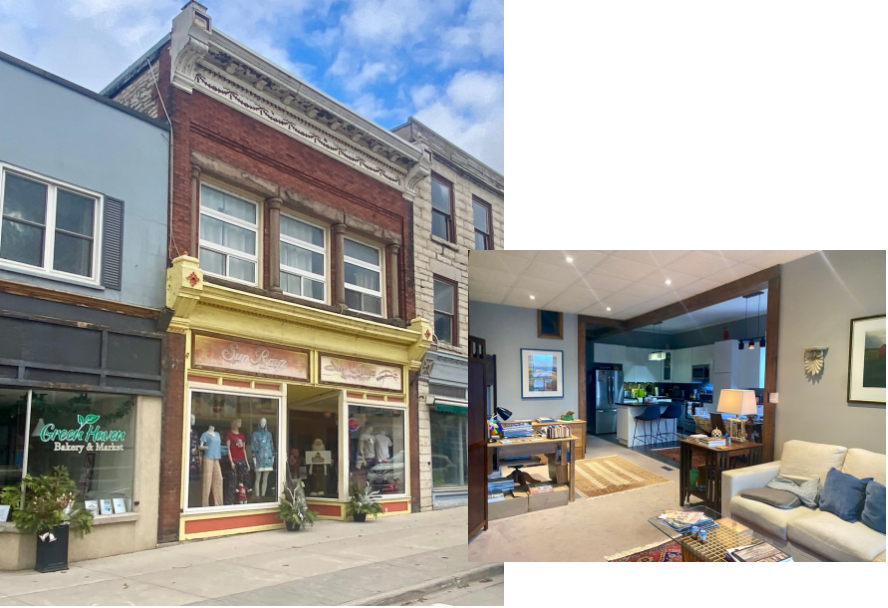
Example: in a commercial building in St. Marys’ downtown Heritage Conservation District, underused second-storey space was converted to three apartments.
The program would have a special impact in smaller towns and cities with vacant and underutilized floor space, such as the upper floors of main street buildings.
In a hopeful sign, ACO representatives have met with Finance Minister Peter Bethlenfalvy’s staff to discuss the proposal — and the exciting prospect of squeezing it into the 2026 Ontario Budget. But the support of the heritage ministry will be crucial. Citizenship and Multiculturalism Minister Graham McGregor should get his ministry on board.
25 years is a long time. Carpe diem.
Notes
Note 1: The other $5 million was designated to provide a source of funding for the Ontario Heritage Foundation (now the Ontario Heritage Trust) to help the Foundation preserve the heritage buildings and natural heritage lands it holds and support related activities. (This component required the Foundation to set up, with matching funds, an endowment to contribute to its long-term viability.)
Note 2: Report Back, Heritage Challenge Fund, MTCR, November 1, 2002.
Note 3: See “Heritage Property Tax Relief (HPTR) — slow but steady.”
Note 4: Full disclosure: This blogger/author is the chair of ACO’s policy committee and was closely involved in the development of the HHH program proposal.
Note 5: For more information on ACO’s proposal go here.