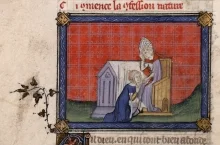
Bibliothèque interuniversitaire section médecine, Université Montpellier, H245, fol. 102v, 1375-1400

Lire en Français


folio 102

Detailed manuscript information (based on Ernest Langlois, Les manuscrits du Roman de la rose. Description et classement, Geneva: Slatkine Reprints, 1974, p. 134-35):

Parchment, measure: 305x216mm, 157 fols. at two columns 42 lines. Beginning of second folio: Et qui de vous se part et emble. The Roman de la rose is on fols 1r to 131r, followed by the Codicille on fols 131r-v and the Testament on fols 131r-157r.


Scene depicted
Nature's confession to Genius

Miniature description

Size:
305x216mm
Column picture
Height: 9 lines
 
Materials and colours:
Parchment
Gold leaf, red, blue, yellow, purple, green
 
Initials: 
Partial foliated initial "C" over a gold leaf background, with a gold leaf foliate extender.
 
Rubric: 
Above the miniature, "Ci commence la confession nature"
 
Frame:
Frame consists of a simple exterior gold leaf frame and a thicker inner blue frame with white wave patterns. At each corner is a gold leaf diamond shaped cornerpiece with a cross inscribed inside and four semicircles decorating each side.
 
Background:
Diaper pattern background (red checkerboard pattern with double grey lines going horizontally and vertically, each intersection decorated by a quatrefoil shape).
 
Landscape: 
Grass beneath Genius, Lady Nature and the cathedral.  A small hill is on the right.
 
Placement of miniature: Directly after Nature's confession
 
Place of Production of the Miniature:
France
 
Date of Production of the Miniature: 
1375-1400
 
Similarities to other images from the corpus:
Gestures:
Genius and Nature are in the same positions, with corresponding gestures: BNF, Ms. fr. 12595, fol.121r
 
Secondary sources:
Langlois, Ernest. Les manuscrits du Roman de la rose. Description et classement. Geneva: Slatkine Reprints, 1974, p. 134-35.

Detailed description

Allegories: 
Lady Nature is on the left
Genius is on the right (Bishop)
 
Clothing:
1. Lady Nature
  • Dark blue cotehardie with white and blue tippets
  • Yellow kirtle
  • Elaborate hairdo with crespines on the sides 
2. Genius (dressed as a bishop)
  • White alb
  • Long blue and red cape clasped at the center by a morse in the shape of a diamond
  • Black poulaines
  • Decorated mitre with a filigree pattern
     
Gestures:
Lady Nature is kneeling in a submissive manner at the feet of Genius.  Her hands are place together underneath her in a gesture of prayer. Her head is tilted upwards looking at the hand of Genius. Genius is sitting with his left hand on his right knee, and his right hand on his right cheek.  His eyes are looking strait ahead suggesting that he is listening to Nature's confession.
 
Objects:
The Bishop is sitting on an elevated simple brown wooden chair with high back and armrests. On the bottom there is an arched entrance maybe suggesting the architectural space of a cathedral. The chair is actually the cathedra, the symbol of power and authority of a bishop. Behind the figures there is an architectural structure elevated by a pedestal covered by a piece of white fabric. The structure has a trefoil tracery inscribed on the front over two narrow windows. 

Ex-libris

  1. Fols 1r and repeated on 157r: The signature of P. Florimond dated from 1567.
  2. On the first flyleaf: Ms. de la bibliothèque de Mr. le P. Bouhier .C. 33. MDCCXXI.
  3. At the end, the following lines have been added:
    1. Explicit le Romans de la Rose,
      Ou l'Art d'Amours est toute enclose.
      Nature rit, si com moy semble,
      Quant hic et hec joingnent ensemble.

At the end of the manuscript, a booklet has been appended containing Remarques sur le Roman de la Rose by M. Lucotte, Sr du Tillot. Two of these remarks are perhaps noteworthy:

  1. A Rome, dans la bibliothèque du cardinal Bagny, il y a un Roman de la Rose écrit de la main d'un nommé Nicolas Flamel, qui étoit un écrivain qui travailloit et négocioit à Paris et ailleurs pour les juifs en l'année 1393.
  2. Il y a encore un ms. du Roman de la Rose dans la bibliothèque d'Oxford, qui est très bien écrit sur du velin avec de fort jolies figures en miniature, qui est une marque de son antiquité.

Creative commons licence logo

© Bibliothèque interuniversitaire de Montpellier | This work is licensed under a Creative Commons Licence © 2012