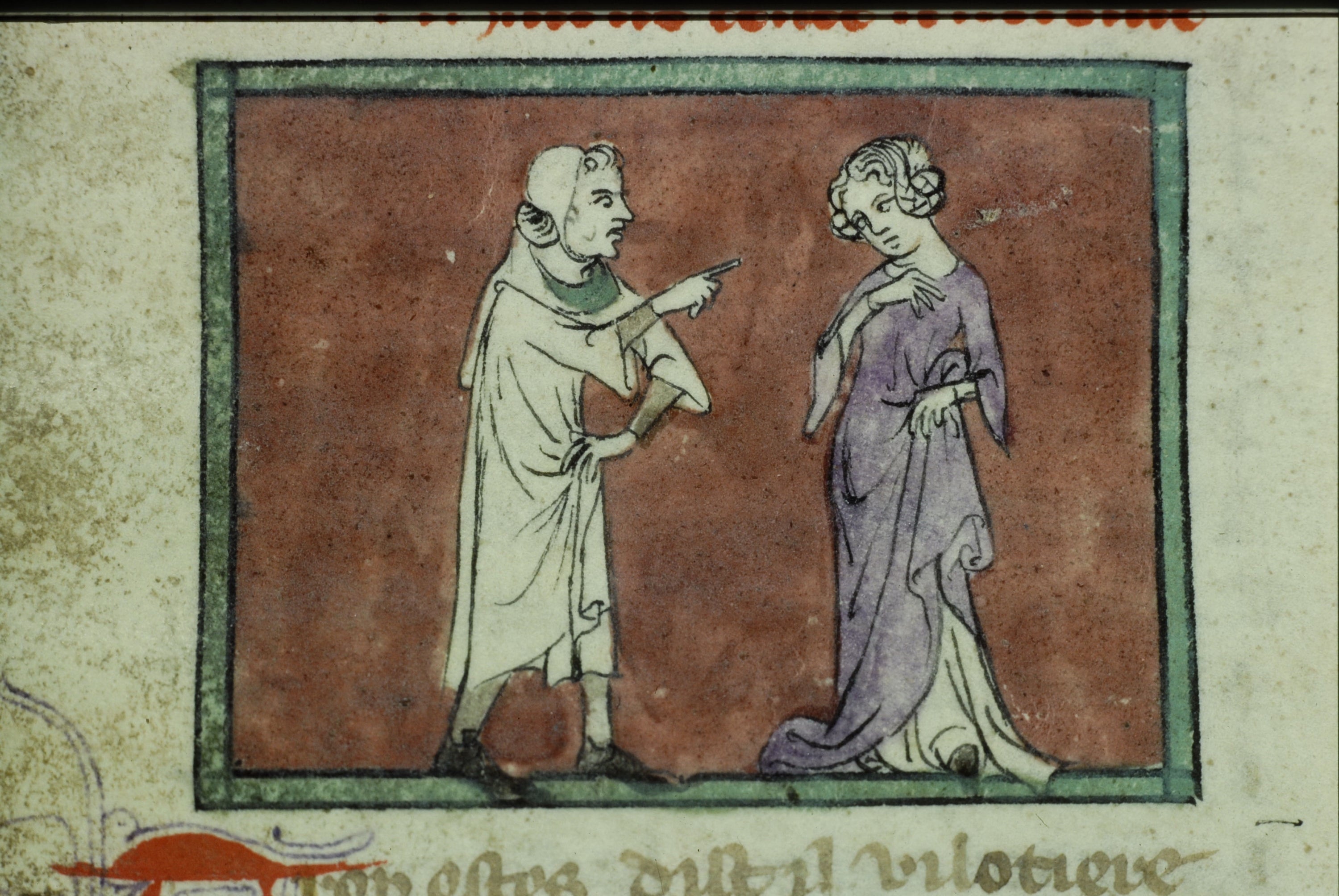
Florence, Biblioteca Nazionale Centrale Firenze, Codice Laurenziano Acquisti e Doni 153, fol. 103v, 1300-1350

Lire en Français


Folio 103v

Detailed manuscript information (based on Simonetta Mazzoni Peruzzi, Il Codice Laurenziano Acquisti e Doni 153 del Roman de la rose, Florence: Casa editrice Le Lettere, 1986 and Ernest Langlois, Les manuscrits du Roman de la rose. Description et classement, Geneva: Slatkine Reprints, 1974, p. 184-187):

Parchment, measure: 242x77mm, 259 folios, one column of 45 lines. The Roman de la rose is fols 3-257. On fols 257v-259r, a text in Latin has been added (see Langlois for full transcription). Beginning of the fourth folio (formerly the second): Lors esteut jovenes gens entendre.


Scene depicted

Jealous husband scolds his wife.

Miniature description

Size:
Column picture.
Height: unknown

Material and colors:
Parchment
Red, green, pink, black

Initial:
Decorated pen-flourished initial under the miniature
Rubric:
Above the miniature

Frame:
Simple border with black outline and green fill.

Background:
Tinted red.

Placement of miniature:
Placed right above Jealous husbands first interjection scolding his wife.

Place of production of miniature:
unknown

Date of production of miniature:
1300-1350

Detailed description

Allegories:
Jealous husband on left
Wife on right

Clothing:
1. Jealous husband:
  • Black shoes
  • Grey hose
  • Grey kirtle
  • White (outline drawing) surcote
  • White (outline drawing) chaperon with green lining
  • White (outline drawing) coif
2. Wife:
  • White (outline drawing) kirtle
  • White (outline drawing) underdress
  • Purple gown
  • Her hair is coiled over her ears and held with a crespine.
  • Black shoes

Gestures:
Husband points accusingly at wife.
Jealous husbands anger is displayed through his pronounced facial expression: downturned mouth (scowl) and scornful gaze, and the way he holds his surcote tightly.
Wife’s head and gaze are turned downwards. This could signify grief, shame or anger.
The wife also grasps her dress and grabs at her chest, which can signify grief.
“The husband stands facing his wife and holds his hands in a set of speaking gestures that visualize the aggressive thrust of his words” (Desmond, Marilynn. Ovid’s Art and the Wife of Bath. The Ethics of Erotic Violence. Ithaca: Cornell UP, 2006: pp. 87-9)

Ex-libris

  1. Fol. 1v: Hanc romanensem de Amore fabulam, a Guillelmo de Lorris, jurisconsulto et poeta, gallicis versibus, anno circiter 1260 exacratam, ex hereditate Jo. de Menabuonis adquisitam, Ferdinandus III, A.A.M.D.E., Laurentianae bibliothecae muneri dedit, die XV sept., a 194, curante Angelo Mario Bandinio.
  2. Fol. 2v: In modern writing Cy est li Rommant de la Rose, ou tout l'art d'amours est enclose. Manuscript.
  3. Fols 257v-259: Text in Latin (see above)
  4. Fol. 259r: Effaced and illegible ex-libris.
  5. Fol. 259v: Two sales from the XVth century have been noted, both by the same hand:
    1. Je vous vent le pré qui fueille,
      Si pri a Dieu du ciel, belle, qu'il vueille
      En vostre cuer metre et escrire
      Ce que le mien ne vous osse dire.
    2. Je vous vent la pierre de l'ambre,
      Vostre nature, belle, li resemble,
      Qui trait la busche et tire a soy,
      Si faites vous, belle, le cuer de moy.
  1. Other verses or ex-libris follow, but they are scratched and illegible.

© Firenze, Biblioteca Medicea Laurenziana; su concessione del Ministero per i Beni e le Attività Culturali E' vietata ogni ulteriore riproduzione con qualsiasi mezzo

This work is licensed under a Creative Commons Licence © 2012                                                                                                                                                                                                                                                                         Creative commons licence logo