
University of Waterloo researchers have developed a new 3D-printed electrode design for redox flow batteries, a technology that could help store renewable energy generated by wind and solar farms. Their work shows how carefully designed electrode structures can help battery fluids move more effectively through the system, improving performance and reducing the energy needed to operate the battery.
Led by Nanotechnology Engineering professor Maxime van der Heijden, the research team created porous, 3D-printed electrodes with internal patterns inspired by structures found in nature. These designs helped the battery liquid reach more of the electrode surface while allowing it to flow through the battery with less resistance.
Electrodes are an important part of a battery because they are where the chemical reactions that store and release energy occur. Making electrodes porous, meaning full of tiny open spaces, increases the available surface area and creates more places where these reactions can take place.
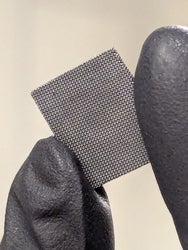
Heat-treated electrode showing its porous structure and the fine details retained after heat treatment
Redox flow batteries work differently from lithium-ion batteries. Instead of storing energy inside solid materials, they store energy in liquid electrolytes contained in external tanks. During charging and discharging, the liquids are pumped through a reactor where the electrochemical reactions occur.
Because the energy is stored in tanks, the amount of energy a flow battery can store can be increased simply by using larger tanks. This makes the technology particularly attractive for storing electricity from renewable energy sources and helping balance the power grid.
“Most electrodes used in redox flow batteries are made from carbon fibers and were not specifically designed for this type of chemistry,” says van der Heijden. “That means there is an opportunity to design better electrode structures that make it easier for the liquid to reach the places where reactions occur while also reducing the energy needed to pump the liquid through the battery.”
Traditional commercial electrodes contain dense networks of carbon fibers that provide a large surface area for reactions. However, those same complex structures can make it difficult for the liquid electrolyte to move through the battery, increasing pumping requirements.
To address this challenge, the researchers used additive manufacturing, more commonly known as 3D printing. Unlike conventional manufacturing methods, 3D printing allows engineers to precisely control the shape and internal structure of a material.
Using a digital light processing (DLP) 3D printer, the team produced porous electrode structures and then converted them into conductive carbon electrodes through a heat-treatment process. The electrodes were tested in laboratory flow-cell experiments and in a proof-of-concept vanadium redox flow battery.
The researchers also see potential for applying these engineered porous materials to other clean-energy technologies, including electrolyzers used for hydrogen production, where efficient movement of fluids and reaction species is equally important.
The study, “Enhancing Mass Transport in Redox Flow Batteries with 3D-Printed Triply Periodic Minimal Surface Electrode Structures,” has been published in the Journal of Energy Storage.