Mastering Japanese, art history and linear algebra can be easy, thanks to the latest AI collaboration between Google and the University of Waterloo.
At the heart of this collaboration is reimagining education and career development in an AI-driven world, spearheaded by Waterloo’s new Future of Work Institute.
In October, Google and Waterloo launched a new partnership that included a $1M investment to create the Google Chair in the Future of Work and Learning. The ensuing chair was endowed to Computer Science Professor Edith Law, and is related to Law’s broader initiative, the Future of Work Institute. The Future of Work Institute is also supported by Waterloo’s Global Futures Fund, which helped create a range of initiatives that advance the vision of Waterloo’s Global Futures.
The Future of Work Institute’s first initiative is the Futures Lab: An AI + UX Prototyping Workshop. This bootcamp-style workshop series invites students to learn AI-related skills, from coding to business ideation. They also form teams to tackle an educational problem by leveraging Google’s suite of AI tools, such as Gemini Canvas and Google AI Studio. Each team must include students from different faculties, fostering interdisciplinary knowledge and creativity.
Throughout the workshops, students received mentorship on their AI prototypes from Google staff members. Many of those staff are Waterloo alumni, returning to campus to empower the next generation of students.
The workshop series concluded with the “Google-UWaterloo Symposium on the Future of Learning,” held early December. Students presented their months-long projects to the public, industry partners and faculty members.
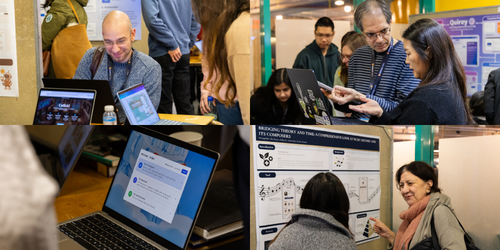
The Davis Centre was buzzing with students, faculty and community members, as they explored the future of AI and learning.
“What stood out to me from the student projects is how AI has added interactivity to learning without taking away human agency. To me, this is the central tenet of my research chair and this amazing partnership between Google and University of Waterloo,” says Professor Law.
One of the projects presented was LinearViz, an app created by software engineering student Jenny Hui, sociology and legal studies PhD student Yan Qiu and math student Yichen Xian. Linear algebra is considered one of the hardest courses in high school, with many students struggling with its abstract and geometric concepts. LinearViz helps visualize these concepts through an interactive 3D space, where users can tweak, transform and manipulate lines, coordinates and shapes. The app also provides quizzes on vectors and matrices. For example, students can play “gamified puzzles” to learn how to transform matrices of numbers, which are connected to 3D visuals. With this dynamic and interactive tool, students can bring their learning to motion.
“With AI growing at exponential speed, a lot of non-math students would like to get into this space which heavily relies on understanding linear algebra. So, we created LinearViz to equip these skills for non-math students by using animation,” explains co-creator Jenny Hui.
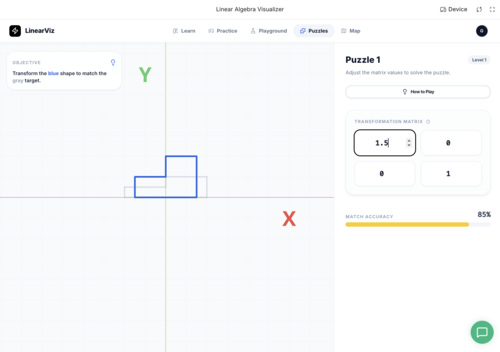
In LinearViz, a student can learn how to add vectors by dragging arrows or how to transform matrices by playing gamified puzzles.
Another standout project was a Japanese learning app called Kanji Garden. Users receive lessons on Japanese and practice tracing Kanji. The app incorporates a Tamagotchi-like virtual plant that grows with the learner’s progress. Kanji Garden was created by Lara A., a Master of Digital Experience and Innovation (MDEI) candidate, Spencer S., a Chemistry graduate student and Justin Xing, a Computer Science undergraduate.
The app embodies mnemonic, a study technique that uses patterns or stories for memorization and recall. When a user draws the Kanji character, they can label parts of it. Then, the app’s AI model generates a story and a graphic based on the labels and the character’s meaning.

Suppose a user sees the Japanese character for “four”, 四, and labels the outsides as a “square” and the insides as the “Pi symbol (π)”. Kanji Garden's AI model will generate a story and visual to help a user remember its meaning.
“By breaking each character into meaningful pieces and generating personalized stories, Kanji Garden helps learners build deeper connections with Kanji rather than relying on rote memorization. We wanted to create a more engaging, human-centered way to learn kanji, one that adapts to individual interpretation and supports long-term retention,” said Spencer.
“The most memorable advice I received was when our Google mentor asked us, ‘If Kanji Garden was a T-shirt, what would you put on it?’ This really helped us zoom in on the app’s core design,” said Justin.
This hard work paid off as Kanji Garden won the “Best Poster” award while LinearViz won the “Best Creative Artifacts” award. Other recipients include PipettePro, a computer vision-based app that helps users practice common pipetting techniques in chemistry labs, and CipherProtocol, a spy-like game on cryptography. They respectively won the “Best Prototype” and “People’s Choice” awards.
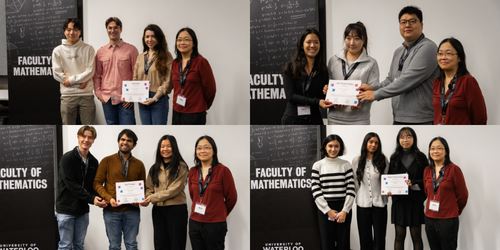
The winning teams (left to right) Kanji Garden, LinearViz, PipettePro, and CipherProtocol.