A first-year Waterloo student has developed a program that tracks the real-time speed of every streetcar line in Toronto. Called the TTCLeaderboard, the app is set up like keeping score of a race, ranking the lines from fastest to slowest.
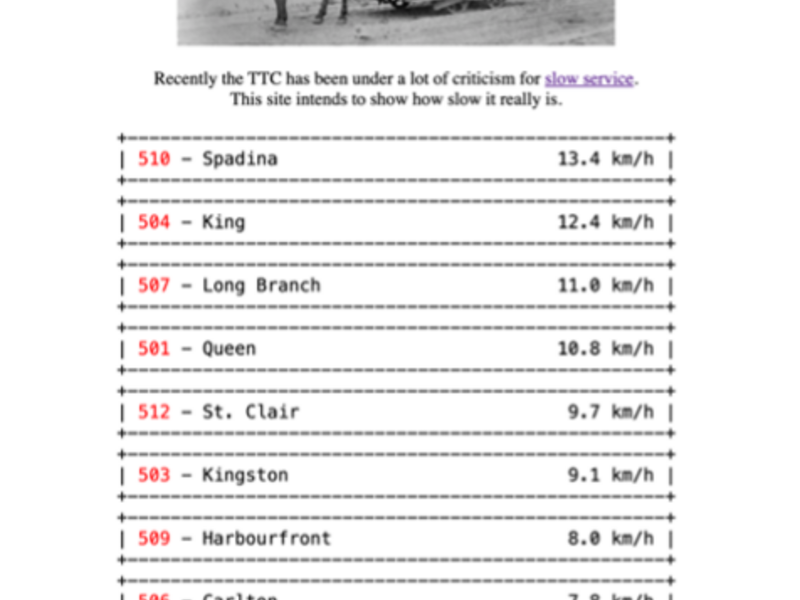
The leaderboard displays the real-time speed of TTC streetcars at any given moment
According to the leaderboard, some of Toronto's quickest streetcars tend to be 504 King, 507 Long Branch, and 510 Spadina.
The creator of the app, computer science undergraduate student Luka Jovanovic, has always had a passion for urban planning: his dorm is covered with maps, including Tokyo’s transit system. In grade 11, his interactive map of Toronto’s streetcar system from the 1940s went viral, and he designed and presented his own bus route to the Toronto Transit Commission (TTC). After coming across the TTC’s public data portal, which showcased their vehicle’s live navigation, he embarked on a new side project.

Waterloo freshman Luka Jovanovic developed the TTCLeaderboard for fun, not expecting it to create a buzz online.
“I would take the instantaneous speed of all the streetcars on that line, let’s say 510 Spadina,” says Jovanovic. “Then I would calculate its average.”
Jovanovic built the program using React, and it was immediately shared widely and received coverage from BlogTO and CityNews.
However, Jovanovic cautions that this leaderboard shouldn’t be taken at face value. Although the averages are accurate, it doesn’t mean that the streetcars are driving at that speed.
For example, some TTC routes have unevenly spaced stops, sometimes being 20 metres apart. Most streetcars don’t have signal priority for red lights or left turns.
“In some sense, this leaderboard is not a critique of the speed of the streetcars, but more so how often and how long they have to stop,” explains Jovanovic.
In comparison, the Kitchener-Waterloo’s ION has signal light priority, so it rarely stops at a red light. Moreover, incoming traffic must yield for the ION to cross at every intersection. Jovanovic recalls taking the ION and checking its live speed on an app, surprised that it read 40 kilometres per hour. “It basically feels like a subway,” he says.
Jovanovic’s program showcases Waterloo’s spirit of innovation, where students are building technology to explore new ideas. He encourages students to pursue their personal interests.
“If you’re here because you love building, you would work on side projects because that’s what you do, even if it doesn’t have a big salary. Do things that you find fun. Make things you find useful.”
Visit the website for the TTCLeaderboard.