March 27, 2026
Students win more than $100,000 at Capstone Design pitch contest
The Norman Esch Foundation awards funds to Waterloo Engineering student teams each year to support their entrepreneurial ambitions
The Norman Esch Foundation awards funds to Waterloo Engineering student teams each year to support their entrepreneurial ambitions
Twelve fourth-year student teams from the University of Waterloo’s Faculty of Engineering competed in the 2026 Norman Esch Entrepreneurship Awards for Capstone Design, making three-minute pitches to a panel of industry judges who awarded more than $100,000 across all 12 teams.
The solutions on offer ranged widely — from a wearable cooling device for menopausal hot flashes to an AI tool that automates body camera redaction for law enforcement.
“Participating in the Norman Esch Entrepreneurship Awards is incredibly rewarding — it’s a chance to show off work you’ve poured yourself into for the past year. Receiving awards is validating, but it’s also useful, tells people we’re serious, that this product is good and needed in the market.” — Jordyn Maywood, fourth-year biomedical engineering student and CoolFlash team member.
The competition was emceed by Waterloo Engineering alum Matt Stevens (BASc ’04, PhD ’08). While still a student, Stevens co-founded CrossChasm Technologies — later known as FleetCarma, a global leader in electric vehicle telematics — which was acquired by Geotab in 2018. He has since launched a second venture, Finite Farms, in regenerative agriculture and orchard robotics.
Projects were judged by three Waterloo Engineering alumni who have built successful careers founding and building businesses — Akash Vaswani (BASc ’14), a general partner at the University’s startup incubator Velocity who sold his student startup to Essity and led machine-learning teams at Palantir; Sylvia Ng (BASc ’04), founder of ReturnBear and a former general manager at Shopify; and Sanjay Malaviya (BASc, ’93) who founded RL Solutions in 1997 and grew it into a healthcare quality software platform used by more than 2,000 organizations worldwide before merging the company with Datix to form RLDatix.
The Esch pitch $12,000 winners
Agentic Version Control Protocol for creating structured version control for AI agent systems, letting developers modularize, track and compare agent configurations — prompts, tools, memory and decision logic — the way Git manages code. Presented by Leen Kamalmaz, Paniz Ojaghi, Vaishnavi Ratnasabapathy, Charlene Rocha — Software Engineering.
CoolFlash for developing a wearable device that delivers automatic, targeted cooling to relieve menopausal hot flashes — symptoms affecting 85 per cent of women that persist on average for 11 years. Presented by Kate Avison, Mariam Busari, Maya DeVries, Jordyn Maywood — Biomedical Engineering.
Division 5 for designing an AI-powered audio pipeline that converts body camera footage into clean, structured transcripts, automatically flagging personal information for redaction and cutting a six-hour manual process per hour of footage. Presented by Gavneet Kaur Bhandal, Resha Shetty, Dhruv Sharma, Rozalin Draghosian, Kirti Bansal — Management Engineering.
L.I.D.D.E. Loupes for creating smart medical loupes that address the neck, back and nasal pain caused by traditional surgical and dental loupes, improving ergonomics and career longevity for clinicians. Presented by Chelsea Dmytryk, Nick Drazso, Nathan Rowe, Lili Strong, Natalie Tsang — Mechatronics Engineering.
PneuBra for developing a pneumatic sports bra with individually adjustable support that addresses the breathing difficulties and pain experienced by 62 per cent of women during physical activity, reducing barriers to participation in sport. Presented by Evangeline Dryburgh, Jocelyn Lim, Janvi Patel, Jack Pearson — Mechatronics Engineering.
Stella for building an AI-powered search assistant that finds documents across laptops, cloud drives and shared folders by meaning rather than filename, helping teams spend less time searching and more time working. Presented by Ayush Bhargava, Senan Gaffori, Matthew Stebelsky, Adam Stevenson, Michael Stevenson — Management Engineering.
The Esch pitch $5,000 winners
AlertDriver for building a real-time visual alert system that helps hearing-impaired rideshare drivers detect emergency sirens and passenger speech — addressing a road safety gap for a group three times more likely to be in a motor vehicle accident. Presented by Sarah Chun, Samantha Grieco, Jenny Yu, Tiffany Zhang — Electrical and Computer Engineering.
DotPal for creating a USB braille learning pad that introduces blind children aged three to five to braille before formal instruction begins, closing a pre-literacy gap that sighted children don’t face. Presented by Rachel Joy Copreros, Surya Sendhilraj, Niharika Srivatsa, Tiffany Yang — Systems Design Engineering.
GlycoTech for engineering a compact, field-deployable electrochemical sensor that detects ethylene glycol contamination in water on-site, without the need for laboratory infrastructure. Presented by Matthias Bernhard, Diego Roti, Marcus Tunkl, Jonathan Zambrano — Nanotechnology Engineering.
H.A.L.O for developing a clinical-grade canine wearable that continuously monitors heart rate, respiration and temperature during post-operative recovery, replacing labour-intensive manual monitoring with automated tracking. Presented by Mena Azab, Carter Demars, Jared DiZio, Dylan Ellingson — Mechatronics Engineering.
LARS for designing a semi-robotic arm attachment for existing ultrasound equipment that reduces the physical strain on cardiac sonographers by applying assistive force during scans, without disrupting their workflow. Presented by Luke Coulter, Alexa Daly, Rylin Soto, Serena Wittenberg — Biomedical Engineering.
PRISM for building a pressure-sensing prosthetic sock that provides real-time feedback on socket fit, helping amputees and their clinicians identify high-risk pressure zones and prevent skin degradation. Presented by Joel Lee, Gary Liu, Livia Murray, Gloria So — Biomedical Engineering.
Division 5 also won the Adel Sedra People’s Choice Award, selected by the audience, taking home an additional $4,500.
The 12 qualifying teams were drawn from more than 350 projects developed by more than 1,500 fourth-year engineering students and showcased at the University’s 2026 Capstone Design Symposia.
The pitch competition, funded by the Esch Foundation, has supported creative and entrepreneurial senior engineering students pursuing the commercialization of innovations that benefit Canada since 2014.
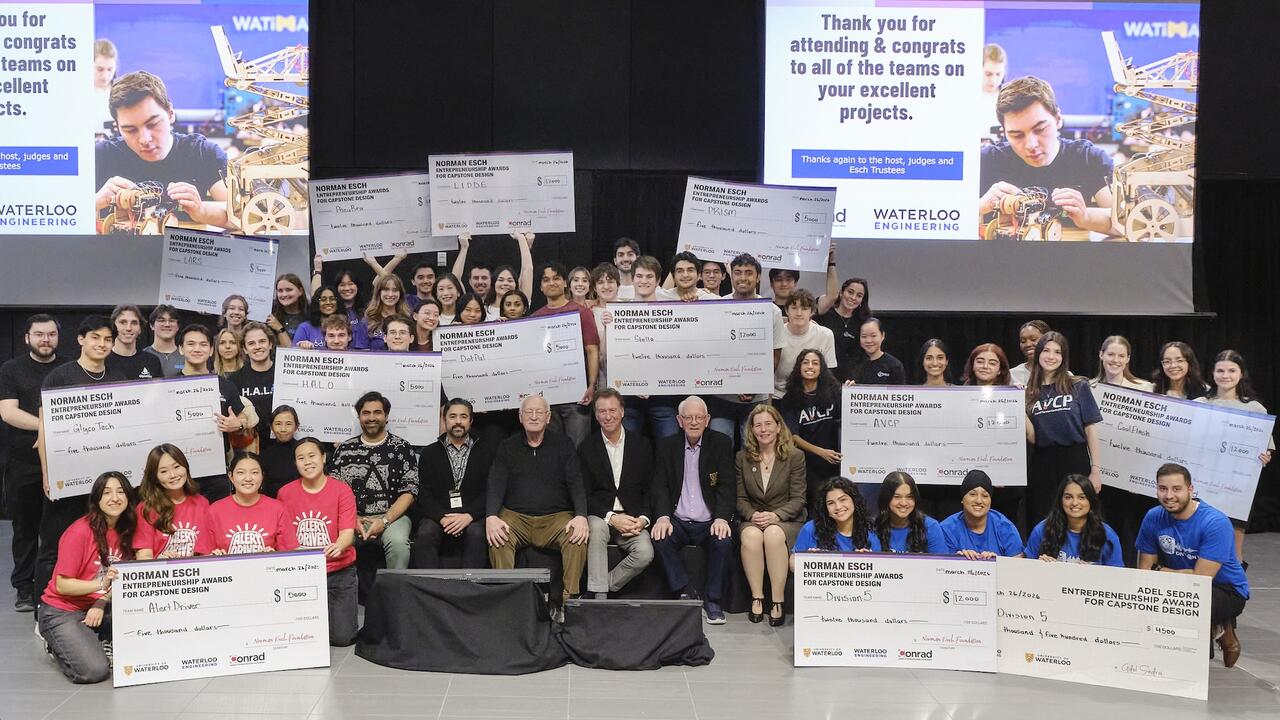
Feature image: Judges, Esch Trustees and Dean Mary Wells in the front row with student teams. Credit: Bruce Ladouceur @ Light Imaging.