April 28, 2026
Google and UWaterloo show the future of learning in the age of AI
From acing driver’s tests to democratizing fitness, students show how AI can enhance learning at the Future of Learning Symposium
From acing driver’s tests to democratizing fitness, students show how AI can enhance learning at the Future of Learning Symposium
To keep up with the AI paradigm shift, the University of Waterloo and Google partnered up to explore AI’s role in education and career readiness. This million-dollar partnership included the Google Chair in the Future of Work and Learning, which was endowed to Computer Science Professor Edith Law. The research chair is part of Dr. Law’s broader initiative, the Future of Work Institute, which she leads as its inaugural Executive Director.
The Future of Work Institute launched the Futures Labs as one of its flagship activities. This bootcamp-style workshop exposes students to AI-related skills, such as prompt engineering, as well as Google’s suite of AI tools, including Gemini Canvas and Google AI Studio. Students also received exclusive talks and mentorship from Google staff, many of whom are Waterloo alumni. To cap off their learning, the students form interdisciplinary teams to create an AI-powered tool.
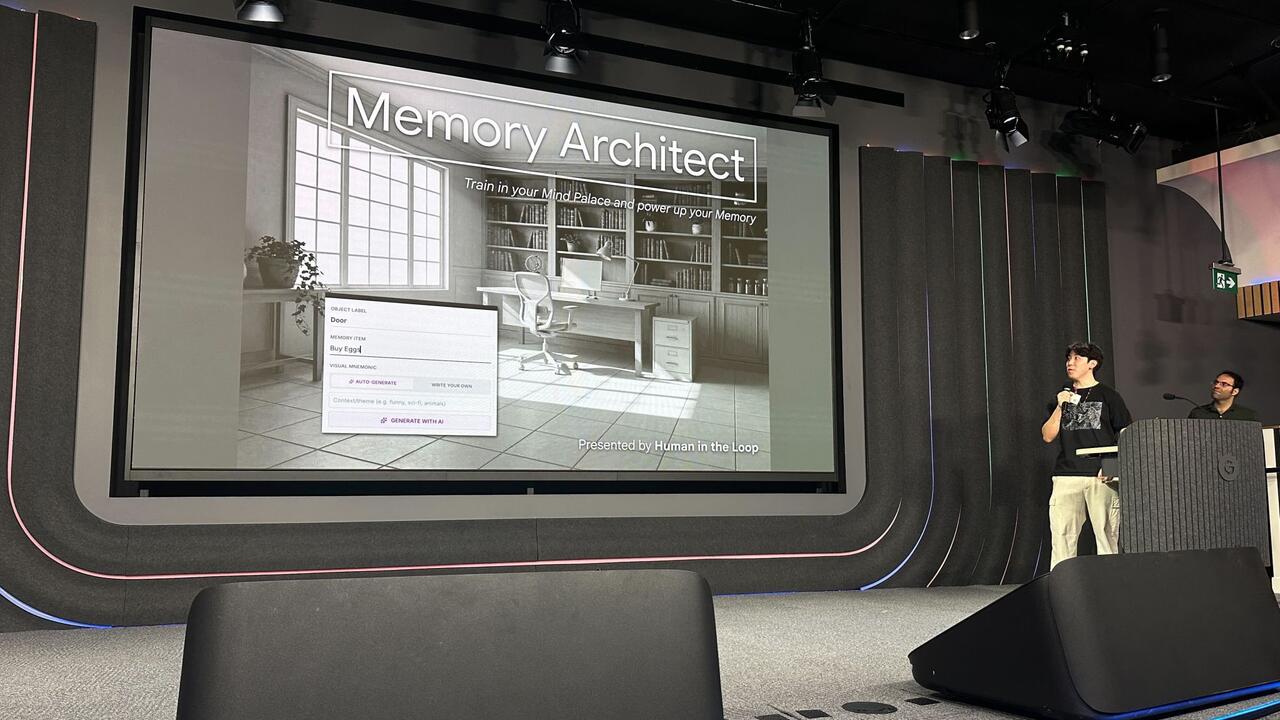
The workshop concluded with the “Google-UWaterloo Symposium on the Future of Learning,” held in late March at the Google campus in downtown Kitchener. Students presented their AI prototypes, which focused on tackling a unique learning challenge.
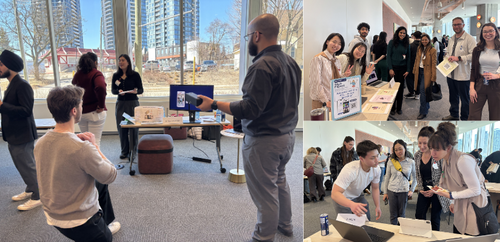
Students showcased how AI can unlock human learning at the Google-UWaterloo Symposium
For example, a group composed of engineering students and a health science student — Kathryn Percy-Robb, Elbert Chen, Jimmy Phan and Areeba Hashmi — built G1NIUS. This immersive game puts users in the driver’s seat, so they can prepare for their driver’s license test. Players navigate a busy street while monitoring speed limits. If they break any traffic rules, they will be kicked out of the game. Users must answer questions based on their current situation, prompting them to actively monitor their surroundings, such as road signs and traffic, and recall driving rules.
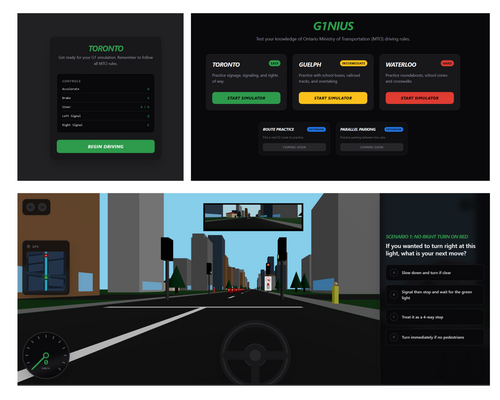
Using their keyboard, G1NIUS helps up-and-coming drivers practice their G1 test.
“What I love about the Futures Lab is that it breaks us out of the engineering bubble,” says Phan, a computer engineering student. “Working with people from completely different backgrounds brought new perspectives to our projects that I wouldn’t have found elsewhere.We’re all bustling with ideas, but the lab actually gave us the tools and mentorship to build and prototype them fast, turning a vision into something real in just a few weeks.”
Notably, G1NIUS won the Best Prototype Award at the symposium. Other award recipients included SignFluent, an AI-driven American Sign Language platform delivering real-time guided practice with integrated social learning; ELIX, a game that promotes active learning by teaching AI students, who track the user’s understanding and knowledge gaps; and FeynMind, a platform that develops teaching skills and perspective-taking through AI agents. These teams won the Best Creative Artifact Award, the People's Choice Award, and the Best Demonstration Award, respectively.

The winning teams (top to bottom from left to right): G1NIUS (Jimmy Phan, Kathryn Percy-Robb, Elbert Chen and Areeba Hashmi), SignFluent (Nimisha Jain, Emily Yang, Joanna Dong and Mahdee Khandokar), ELIX (Jaeeun Kim, Nathaly Concepcion Llanos Garcia, Jaemin Han and Jialing Yong) and FeynMind (Dazhuang Teng, Yuhan Zhang, Chaozhong Wang, and Misha Stastna)
What stood out to many attendees was how AI can democratize learning. For example, one group, comprising Engineering and Arts students — Sadiq Islam, Sabrina Tam, Tales Mello Paiva, Bhavnoor Virk, and Amar Singh — created MuscleMemory. This app acts as a real-time biomechanical coach for calisthenic exercises such as squats and deadlifts.

An overview of MuscleMemory, which coaches users through calisthenic exercises from squats to deadlifts!
MuscleMemory uses an AI model that tracks the user’s movement through their smartphone’s camera and provides instant audio and visual feedback to perfect their form and avoid injuries. With personal training being so expensive, MuscleMemory can break the barrier to safe and personalized fitness.
“As an Arts and Business student, I’ve always been curious about the world of building, but I didn’t know how to start. This workshop gave me the toolkit to do exactly that,” says Virk. “Being a part of the Muscle Memory team was incredibly rewarding. The iteration, problem-solving, and collaboration provided a practical framework for design thinking. As AI is rapidly evolving, it's important to learn these skills as leverage. With these tools becoming more accessible, the potential for innovation exponentially grows.”
The symposium ended with an impromptu speech by Kevin Jeyakumar, a Product Lead in AI Research at Google. He also served as a mentor in the Future Labs. He said that he was impressed by the student’s dedication to “user empathy.”
“You all built so many compelling projects with thoughtfulness and care,” he said. “The world is moving so fast. What previously would have taken an engineering team months, you succeeded in doing in a quarter of the time with AI. Don’t keep these ideas in your back pocket. Continue exploring! Great ideas come from understanding real human needs, so having user empathy informing what you build and why will become the paramount skill.”