June 22, 2017
Mixing research and art to tell the story of bisexual life experiences
Waterloo professor uses comics and other artforms to make findings more engaging for a general audience
Waterloo professor uses comics and other artforms to make findings more engaging for a general audience
 In LGBTQ research and even in LGBTQ communities, the representation of bisexuality—the attraction to both one’s own gender and the gender of others-- is often narrow or erased, says a University of Waterloo professor.
Lisbeth Berbary, a professor in the department of Recreation and Leisure Studies, is co-constructing zines, comics and graphic novels as part of research that she calls queer narrative inquiry. “It’s looking to ‘queer’ or trouble the idea that there are stable sexual identities of either straight or gay that we all have to claim, and particularly trying to challenge some of the stereotypes of bisexuality,” says Berbary.
These stereotypes include the perception that bisexuality is just a gateway to a more stable gay or straight sexuality; that one’s sexuality should be dependent on the gender of a person’s romantic partner rather than allowing for the maintainence of a bisexual identity within relationships; and the misperceptions that all bisexuals are questioning, confused, and/or promiscuous.
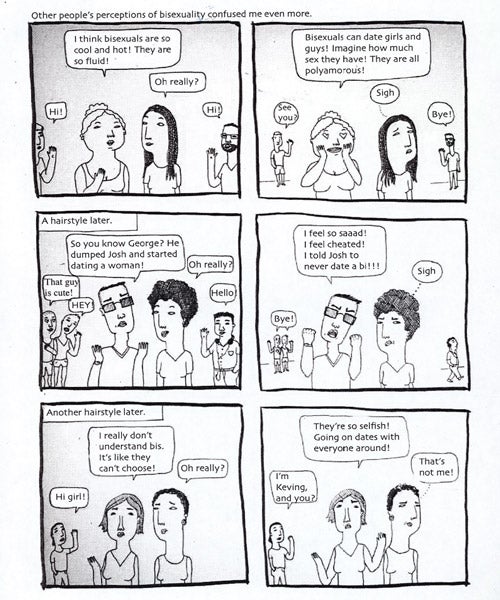 Because of these stereotypes, bisexual people find themselves rejected by gay and straight communities, says Berbary. As a result, “people who identify as bisexual actually have much higher rates of depression, erasure, exclusion, and suicide, partly because they do not feel that they are supported or recognized fully by any community,” she explains.
Berbary’s research focuses on individuals who identify as bisexual in the Waterloo Region and their navigation of community inclusion, exclusion, and desires for transformations. Berbary hopes to expand her study to examine bisexual erasure (the denial of bisexuality as a legitimate identity) within the Greater Toronto Area.
Comic tells the story of nine women’s experience of bisexuality in the Waterloo Region
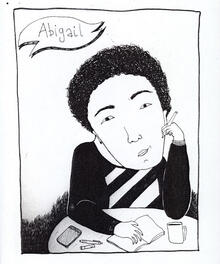 The first of a series of comics created through this research follows the story of Abigail, a cis-gendered woman who identifies as bisexual. Throughout the comic, Abigail questions her sexual identity and how she relates to people and their perceptions of bisexuality. The character is a composite of nine cisgender-identified bisexual women interviewed by Berbary and her student researchers, Kathryn Wettlaufer and Ashley Flanagan.
Using a practice called narrative analysis, Berbary looked at shared and juxtaposed experiences among the participants of the study and how these experiences could create composite stories. Berbary then worked with Toronto-based artist Coco Guzmán who created storyboards and turned the narratives into illustrations.
“The intention of this was to think of the process of how we engage research and art together, where both the artist and the researcher are co-constructing the final product. Such creative analytic practices make the work more accessible to the general population, so that people are excited to read and get involved in the research that we do,” says Berbary.
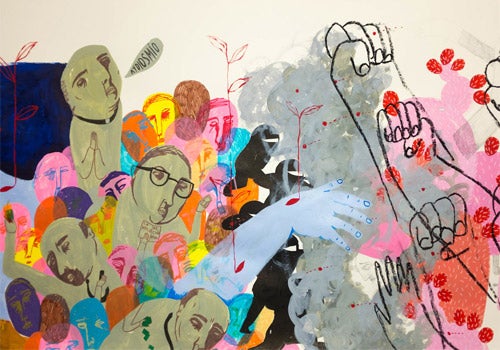
The project's artist, Coco Guzmán, is a queer visual artist of Spanish origin, who is internationally known for their activism and artistic exploration of gender equality and feminist issues. Coco's work has been exhibited in Canada, as well as internationally in museum, galleries and festival of Europe (Spain, Netherlands, Germany), South Korea and Costa Rica.
Creative data representations make research more inclusive
Berbary defines creative analytic practices (CAP) in qualitative research as “the use of creative genres such as fiction, poetry, and screenplay for data representation,” in a 2015 research paper.
By their nature, these creative analytic practices attempt to engage a wider audience by turning complex theoretical research into a form that is more engaging for all readers , an important element of Berbary’s work, she says.
“That for me, as a leisure scholar, is an interesting component of CAP in the sense that not only am I studying people’s engagement in leisure spaces in the community, but also the result of my research in itself is an activity in which people can engage during their leisure. You sit down and read a comic book, compared to having to read a journal article,” says Berbary.
Berbary and her research team are currently working on a second comic. They hope to later produce a full-length graphic novel. Dr. Berbary would also like to extend a special thank you to Dr. Shana MacDonald, of Drama and Speech Communications at the University of Waterloo, for her feedback and support in the creation of the comic.


