Waterloo entrepreneurs turn heads at Y Combinator Demo Day
Four companies affiliated with the University of Waterloo pitched to investors at the online-only event
When investors logged in to Y Combinator’s virtual summer 2020 Demo Day, they got to see Waterloo entrepreneurship in action. Four companies with ties to Velocity and the University of Waterloo took part in the event, which brought together a class of 198 of founders from 26 different countries.
“To have four founders with ties to our campus in a group from across the globe is a testament to the strength of our entrepreneurs and the tools and supports we’re able to provide here at Waterloo,” says Adrien Côte, executive director of Velocity. “Whether companies are getting their start here on campus or coming to us for tools and resources as they develop, we’re proud to be able to offer the right supports at each stage of the journey.”
Meet the companies who made Waterloo proud on Demo Day.
TyltGO

Business was brisk, and when the time came to expand, Pereira found his match in Management Engineering student Aaron Paul. TyltGO also got a helping hand in the form of the Enterprise Co-op (E Co-op), a made-at-Waterloo program that allows students to start their business while earning credit.
“[Enterprise Co-op] played a huge role in me coming on full-time, to giving that full-time dedication towards TyltGO. And that’s what allowed us to get the traction to grow and grow,” says Paul. “By the time we submitted our Y Combinator application and interview, we had that traction to back us and say ‘we are an investable company and we’re going to make it.’”
The pair shifted in October 2019 from a consumer-facing model to a business-to-business model. TyltGO manages the last-mile delivery logistics for brick-and-mortar retailers and e-commerce brands, offering same-day delivery under their own brand name, including live-tracking and status updates. They’re also creating collaborative delivery networks to allow retailers to share a delivery route, effectively lowering the cost for both businesses.
Now looking to expand their team to meet the growing interest from potential customers, Pereira credits Waterloo with giving TyltGO the tools and opportunity to take flight.
“E Co-op gave us that opportunity, four months to really give it your all and see what happens. Without that I don’t think we’d be where we are right now.”
LSK Technologies

It’s easy to understand the excitement. Their “lab in a box” device, called PLUM, is a portable diagnostic tool that can test for hundreds of infectious diseases, including COVID-19. Designed to be easy-to-use and cost effective, the tool allows for testing right at the point of collection. Founded by Seray Çiçek and Yuxiu (Livia) Guo and their professor Keith Pardee at the University of Toronto, LSK’s devices have caught the attention of the federal government too. As efforts to combat the global coronavirus pandemic ramped up earlier this year, Pardee’s lab received $1 million to fund research, which will include field use of the PLUM device.
The Toronto-based company has found a new home in Velocity. Çiçek credits the support they’ve received since joining the community with helping push them to the next level. And she wasn’t surprised to see strong representation from other Velocity companies at Demo Day.
“Velocity encourages people to challenge themselves and puts them into a position where they should be feeling comfortable with their idea,” says Çiçek. “And there’s also resilience in the community, so if you don’t get what you want the first time, you’ll keep applying. So I’m not that surprised, but I acknowledge that it’s a high success rate.”
LSK continues to work towards field testing, to apply what they learn and commercialize PLUM. Çiçek says they are eager to ramp up support for communities and are hoping to commercialize and be in-market within a year, thanks in part to the helping hand from Velocity.
“The Velocity community has offered us lab space and office space, on top of the on-site direct mentorship. It’s a hub that contains everything, and we have access to our advisors whenever we have a question. It’s been quite valuable to us.”
OpenUnit

“The online shopper may have 13 or 14 tabs open when looking to make a purchasing decision. If you got to a website that doesn’t have pricing information, doesn’t have inventory, doesn’t have a button to rent online and they’re just a phone number, you’re going to close that one down and go to another website. And you’ll end up at one of the big companies,” explains Cooney, adding that these small business owners often can’t afford the off-the-shelf software needed to compete online.
OpenUnit is helping these operators by providing them with an all-in-one platform designed to boost their online presence, plus a reservation system, merchant solutions, support for legal agreements and insurance, and management software. And customers with storage needs can use their website to compare availability and prices for facilities near them.
With COVID-19 increasing the demands for storage rentals and the kinds of contactless and online options that OpenUnit can offer out-of-the-box, Cooney and Playford are taking advantage of a full schedule of meetings with potential investors and customers.
“The industry had to rapidly adopt contactless move-ins to keep their frontline staff and renters safe,” says Cooney. “Being built right out-of-the-box to accommodate this new process, like accepting eSignatures for rental agreements and allowing customers managing their own information and payment methods, makes us attractive to operators when we are speaking with them.”
Intelline
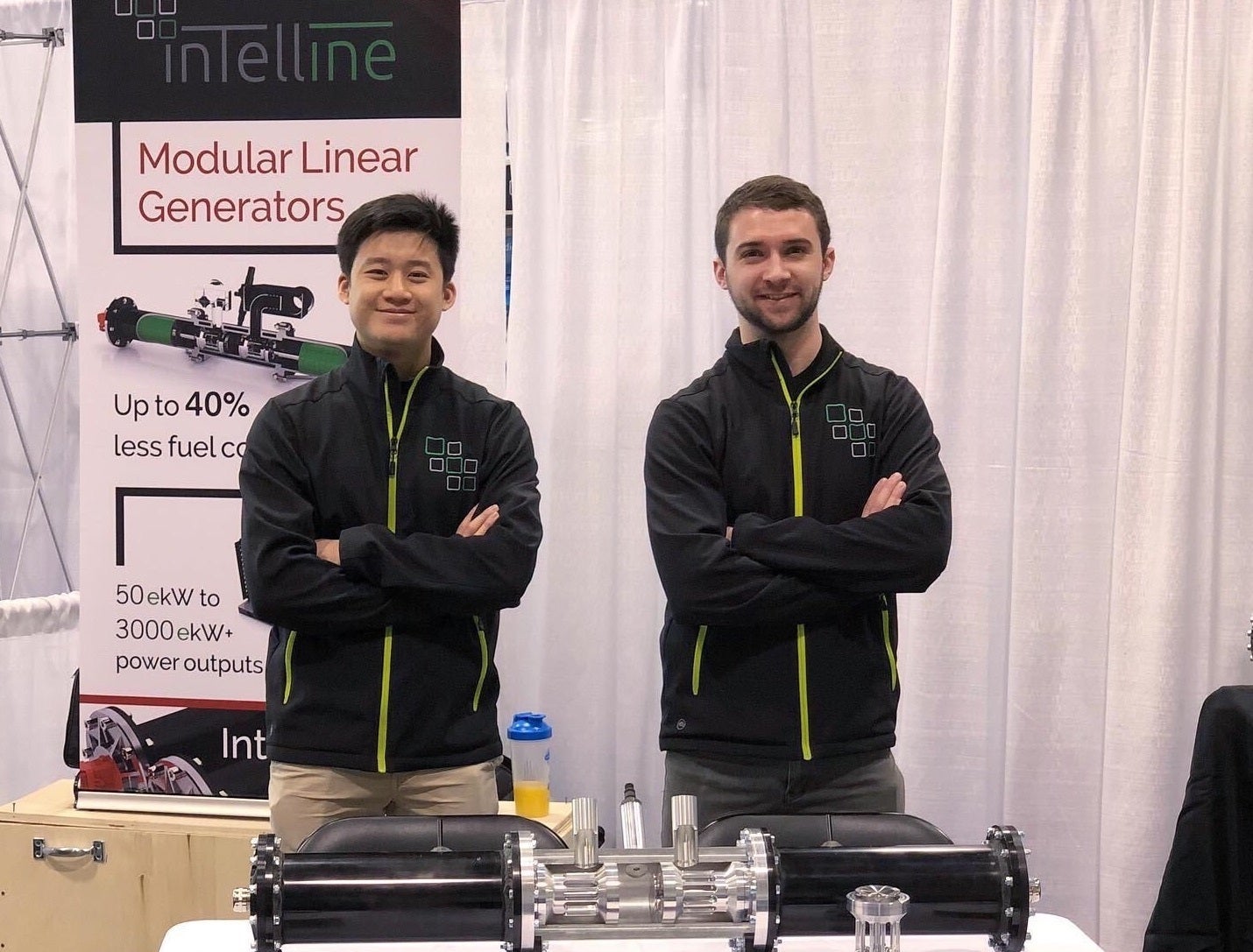
Their next stop for Intelline was the 2018 Velocity Fund Finals, where they picked up an extra $10,000 to help fund the hardware they needed to create a more affordable cryocooling system for commercial use. As they continued testing, their designs have evolved into a linear generator technology that can save fuel and significantly reduce greenhouse gas emissions.
Intelline’s diesel generators use 40 per cent less fuel and are propelling their business success. They showed off their technology to the mining industry at the annual Prospectors & Developers Association of Canada conference in March 2020, generating considerable interest from customers looking to save on costs. They project that the technology can save a mine operation $35 million a year.
The Intelline Modular Linear Generator (MLG) is modular, meaning that the units can be scaled to add generating capacity and grow with a business. The MLG is cost-competitive and more efficient, and it’s eliminated many of the moving parts found in traditional engines, resulting in a fivefold extension of the lifetime between rebuilds.
“Our generators are truly a direct replacement for traditional generators, making it easy for customers to make the switch to more efficient technology without having to invest heavily in new infrastructure, says Faller. “We want them to start using less diesel ASAP, but our technology is also designed to work with other fuel types without having to change the hardware."
Next year, the plan is to test a hybrid generator application, then in a rail vehicle as the team explores the possible applications of the MLG in a world where fleets traditional diesel and natural gas engines will require new, modern replacements.
“We imagine a future where mining operations, remote communities, ships, trains, and construction equipment are all powered by Intelline generators, and our products can become a driving force in the transition to sustainable zero-carbon fuels," says Faller.