
Policy 70 is one of those policies most students do not think about until they need it. When that moment comes, it can take some time to figure out where to begin.
As of June 1, 2026, Policy 70 has been updated. The revised version is organized differently from the previous one, with a stronger focus on defined pathways and step-by-step processes.
One of the most noticeable changes is how the policy is written. The language is more direct, and the steps are easier to follow. At the same time, this structure shifts more responsibility onto students to understand how the process works and to choose the appropriate pathway.
The most significant structural change is that Requests for Reassessment are now set out as a separate process, rather than being embedded within other pathways. This creates a clearer distinction between concerns about grading, fairness, and exceptions. It also means students are expected to identify the correct process at the outset.
Because of this shift, understanding the differences between petitions, grievances, and reassessment requests is more important than it may have been under the previous version of the policy.
This post breaks down each pathway, how it functions, and how to decide where your situation fits.
Petitions: Asking for an Exception
What a petition is under the new policy
A petition is used when a student is asking for an exception to a rule or requirement.
In this situation, the policy assumes that the rule itself was applied correctly. The question is whether there is a reason to make an exception in a specific case.
A petition is not about fairness or disagreement with a decision. It focuses on whether extenuating circumstances justify a different outcome.
When a petition is the appropriate path
A petition may apply when a student’s situation affected their ability to meet an academic requirement.
Examples include:
- illness during an exam or major assessment
- an unexpected disruption that affected performance
- a request to waive or adjust an academic rule
In each case, the student is not arguing that something was done incorrectly. The question is whether flexibility can be considered based on what occurred.
How the process is structured
Under the revised policy, the petition process is set out more directly.
In practice, it follows a sequence like this:
- Identify the requirement or regulation being requested for exception
- Describe the circumstances and how they affected your ability to meet that requirement
- Provide documentation where relevant
- Submit the petition through your Faculty
- Wait for a decision based on the information provided
What students should be aware of
Documentation and explanation are central. The decision depends on whether the circumstances support an exception.
Petitions are also more clearly distinguished from other processes. Where the concern is about fairness or how a decision was made, a grievance is generally more appropriate.
Deadlines
Petitions are time-sensitive, but they do not have a fixed deadline set out in the policy.
Instead, the expectation is that students act as soon as possible after they become aware of the issue. Waiting too long can affect how the request is assessed or whether it can proceed at all.
Grievances: Concerns About Fairness
What a grievance is under the new policy
A grievance is used when a student believes that a decision or action affecting their university experience was unfair or unreasonable.
The focus is on how something was done. The question is whether the process, decision, or application of a rule aligns with university policies and expectations.
When a grievance is the appropriate path
A grievance may apply when there is a concern about fairness or process.
Examples include:
- course policies not being applied consistently
- a decision that does not align with what was outlined in the syllabus
- concerns about how a process was followed
These situations involve questioning how a decision was reached, rather than asking for flexibility or disputing a grade directly.
How the process is structured
The revised policy places greater emphasis on sequence.
In practice, the process generally follows this structure:
- Attempt informal resolution, often with the instructor or unit involved
- If unresolved, submit a formal Notice of Grievance
- Clearly describe what occurred and why it is believed to be unfair
- Provide relevant documentation
- The Faculty reviews the grievance and issues a decision
What students should be aware of
There is an expectation that informal resolution is attempted first, where appropriate.
Grievances are also more clearly distinguished from other pathways. This reduces some of the ambiguity that existed previously, but it means students need to identify early whether the issue is about fairness, grading, or an exception.
Deadlines
Grievances have defined timelines.
A formal Notice of Grievance must be submitted within 20 working days of the decision or issue being challenged. The timeline begins when the student becomes aware of the issue.
After that point, the grievance may not be accepted.
Informal discussions do not pause this timeline, so it is important to keep track of how much time has passed.
Requests for Reassessment: Asking for a second look
What a reassessment request is under the new policy
Requests for Reassessment are now a distinct pathway within Policy 70.
This is the most significant structural change. It separates concerns about grading from broader issues about fairness or exceptions.
A reassessment request is used when a student believes their academic work was not evaluated correctly.
When a reassessment request is the appropriate path
This pathway applies when the concern is directly related to how work was assessed.
Examples include:
- an error in calculation or totaling marks
- grading that does not align with the stated criteria
- inconsistency in how evaluation standards were applied
The focus is on the application of grading criteria, not on fairness more broadly or on requesting flexibility.
How the process is structured
The revised policy presents reassessment as a clearer, step-by-step process:
- Review feedback and grading criteria
- Raise the concern with the instructor
- Clearly explain what appears to be incorrect
- If unresolved, submit a formal request
- The work is reviewed and a decision is issued
What students should be aware of
This process focuses on whether the assessment was carried out correctly, not on whether a higher grade should be assigned.
As a result, grading concerns now follow a more defined pathway. Students need to identify early when reassessment is the appropriate route rather than using a grievance.
Deadlines
Reassessment timelines are more immediate than petitions and similar to, or shorter than, grievances.
- The concern should be raised with the instructor within about one month of receiving the grade
- A formal request must be submitted within 10 working days of the instructor’s response, or when a response would reasonably be expected
These timelines move quickly, which makes early review and follow-up important.
Which Path Should You Choose?
When you look at Policy 70 for the first time, the most difficult part is often knowing where to begin.
This decision tree is designed to help identify the right starting point based on the type of concern.
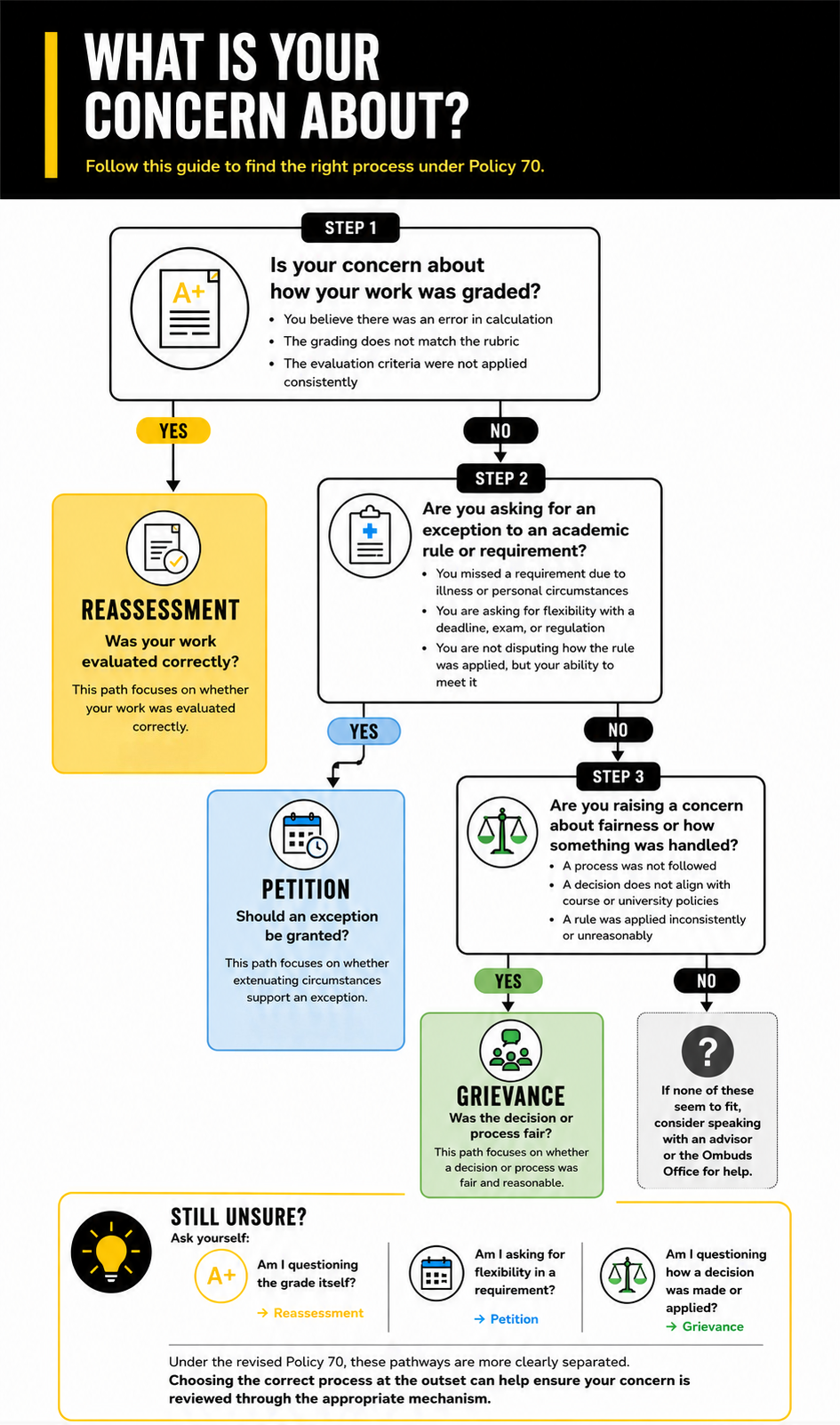
Image generated using ChatGPT
Policy 70 does not change what students can raise concerns about. What has changed is how those concerns are organized and how each pathway is applied.
The revised structure makes it easier to identify where an issue fits. At the same time, it places more responsibility on students to choose the correct path and act within the timelines.
If you find yourself navigating Policy 70, start by asking:
- Is this about how something was graded
- Is this about needing an exception
- Is this about how a decision was made
Once that is clear, the process becomes much more manageable.