During your time as a student, you may experience circumstances that affect your academic performance, encounter a decision you believe was unfair, or question how your academic work was assessed.
At the University of Waterloo, Policy 70 provides three distinct processes for addressing these concerns: a Petition for Exception to Academic Regulations (petition), a Grievance, and a Request for Reassessment. Each process serves a different purpose and has its own requirements, timelines, and potential outcomes.
- A petition is used when University or Faculty rules were applied appropriately, but extenuating circumstances may warrant an exception to those rules.
- A grievance is used when a student believes that a decision or action affecting their University experience was unfair or unreasonable.
- A request for reassessment is used when a student believes that an assignment, test, examination, or other academic work was assessed incorrectly.
Before starting a process, it is important to identify the nature of your concern and determine which pathway best fits your circumstances. The examples below are intended as a guide and are not exhaustive.
Remember: Concerns that are under Policy 33 - Ethical Behaviour follow the procedure listed in Policy 33.
Petition
A petition is a request for an exception to a University or Faculty rule, regulation, or academic requirement because of extenuating circumstances. A petition may be appropriate when the rule was applied correctly, but circumstances beyond your control prevented you from meeting the requirement.
Examples
A petition may be appropriate if you are seeking:
- To add or drop a course after the deadline.
- Reconsideration of an academic standing or other academic decision.
- Reconsideration of an aspect of your academic record.
- An exception to a Faculty or University academic regulation because of extenuating circumstances.
- Reconsideration of certain Co-operative and Experiential Education decisions, such as co-op credit eligibility, work term status, or access to WaterlooWorks.
Petition Grounds
Petitions are typically based on extenuating circumstances. These are generally situations that were beyond your control and could not reasonably have been predicted or prevented. Common examples include:
- Medical or health concerns.
- Unexpected family responsibilities or emergencies.
- Bereavement.
- Significant personal circumstances that affected your ability to meet academic requirements.
A pettion cannot
A petition cannot normally be used to:
- Change a grade simply because you disagree with the assessment.
- Request that academic work be re-evaluated.
- Raise concerns about unfair or unreasonable treatment.
- Address matters governed by other University policies, such as complaints under Policy 33.
Grievance
A grievance is a process used when a student believes that a decision, action, or omission affecting some aspect of their University experience was unfair or unreasonable. A grievance focuses on how a decision was made, how a process was followed, or whether a policy, procedure, or expectation was applied appropriately.
Examples
A grievance may be appropriate if you believe:
- A University policy, procedure, or course requirement was applied inconsistently.
- A decision affecting your University experience was unfair or unreasonable.
- An established process was not followed appropriately.
- Information outlined in a course syllabus or other official document was not followed without reasonable justification or notice.
- You experienced unfair treatment in relation to an academic or non-academic decision that falls within the scope of Policy 70.
Grounds for a grievance
Grievances are typically based on concerns that a decision or action was:
- Unfair: the process, interaction, or outcome was procedurally, relationally, or substantively unfair.
- Unreasonable: the decision or action departed from established policies, procedures, expectations, or normal practice without appropriate justification.
- Inconsistent: similar situations were treated differently without a reasonable basis for doing so.
A grievance cannot
A grievance cannot normally be used to:
- Request an exception to a Faculty or University rule because of extenuating circumstances. A petition may be the appropriate process.
- Seek a re-evaluation of academic work based on concerns about grading or assessment. A Request for Reassessment may be the appropriate process.
- Address matters governed by other University policies, including complaints related to harassment, discrimination, or sexual violence that fall under Policies 33 or 42.
Request for Reassessment
A Request for Reassessment is a process used when a student believes that an assignment, test, examination, or other academic work was assessed incorrectly. A reassessment focuses on whether the evaluation was conducted appropriately and whether the stated grading criteria, expectations, and standards were applied correctly.
Examples
A Request for Reassessment may be appropriate if you believe:
- An assignment, test, or examination was graded in error.
- The grading does not align with the stated evaluation criteria or rubric.
- There was an error in the calculation or recording of a grade.
- Established grading standards were applied inconsistently.
- An assessment departed from course or institutional expectations.
Grounds for a request for reconsideration
Requests for Reassessment are typically based on concerns that:
- There was a demonstrable error in the assessment.
- The assessment was inconsistent with stated evaluation criteria.
- Established grading standards were not applied appropriately.
- The assessment departed from course or institutional expectations.
A request for reassessment cannot
A Request for Reassessment cannot normally be used to:
- Request an exception to a Faculty or University rule because of extenuating circumstances.
- Challenge the fairness or reasonableness of a decision, action, or process.
- Seek a higher grade simply because you are dissatisfied with the result. The purpose of a reassessment is to determine whether the work was assessed correctly.
Which process fits your situation?
One of the most challenging parts of Policy 70 is determining which process applies to your circumstances. While petitions, grievances, and requests for reassessment may seem similar, each process is designed to address a different type of concern. Use the decision tree below to help identify the pathway that best fits your situation.
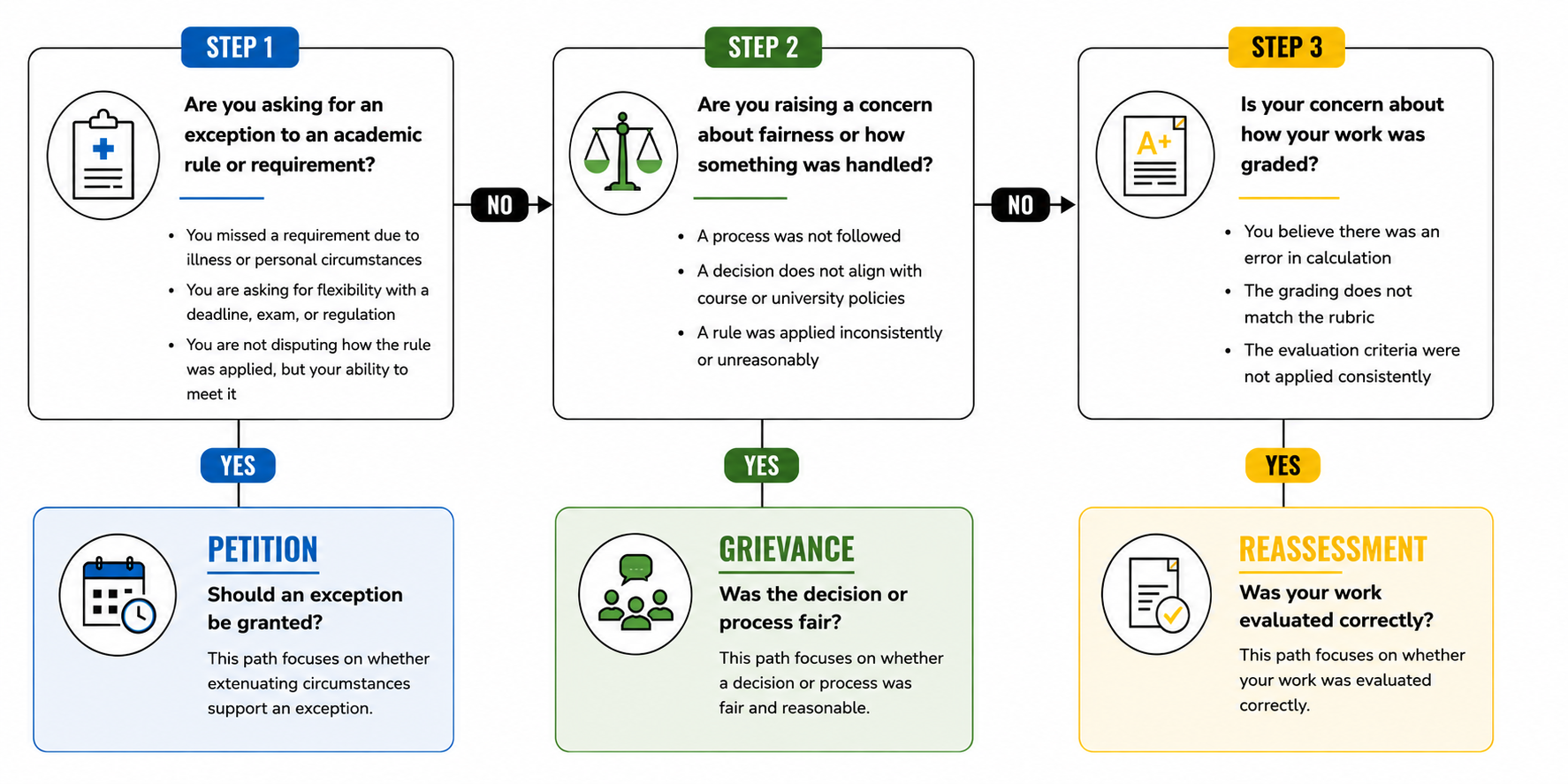
Once you have identified the appropriate process, the next section outlines the steps to get started.
Starting a Petition
1. Identify the outcome you are seeking
Be clear about the exception you are requesting and the academic requirement, regulation, or deadline it relates to.
2. Gather supporting documentation
Collect documentation that supports your circumstances and explains how they affected your ability to meet the requirement.
3. Complete the petition form
Undergraduate and graduate students use separate petition forms. Be prepared to explain your circumstances, their impact, and the outcome you are requesting.
4. Await a decision
Your petition will be reviewed by the appropriate Petitions Committee. You may be contacted if additional information is required.
Starting a Grievance
1. Attempt informal resolution
Where appropriate, raise your concern with the person, office, or department involved. Many concerns can be resolved through conversation, clarification, or additional information.
2. Identify your concern and desired outcome
Be prepared to explain the decision, action, or process you are concerned about, why you believe it was unfair or unreasonable, and what outcome you are seeking.
3. Submit a Notice of Grievance
If the concern remains unresolved, complete and submit a Notice of Grievance along with any supporting documentation.
4. Await a decision
Your grievance will be reviewed by the appropriate decision-maker and a decision will be communicated to you.
Starting a Request for Reassessment
1. Review the assessment
Carefully review the grading criteria, rubric, course expectations, and any feedback you received. Identify the specific aspect of the assessment you believe was evaluated incorrectly.
2. Discuss your concerns with the instructor
Raise your concern with the instructor and explain why you believe the assessment may contain an error or may not align with the stated evaluation criteria.
3. Submit a Request for Reassessment
If your concern remains unresolved, complete and submit a Request for Reassessment. Be prepared to explain the basis for your request and provide any supporting information.
4. Await the outcome
The assessment will be reviewed according to the procedures outlined in Policy 70 and the outcome will be communicated to you.
Timelines
Policy 70 includes deadlines for grievances and requests for reassessment. Meeting these deadlines is an important part of the process and helps ensure concerns are addressed in a timely manner.
Petition
Petitions do not have a specific deadline under Policy 70. However, students are encouraged to submit their petition as soon as possible after becoming aware of the issue or circumstances giving rise to the request. Delays may affect the availability of information, documentation, or potential remedies.
Grievance
A formal Notice of Grievance must normally be submitted within 20 working days of the decision, action, or matter being challenged, or from when the student became aware of it. Informal discussions do not stop or extend this timeline.
Request for Reassessment
Students should raise concerns about an assessment with the instructor as soon as possible. If the concern remains unresolved, a formal Request for Reassessment must normally be submitted within 10 working days of the instructor's response, or when a response would reasonably be expected.
Remember: If you are considering a grievance or request for reassessment, review the applicable timelines in the policy early. Waiting too long may affect your ability to proceed with the process.
Appeals and Policy 70
An appeal is not the same as a petition, grievance, or request for reassessment. Appeals are governed by Policy 72 and are generally available only after a student has exhausted the applicable process under Policy 70.
When might an appeal be appropriate?
An appeal may be appropriate when a student believes there was:
- A procedural error in the decision-making process.
- New information that was not reasonably available at the time the original decision was made.
- Another ground for appeal recognized under Policy 72.
Can all Policy 70 decisions be appealed?
Not necessarily.
- Decisions made through the grievance process may be appealed in accordance with Policy 72.
- Decisions made through a request for reassessment may be appealed in accordance with Policy 72.
- Petition decisions cannot be appealed; however, a petition may be reconsidered if new information becomes available that could affect the original decision.
Learn more
For information about appeals, including timelines, grounds for appeal, and the appeal process, visit the Appeals page.
Need help?
Understanding University policies and procedures can be challenging, particularly when you're dealing with a stressful situation.
There are several resources available to help you understand Policy 70, explore your options, and prepare to engage in the appropriate process:
- Your Academic Advisor (undergraduate students) or Graduate Coordinator (graduate students) can help you understand academic requirements, procedures, and the potential implications of a request.
- Centre for Academic Policy Support (CAPS) can assist undergraduate students in understanding academic policies and procedures.
- Graduate Student Association (GSA) can provide graduate students with information, guidance, and support.
- Connect with a staff member in the Office of the Ombudsperson. We can help you think through your individual circumstances, understand your options, prepare for meetings or submissions, and discuss strategies for navigating a process.
You do not need to have everything figured out before seeking advice. Sometimes a conversation can help clarify which process is most appropriate for your situation