Conflict is a normal part of working, learning, and living in a university community. It can arise from unclear expectations, different perspectives, communication breakdowns, competing needs, or concerns about how a decision or interaction was handled.
Conflict does not always mean that someone has done something wrong. It does mean that something may need attention. Addressing concerns early, when it is appropriate and safe to do so, can prevent misunderstandings from becoming more difficult and can create space for clarification, accountability, and repair.
The Office of the Ombudsperson provides a confidential, impartial, and independent place for students to talk through a conflict, understand their options, and decide what approach makes sense for them.
Understanding the conflict
Before deciding what to do, take a moment to identify what is at the centre of the conflict. Ask yourself:
- What happened? Focus on the specific words, actions, decisions, or events you observed.
- What impact did it have? Consider how the situation affected your studies, work, well-being, relationships, or ability to participate.
- What matters most to you? You may be looking for information, acknowledgement, changed behaviour, a corrected decision, clearer expectations, or another outcome.
- Who has the ability to address the concern? This may be the person directly involved; an instructor, supervisor, department, residence staff member, or another University office.
- Is there a policy or deadline that applies? Informal conversations do not necessarily pause formal timelines.
You do not need to know exactly what happened or what outcome is possible before asking for help. Talking with an impartial resource can help you organize the situation and identify realistic next steps.
Fairness check
The Fairness Triangle can help you examine a conflict from three perspectives:
- Procedural fairness: Was there a clear and fair process?
- Relational fairness: Were you treated respectfully and given understandable information?
- Substantive fairness: Was the decision or outcome reasonable?
Choosing a way forward
There is no single correct way to respond to conflict. The most appropriate option depends on the circumstances, the relationship, any power imbalance, applicable University policies, and what you hope will change.
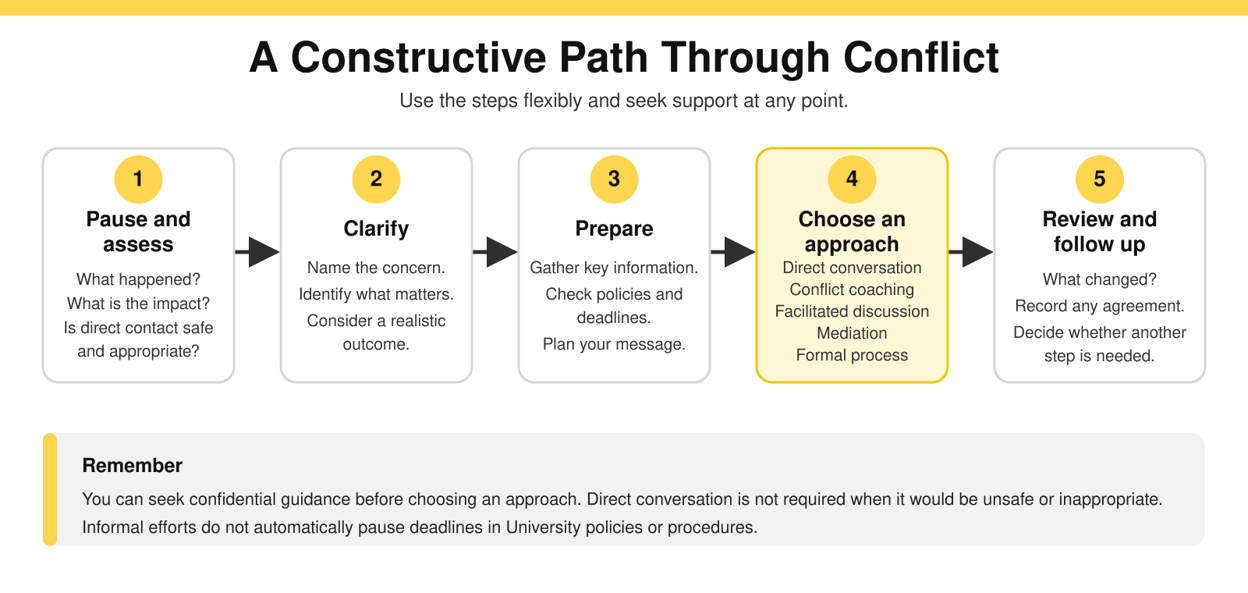
The steps are flexible. You may move between them, return to an earlier step, or seek support before deciding whether to communicate directly.
If a University process has a deadline, protect that deadline while you explore informal options.
Preparing for a constructive conversation
If a direct conversation is appropriate, preparation can help you communicate clearly and reduce the chance of the discussion becoming more difficult.
Before the conversation
- Choose a time and setting that allows for privacy and enough time to talk.
- Identify one or two main concerns rather than trying to address every past difficulty at once.
- Separate what you observed from what you assume about the other person's intentions.
- Decide what you would like the other person to understand and what you are asking them to do.
- Consider how you will respond if the conversation becomes unproductive. It is okay to pause and return to the discussion later.
During the conversation
A simple structure is observation, impact, and request:
- Observation: Describe the specific situation without assigning motive.
- Impact: Explain how it affected you or the work you were trying to do.
- Request: Ask for a clear and realistic next step.
For example:
“When the project responsibilities changed after our meeting, I was unsure which tasks I was expected to complete. That made it difficult for me to meet the deadline. Could we confirm the responsibilities and deadlines in writing after today’s conversation?”
Try to leave room for the other person’s perspective. Listening does not require you to agree. You can acknowledge what you heard, ask a clarifying question, and still explain where your understanding differs.
When a direct conversation may not be appropriate
You are not required to address every conflict directly with the other person. A direct conversation may not be appropriate when:
- You are concerned about your safety or possible retaliation.
- There is a significant power imbalance that makes direct communication difficult.
- The concern involves possible harassment, discrimination, gender-based or sexual violence, threats, or other serious conduct.
- Previous attempts to address the concern have not helped or have made the situation worse.
- Contact has been restricted, or another University process is already underway.
- A policy requires the concern to be raised with a particular person or office.
In these situations, consider seeking confidential advice before taking further action. The Conflict Management Office, the Office of the Ombudsperson, or another appropriate University resource can help you understand available options. If there is an immediate safety concern, contact emergency services or the University’s Special Constable Service.
Informal conflict-management options
Informal resolution does not mean that a concern is unimportant. It means that the people involved are exploring whether the concern can be addressed without a formal decision-making process.
Self-directed conversation
The people involved communicate directly to clarify what happened, discuss impact, and identify possible next steps. This may happen in person or in writing.
Conflict coaching
A neutral professional helps you understand the conflict, prepare for a conversation, consider different perspectives, and develop a plan. Conflict coaching does not require the other person to participate.
Facilitated conversation
A neutral person supports a structured conversation so that each participant can explain their perspective, identify concerns, and discuss possible next steps. The facilitator does not decide who is right or impose an outcome.
Mediation
Mediation is a voluntary process in which an impartial mediator helps participants communicate and explore whether they can reach a mutually acceptable agreement. The participants—not the mediator—decide whether to agree and what any agreement will include.
Formal University process
Some concerns may need to be addressed through a formal policy or procedure. A formal process may involve a written complaint or request, information gathering, an opportunity for affected people to respond, and a decision by an authorized decision-maker. The appropriate process depends on the nature of the concern.
The Ombuds Office can help you identify whether a policy may apply, but it does not receive formal complaints or make decisions for the University.
Informal and formal options: what is the difference?
Informal options |
Formal processes |
|
Usually voluntary and flexible |
Follow a defined policy or procedure |
|
Focus on communication, understanding, and possible agreement |
Focus on determining or reviewing an issue and reaching an authorized decision |
|
Participants retain control over whether to agree |
A designated person or body may determine the outcome |
|
May include coaching, facilitated discussion, or mediation |
May include a grievance, complaint, investigation, petition, reassessment, discipline process, or appeal |
|
Do not necessarily pause formal deadlines |
Include specific requirements and may include strict timelines |
Informal and formal options are not always mutually exclusive. In some situations, an informal approach can occur before or alongside a formal process. Always check the applicable policy and confirm how an informal effort may affect your rights, responsibilities, or timelines.
How the Ombuds Office can help
The Office of the Ombudsperson is independent, impartial, and confidential. We can:
- Listen to your concerns and help you identify the main issues.
- Help you understand relevant University policies, procedures, rights, and responsibilities.
- Explore informal and formal options without directing you toward a particular choice.
- Help you prepare for a difficult conversation, meeting, or written communication.
- Discuss what outcomes may be possible and reasonable.
- Consider the situation through a procedural, relational, and substantive fairness lens.
- Facilitate communication or explore mediation options.
- Refer you to the Conflict Management Office or another University resource when their services are a better fit.
We do not take sides, make findings of misconduct, impose solutions, provide legal advice or counselling, or replace the University decision-maker responsible for a formal process.
Need help?
Conflict can be stressful, especially when the situation affects an important academic, professional, or personal relationship. You do not need to have the problem or the solution fully figured out before asking for advice. There are several resources available to help you understand your options and prepare for a next step:
- The Conflict Management Office provides confidential conflict coaching, support with difficult conversations, mediation, and guidance when a formal resolution process is being considered.
- Our Navigating Concerns guide can help you organize a concern and prepare to raise it.
- The Support Person – Advocacy versus Support page explains how someone may support you in a meeting or process.
- Connect with a staff member in the Office of the Ombudsperson. We can help you think through your circumstances, understand University processes, prepare for communication, and consider fair and reasonable options.
Sometimes, a confidential conversation is the best place to begin.