Guest post by Chelsea Uggenti, Assistant Professor, Teaching Stream, Statistics and Actuarial Science (cuggenti@uwaterloo.ca)
At this year’s Western Conference on Science Education (WCSE) in London, ON, the theme was “sustainable learning”. WCSE defined sustainable learning as efficient and effective ways of furthering quality science education while prioritizing our own well-being. I was struck by how many sessions addressed well-being directly – ranging from supporting new faculty to navigating mid-career challenges and exploring work-life balance.
One session that stood out was a workshop on work-life balance, led by Christina Booker, an Assistant Professor and Teaching Scholar at Western University. Christina began by inviting participants to define the term work-life balance for themselves, revealing a wide range of personal interpretations. She then introduced a more holistic concept: work-life integration.
Christina shared insights from the paper by Chauhan and Rai (2024) which offers a comprehensive model of work-life integration grounded in a review of 116 scholarly articles. Their framework, designed for both professionals and academics, outlines five domains: one work-related and four non-work-related (see Figure 1).
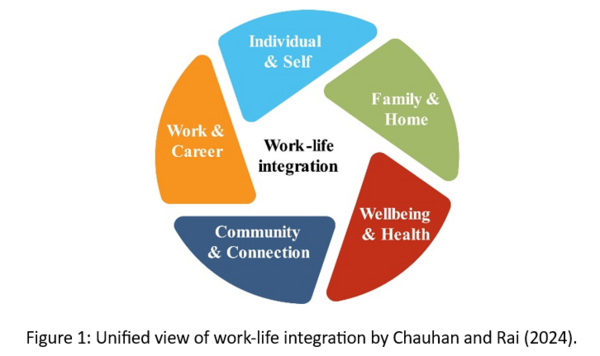
One domain that resonated with me was “Individual & Self.” In academia, we often prioritize others – students, colleagues, family – at the expense of our own needs. These needs might be met through family time, community engagement, or even solitary reflection. Yet this domain continues to be forgotten or neglected, despite its essential role in sustaining well-being.
What was my main takeaway from this workshop? A deeper appreciation for the complexity of work-life dynamics and the integration of the individual/self, well-being, and community connections.
Chauhan, P., & Rai, S. (2024). Conceptualizing work-life integration: A review and research agenda. Asia Pacific Management Review, 29(4), 415-426.
