
Kirsten Nickel
Research Interests
Kirsten completed her BSc at McMaster University and joined the Servos Lab for her MSc, where she developed strong expertise in aquatic ecotoxicology and wastewater-based environmental monitoring. She is experienced in a wide range of field and laboratory techniques, including backpack electrofishing, fish identification and dissection, stable isotope analysis (δ¹³C and δ¹⁵N), enzyme-linked immunosorbent assays (ELISA), histology, and qPCR, which she used to assess contaminant exposure and reproductive health endpoints in fish.
Her work has focused on linking wastewater treatment plant upgrades to biological responses in aquatic organisms, particularly endocrine and reproductive effects in rainbow darter in the Grand River. She has also contributed to applied public health surveillance through wastewater-based COVID-19 monitoring and is currently a Research Associate with Prof. Heidi Swanson at Wilfrid Laurier University.
MSc (Graduated Sep. 2020)
Kirsten completed her MSc in the Servos Lab, focusing on the effects of municipal wastewater effluent on rainbow darter (Etheostoma caeruleum) in the Grand River. Her research built on long-term studies showing that fish downstream of wastewater treatment plants exhibit multiple signs of endocrine disruption, including altered vitellogenin expression, reduced in vitro steroid production, and increased incidence of intersex. These effects were largely associated with exposure to estrogenic compounds in treated effluent.
Previous work in the system demonstrated that upgrades to the Kitchener wastewater treatment plant led to improved effluent quality and partial recovery in several biological endpoints in rainbow darter. Kirsten’s MSc extended this work by examining whether similar responses occurred following subsequent upgrades to the Waterloo wastewater treatment plant (2017–2018), providing an opportunity to assess recovery across multiple facilities within the same watershed.
She compared upstream and downstream fish collected before and after the Waterloo upgrades using a multi-endpoint approach. Stable isotope analysis (δ¹³C and δ¹⁵N) was used to assess differences in energy sources and exposure pathways, in vitro steroid production assays were used to evaluate endocrine function (including testosterone and 11-ketotestosterone production), and histological analysis was used to assess intersex severity and gonadal condition.
Her results showed that following upgrades, downstream fish at the Waterloo WWTP exhibited partial recovery toward upstream reference conditions in key endocrine and physiological endpoints, although the magnitude of recovery was less pronounced than that previously observed at the Kitchener facility. Considerable spatial and temporal variability among sites, including reference locations, also highlighted the influence of broader environmental factors such as seasonal variation, flow conditions, and other watershed inputs in shaping biological responses.


Technician
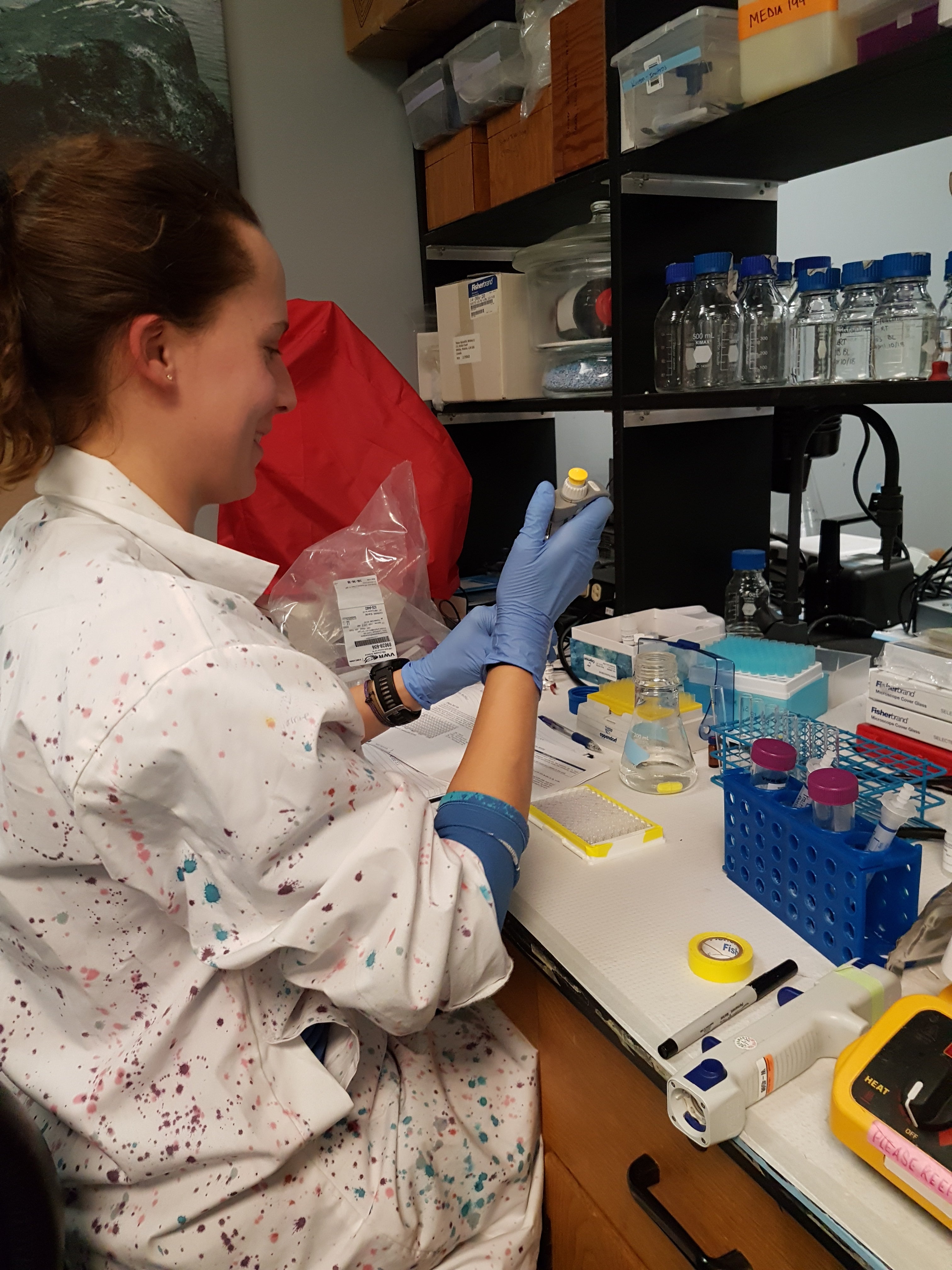
Kirsten also worked in the Servos Lab as a Wastewater Technician supporting COVID-19 wastewater-based surveillance across multiple regions in Ontario. In this role, she contributed to the full analytical workflow, including sample receipt and processing, RNA extraction, qPCR analysis, and generation of data for public health reporting.
She supported the production of consistent, high-quality surveillance data during the COVID-19 pandemic and contributed to maintaining standardized laboratory workflows across ongoing monitoring programs.

