
Nivetha Srikanthan
Research Interests
Nivetha joined the Servos Lab as an undergraduate work-study student, where she quickly became involved in multiple aspects of laboratory research. Following the completion of her BSc in Biochemistry at the University of Waterloo, she continued with the group to pursue her MSc, developing strong expertise in both analytical chemistry and molecular biology.
After completing her MSc, she initially returned to the lab as a technician focused on analytical chemistry. At the onset of the COVID-19 pandemic, she was among the first to establish wastewater-based surveillance workflows in the lab, playing a key role in developing and optimizing early analytical methods for SARS-CoV-2 detection in wastewater. She went on to serve as COVID-19 Project Manager, where she led the expansion of surveillance operations and contributed significantly to method development, implementation, and ongoing monitoring efforts. Nivetha later moved on to a research position at the University of Toronto Scarborough, continuing her work in environmental and analytical sciences.

MSc (Graduated Sep. 2019)
Nivetha completed her MSc in the Servos Lab, where she studied temporal changes in estrogenic compounds released from municipal wastewater treatment plants in southern Ontario. Her research focused on the Grand River watershed, the largest watershed in southern Ontario, which receives effluent from numerous WWTPs, including the major Kitchener and Waterloo facilities. These plants had recently undergone upgrades aimed at improving nitrification and overall effluent quality, providing a unique opportunity to assess changes in contaminant profiles before and after upgrades. She also examined a broader set of secondary treatment plants across southern Ontario to compare influent and effluent composition and evaluate variability in contaminant removal performance.
Using chemical analyses of pharmaceuticals and estrogens, her research assessed compound-specific behaviour during wastewater treatment. Results showed strong removal of compounds such as ibuprofen and naproxen across all plants, while more recalcitrant pharmaceuticals such as carbamazepine and venlafaxine persisted through treatment. Among estrogens, estriol was consistently reduced, whereas 17α-ethinylestradiol showed little change post-treatment. Other estrogens, including estrone and 17β-estradiol, showed variable reductions influenced by treatment conditions, particularly nitrification. Overall estrogenicity was generally reduced following treatment, especially in systems with effective nitrification.
Her findings highlighted that nitrification was associated with improved removal of several non-target compounds and reductions in total estrogenic activity, consistent with patterns observed at upgraded WWTPs in the Grand River. This work demonstrated the importance of understanding treatment-specific processes when evaluating contaminant fate, and provided insight into how wastewater upgrades influence both chemical composition and potential biological effects in receiving waters.


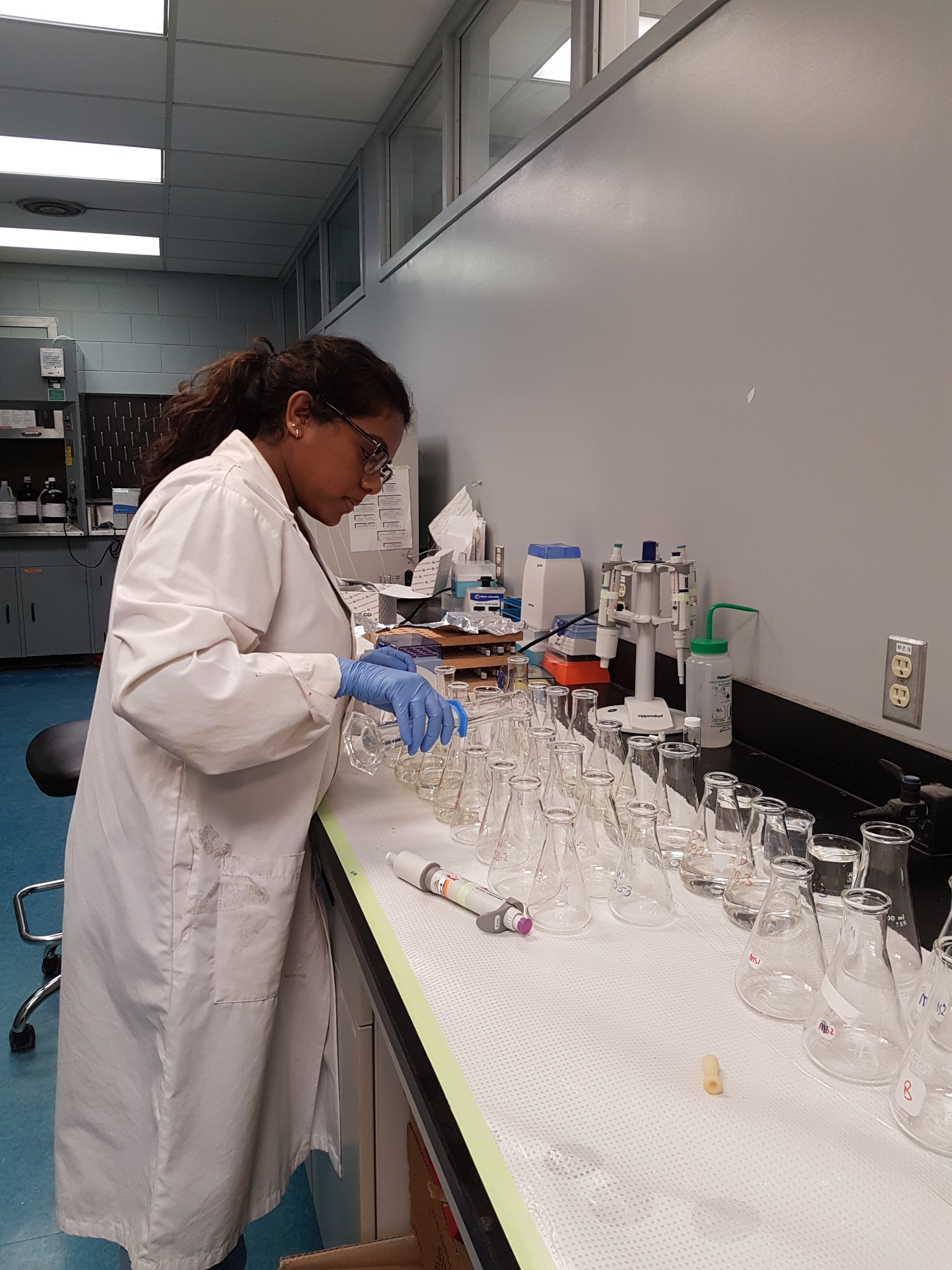

COVID-19 Project Manager
During the COVID-19 pandemic, Nivetha served as the first COVID-19 Manager in the Servos Lab, where she played a foundational role in establishing wastewater-based surveillance for SARS-CoV-2. She was instrumental in developing and optimizing the initial laboratory workflows for the extraction and analysis of viral RNA from wastewater, rapidly building robust and reproducible methods during the early stages of the program. The SOPs and analytical frameworks she established continued to guide and support all subsequent COVID-19 managers in the lab.
Her role included overseeing and coordinating all stages of the analytical workflow, from organizing sample collection and delivery to campus through to sample processing, RNA extraction, and qPCR-based detection of SARS-CoV-2. She maintained a strong focus on consistency, quality control, and continuous method refinement as the program expanded. She also led the implementation of laboratory biosafety protocols required for safe handling of wastewater samples during the pandemic, ensuring compliance with evolving guidelines and supporting safe and effective laboratory operations.
In addition, she played a key role in data interpretation and reporting, often working late into the night with the team to support the rapid turnaround times required during the fast-moving pandemic. She regularly participated in meetings with municipal partners and stakeholders, contributing to coordination of surveillance activities and supporting clear communication of findings across collaborating organizations.

