Research Interests
Samina has contributed to the Servos Lab across multiple roles over several years, beginning as a work study student and later returning in both technical and project support capacities. Her experience spans environmental research, wastewater-based surveillance, and fish ecology studies, with hands-on involvement in laboratory operations, field programs, fish aging, and data-supported research activities.
Samina first joined the Servos Lab as a work study student, where she gained foundational experience in environmental research and laboratory operations, including routine sample handling and support for aquatic field and laboratory studies.
She later returned as a project manager and research technician supporting SARS-CoV-2 wastewater-based surveillance during the COVID-19 pandemic. In this role, she contributed to the coordination and execution of laboratory workflows, including wastewater sample processing, RNA extraction, and RT-qPCR-based detection of viral targets, supporting routine surveillance reporting and public health decision-making.
Following her wastewater surveillance work, Samina transitioned to a biology technician position within the lab, supporting a range of aquatic and fish ecology research projects. In addition to laboratory and field support, she played a key role in fish aging and growth-related studies, including otolith collection and preparation for age determination, as well as contributing to a major fish community assessment project in McKenzie Creek in collaboration with Six Nations of the Grand River. This work involved field sampling, fish community characterization, and coordination of field activities, contributing to broader ecosystem health assessments in the watershed.

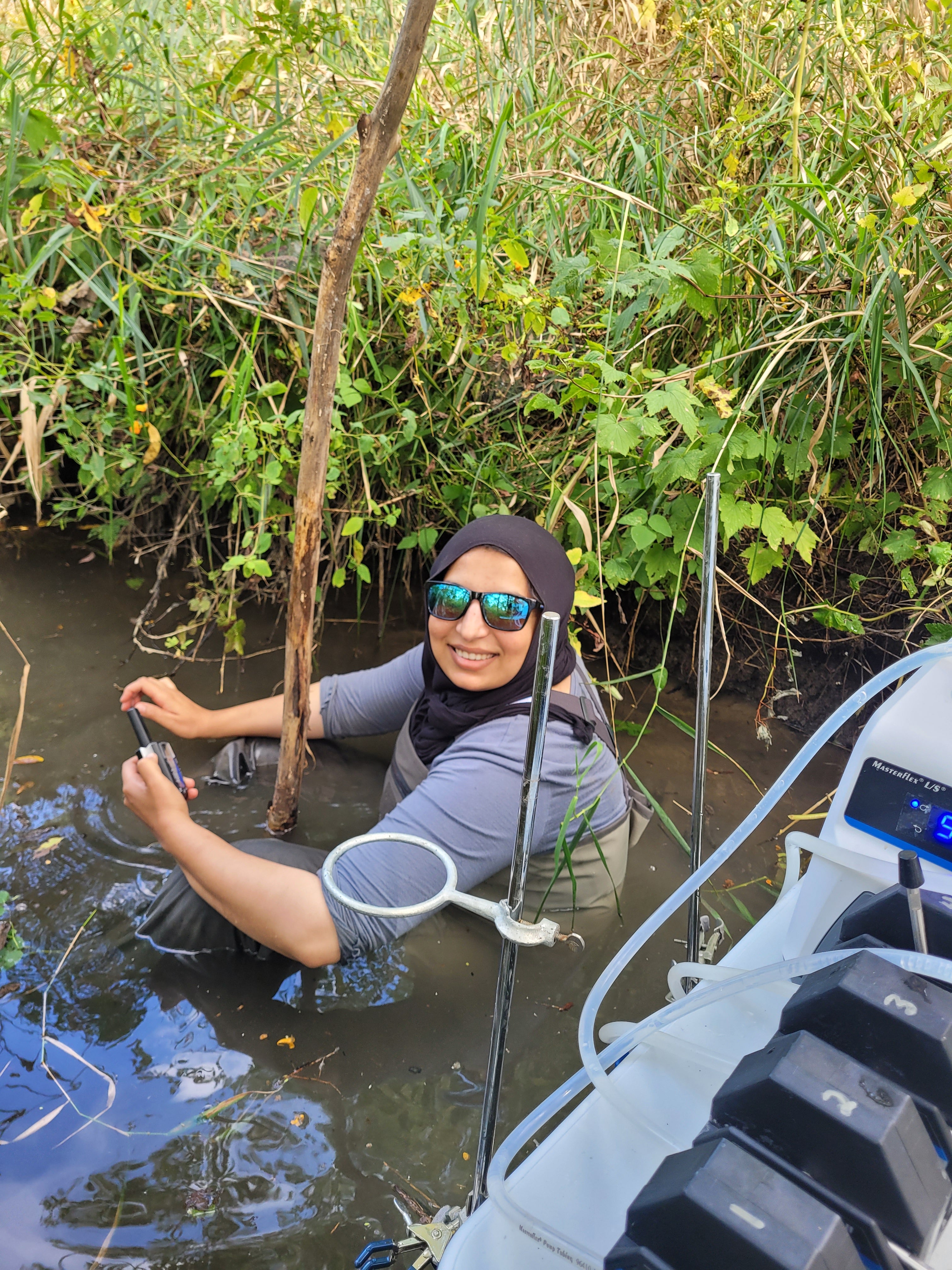
MSc (Graduated Fall 2020)
Samina’s MSc research examined growth in rainbow darter (Etheostoma caeruleum) in the Grand River watershed as a population-level indicator of environmental condition in an urbanized system. Her work focused on fish collected upstream and downstream of the Waterloo wastewater treatment plant, evaluating changes in growth before and after major infrastructure upgrades completed in 2017 that improved effluent quality.
Fish were collected across multiple years, with measurements of length, weight, liver and gonad mass, and otoliths used for age determination. Growth was characterized using von Bertalanffy growth modelling, somatic indices, and back-calculation methods to reconstruct historical length-at-age relationships and improve resolution of growth estimates.
The study identified clear sex-based differences in growth, with males generally exhibiting faster growth and larger size-at-age compared to females. Spatial and temporal variation in growth and somatic indices was observed across sites and years, including some increases following wastewater treatment upgrades; however, no strong or consistent treatment-specific effect was detected. Overall, the research highlighted the value of growth-based metrics and back-calculated age–growth models as sensitive tools for detecting subtle population-level responses in small-bodied fish within urban freshwater ecosystems.
