Waterloo researchers make a significant step towards reliably processing quantum information
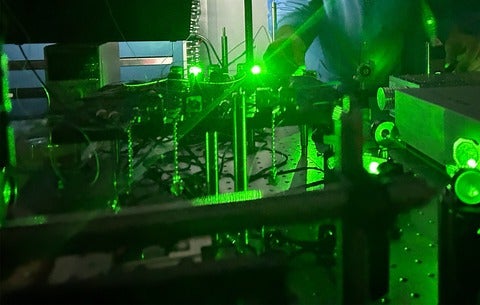
New optical system designed to target and control individual atoms.
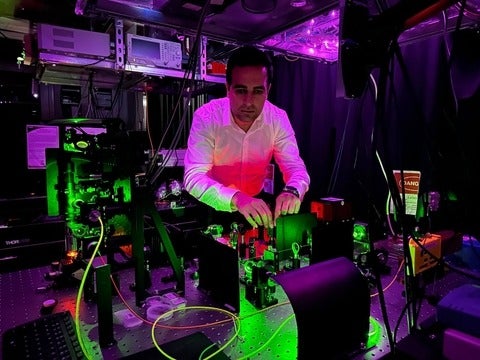
Olivia Woodman and Abdolreza Pasharavesh, graduate students at IQC, together with Dr. Michal Bajcsy and Dr. Christopher Wilson, faculty members at IQC and Waterloo’s Department of Electrical and Computer Engineering, have developed a promising model to detect microwave photons by making use of the light-sensitive properties of a point defect found in the lattice structure of diamond.
Dr. Lai-Tze Fan wants to make a more equitable AI.
Connor Kapahi of Entangled Vision, who is a PhD candidate for Physics in Quantum Information, explained how age-related macular degeneration (AMD) — the leading cause of blindness in people over the age of 60 years old — has existing treatments that can effectively slow and stop vision loss. But there are no treatments which can reverse vision loss once a patient is diagnosed with AMD.
Waterloo Physics and Astronomy’s Prof. Bizheva leads a research group hoping to change this and allow doctors to detect and treat corneal diseases early, before the cloudy veil of late-stage degeneration robs patients of their vision.
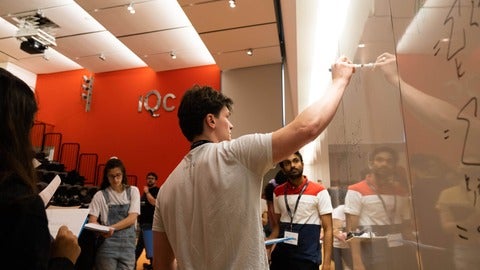
The 14th annual Undergraduate School on Experimental Quantum Information Processing (USEQIP) was in full swing over the last two weeks at the Institute for Quantum Computing (IQC).
In the first allocation of this funding, announced today by NSERC, many faculty members, affiliates, and alumni of the Institute for Quantum Computing (IQC) are leading or collaborating on projects receiving support.
Improving thermal medical imaging of the eye with a new quantum camera and developing new materials to enable “beyond 5G” wireless communications are among the goals of six projects recently supported by the Quantum Quest Seed Fund (QQSF).