Conventional superconductors have trouble performing well in magnetic fields required for electron spin resonance (ESR) – based quantum information processing applications. We can, however, use proximity engineering to select desired properties from different materials and combine them for improved superconducting performance in magnetic fields — an improvement that would have strong implications for the storage and transfer of quantum information in superconductor quantum circuits. In this project, we will construct composite heterostructures with nitrides, oxides and hybrid materials involving high-temperature superconducting oxides and “conventional” transition metals/nitrides. Later, we will use these new composite superconductors to demonstrate improved resonator performance and optimize growth and fabrication recipes towards large-scale quantum circuits. By optimizing the composite heterostructure, and through later integration in a superconducting quantum circuit, we hope to enable larger-scale, more efficient quantum computers.
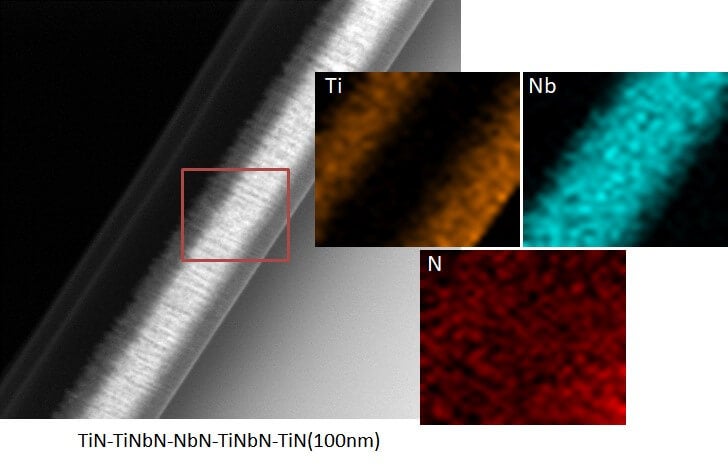
Figure 1. Example of a nitride heterostructure with tapered interfaces for improved superconductivity proximity coupling. Images shown are STEM and EELS elemental mapping.