Entangled photon sources are crucial for quantum computing, quantum sensing, and quantum communication. Of growing importance are sources relying on spontaneous parametric downconversion (SPDC). Unfortunately, these sources of entangled photons are often constrained by momentum conservation laws. To overcome this limitation and expand the possibility of quantum state engineering, we intend to use metasurfaces – a term that refers to periodic 2D arrays of nanoresonators with subwavelength dimensions and spacing – made of highly nonlinear optical materials, in which light-matter interactions can be engineered in novel ways. This project aims to optimize the generation efficiency of entangled photons using epitaxially grown metasurfaces. GaAs is commonly used to enable efficient photon pair generation. While current GaAs-based SPDC metasurfaces are fabricated using the GaAs(001) crystal orientation, the proposed project instead posits using a GaAs crystal orientation known as GaAs(111) that is more challenging to grow but can enhance the rate of photon pair generation by at least one order of magnitude and potentially as much as three orders of magnitude. The epitaxial growth of GaAs-based structures on GaAs(111) substrates will first be explored to optimize layer morphology at an atomic scale. The metasurface design will also be optimized using a deep neural network technique. In close feedback with the modeling, metasurfaces with different designs will be fabricated on the grown GaAs(111) layers. The nonlinear optical response of the metasurfaces will be measured to continue refining of the design, and the entangled photon pair generation correlation will be studied. These new quantum optical metasurfaces can potentially enable the creation of complex photon quantum states, including cluster states and multichannel single photons, that could facilitate compact quantum information processing and universal measurement-based quantum computation.
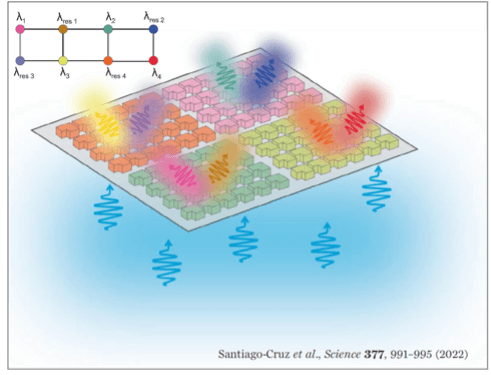
Figure 1: Spatial multiplexing of four metasurfaces for generating a general cluster graph state using a single multifrequency pump beam.