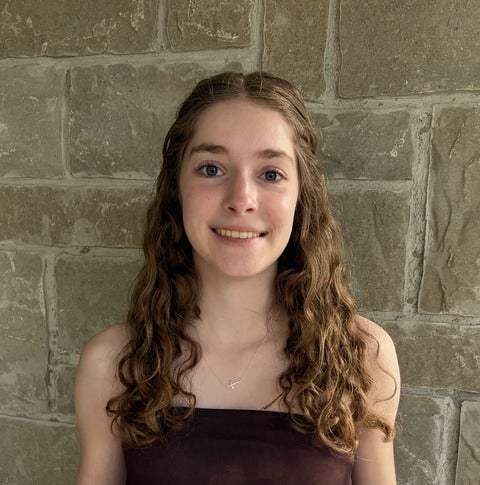
Dr. Elizabeth Nilsen
I am a Professor with the Clinical Division of the Psychology Department at the University of Waterloo. My students and I investigate how children learn to communicate and interact successfully with other individuals.
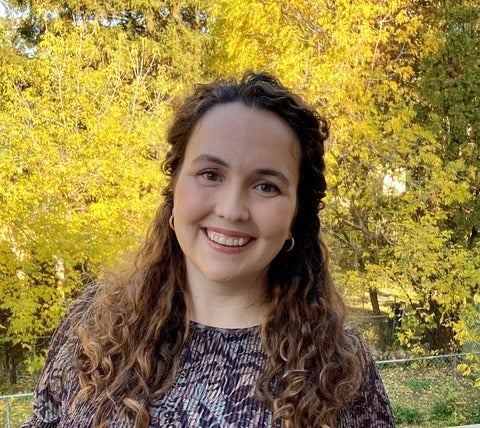
Alanna will be starting her fifth year of the MA/Ph.D. program in Clinical Psychology in the Fall of 2019. She is interested in studying how young children learn to work collaboratively with others. Her master's research examined the various influences of children's sharing behaviours, while her doctoral research will be focused on how children learn to take turns with others.
Charlotte is in the third year of her PhD Program in Clinical Psychology. Her dissertation research looks at how individual factors about youth (e.g. their ability to consider the perspectives of others, their personality, and their cognitive skills) interact to shape their social experiences as they transition from late childhood into early adolescence. For her Master's thesis, Charlotte examined how parent and youth mentalizing mentalizing related to youth social ability, and how parents’ ability to respond sensitively to their teenagers changes during times of stress, like COVID-19.
Thuvaraka is in her fourth year of Bsc Honors Psychology minoring in Biology. She recently completed her thesis investigating the role of empathy in children’s perception of social robots in the context of teaching.
Barbara is in her fourth year in BA Honors Psychology minoring in Social Development Studies. She is interested in cognitive and clinical psychology, with a target population of children. She helps with recruitment and coding in the lab.
Mika is entering her 4th year of the Honour's B.Sc. program in Psychology at the University of Waterloo. She is currently completing her Honour's Thesis under the supervision of Dr. Nilsen and Dr. Henderson, in collaboration with the Cognitive Development Lab and the Social Development Lab. Her thesis examines how shyness impacts children’s communication with peers during a collaborative, goal-oriented drawing task. Broadly, Mika is interested in how children express themselves and how psychopathology manifests in childhood and adolescence. She hopes to pursue a career in the field of clinical psychology.
Kowsi is in her 1st year of the MA/PhD program in Clinical Psychology at the University of Waterloo. She graduated with an Honours B.Sc. in Psychology, Neuroscience, and Behaviour with Mental Health Specialization from McMaster University. Broadly, her research interests focus on the influence of temperament and ADHD on socio-communicative behavior, with particular attention to how these factors shape communication and social interaction in both personal and social settings.
Kristen is in her 2nd year of the MA/PhD program in Clinical Psychology at the University of Waterloo. She completed her Honours B.Sc. in Psychology at UPEI. For her Master’s research, she is investigating the impact of contextual and individual factors on adolescent communication in online games. She is broadly interested in how online spaces affect development in childhood and adolescence, with a focus on how contextual factors can be manipulated to alter outcomes.
Monica completed her Honours Psychology B.Sc. degree at the University of Waterloo. She is broadly interested in studying psychopathology in children, adolescents, and young adults, and she hopes to one day help expand our understanding of and interventions for certain psychopathologies and maladaptive behaviours.
Nadine is in her 1st year of the Clinical Psychology program at the University of Waterloo. She graduated with a BSc in Health Studies and MASc in Developmental and Communication Science at the University of Waterloo. Nadine’s research explores parent-child interactions and in particular, how certain parenting behaviours help or hinder children’s learning in problem-solving contexts.