
Integrating Environmental Water Research Across Multi Scales and Disciplines
Water is our most precious natural resource. All human activities, from agriculture and industrial processes to domestic uses, depend on water of sufficient quantity and quality. This is also true for natural ecosystems. In contrast to highly visible water quantity stressors, such as flash floods and prolonged droughts, changes in water quality are often more gradual and more difficult to detect, and their cumulative impacts more difficult to predict and manage. Water quality deterioration, however, poses more pervasive and chronic risks to the economy, human health and the ecological life-support systems of the planet.
Water quality degradation is a global phenomenon. In Canada, for example, harmful and nuisance algal blooms are a persistent problem for many freshwater bodies, including the iconic Laurentian Great Lakes, while many of our First Nations communities still live under drinking water advisories. Globally, awareness is also growing that climate change adaptation must be an integral part of planning and implementing effective water management policies and practices.
For general inquires about the Ecohydrology Research Group, please email ecohydrology@uwaterloo.ca.
News
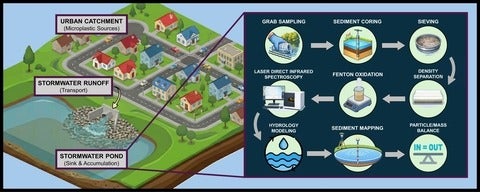
New publication quantifies microplastic sources, catchment yields, and land use drivers in urban stormwater runoff
In a recent publication in the journal of Water Research, ERG members of the Microplastics Fingerprinting Project presented findings on the contribution of stormwater catchments to microplastic (MP) loads and yields in urban areas.
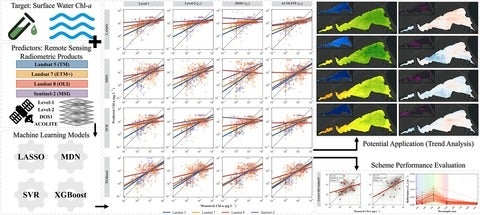
New publication presents a machine learning blueprint for monitoring lake water quality from space
New study evaluates various machine learning models and atmospheric correction tools using over two decades of satellite data (2000–2023) to optimize Chlorophyll-a retrieval in western Lake Ontario and Hamilton Harbour.
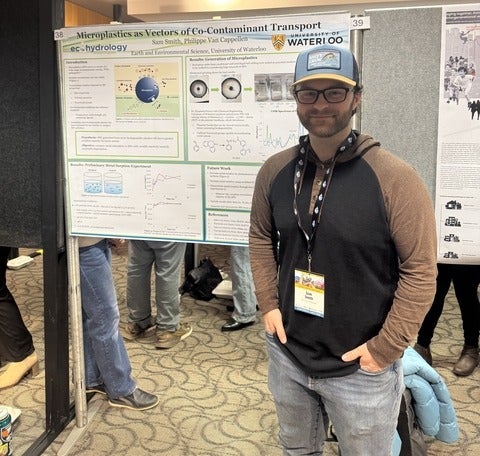
Sam Presents Award-Winning Research on contaminant transport through sorption to microplastics at World Water Day 2026
At the recent World Water Day 2026 celebrations hosted by the Water Institute, MSc candidate Sam Smith won the Best Graduate Poster Award for his work, "Microplastics as Vectors of Co-Contaminant Transport."
Events

EARTH 652: Reactive Transport Modeling (e-RTM)
From May 11 to 22, 2026, Philippe Van Cappellen and Fereidoun Rezanezhad will offer EARTH 652: Reactive Transport Modeling at the University of Waterloo.
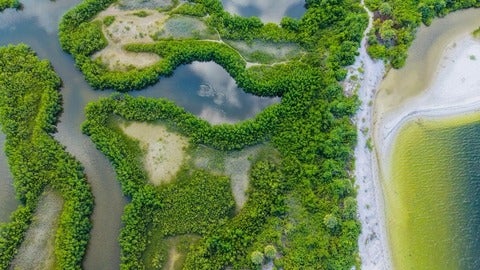
International Workshop on Ecohydrogeology
On July 20 and 21, 2026, we will host an International Workshop on Ecohydrogeology at the University of Waterloo. The Workshop will bring together researchers, practitioners, and students from around the world to explore connections between water, ecological, and geological systems.