
Conducting research is an integral part of a graduate degree.
Support your fellow graduate students by participating in a research study. Research studies may be online or in-person, are often a single session, and provide immeasurable value to the graduate students conducting the research.
Jump to: Engineering studies | Health studies | Math studies | Science studies | Advertise a study
Studies in the Faculty of Engineering
A guessing game for humans and social robots
This study has been reviewed and received ethics clearance through the University of Waterloo Research Ethics Committee, ORE #48147.
This study aims to understand how you interact with a social robot in a teaming scenario, your experiences with the process and impressions of the robot. The ultimate goal is to understand how we can improve human-robot interaction.
- Format: In-person
- Method: Participants will play a number-guessing game with a humanoid robot.
- Length: 20-30 minutes
- Participant requirements:
- Minimum 18 years of age
- Comfortable reading and speaking in English
- Remuneration: $7-$10
- Attachments: Information letter
Shiyao Zhang
Systems Design Engineering
Supervised by Moojan Ghafurian
Story-based networking support: Delivering LLM-driven storytelling prompts to immigrants and newcomers for career communication contexts
This study has been reviewed and received ethics clearance through the University of Waterloo Research Ethics Committee, ORE #48068.
This project explores how artificial intelligence (AI) can support immigrants and newcomers in learning to tell their professional stories with confidence. Many newcomers arrive in Canada with strong skills and experiences, but informal networking, such as coffee chats, introductions, or elevator pitches, can feel unfamiliar or intimidating. This study tests whether guided storytelling sessions with an AI companion can help.
- Format: In-person
- Method: Participants take part in a workshop-style session where an AI system acts as a supportive conversation partner. It helps them reflect on their experiences, identify strengths, and shape personal stories for professional situations.
- Length: 1 hour
- Participant requirements:
- University of Waterloo international student
- Living in Canada for less than 2 years
- Remuneration: Up to $24
Priyank Avijeet
Electrical and Computer Engineering
Supervised by Kerstin Dautenhahn
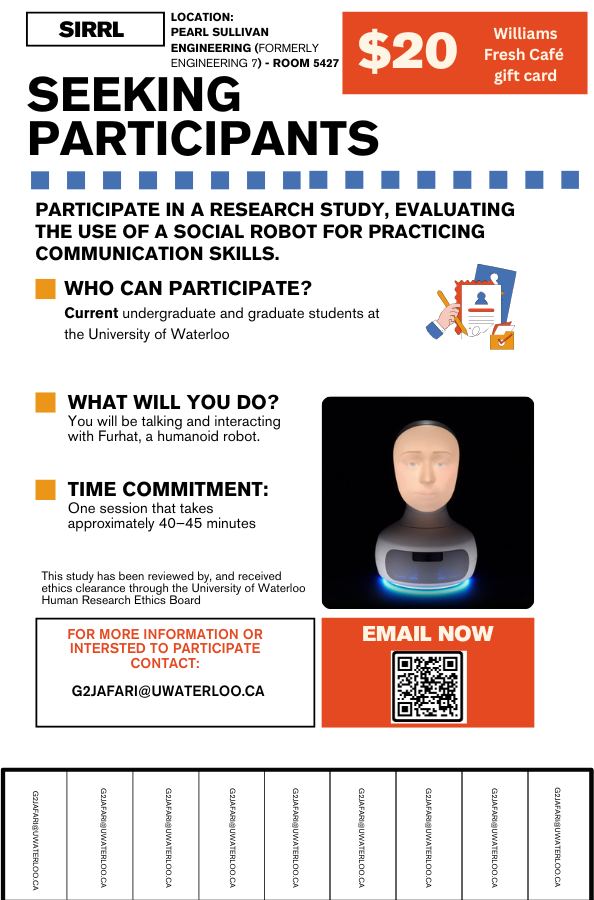
Evaluating the implementation and perception of furhat robot in developing interpersonal skills
This study has been reviewed and received ethics clearance through the University of Waterloo Research Ethics Committee, ORE #47794.
This study aims to better understand how to develop social robots that can help improve students' communication skills.
- Format: In-person
- Method: Participants will talk to a humanoid robot in two scenarios, each featuring a different personality.
- Length: Approximately 45 minutes
- Participant requirements:
- University of Waterloo student
- Remuneration: $20 Williams Cafe gift card
- Attachments: Recruitment poster
Golgisoo Jafari
Electrical and Computer Engineering
Supervised by Kerstin Dautenhahn
Studies in the Faculty of Health
Evaluation of lower back and knee loading during infant lifting from the floor using the tripod technique: a comparative study with squat and kneel lifts
This study has been reviewed and received ethics clearance through the University of Waterloo Research Ethics Committee, ORE #47350.
This study examines how different infant lifting techniques, including tripod lifting, affect loading on the lower back and knees in childcare workers. The goal is to identify safer lifting methods that reduce strain and help prevent injury.
- Format: In-person
- Method: Participants will perform a series of infant lifting tasks using different techniques while lifting a 17 lb doll, with motion and pressure data collected.
- Length: Approximately 3 hours
- Participant requirements:
- Between the ages of 18 and 45
- No history of low back or lower limb injury requiring medical intervention or more than 3 days off work in the past year
- No history of surgical interventions to the back or lower limb
- Must be able to kneel to the ground and lift 7.7kg (17lb) without pain
- Remuneration: $10
- Attachments: Recruitment poster
Sajedah Almomani
Kinesiology and Health Sciences
Supervised by Stacey Acker
What mid-career means to nurses and what makes them stay?
This study has been reviewed and received ethics clearance through the University of Waterloo Research Ethics Committee, ORE #46503.
This study explores what supports experienced nurses in remaining in the profession, drawing directly on nurses’ lived experiences. The goal is to inform more practical, nurse-informed retention approaches that better reflect real workplace and life contexts.
- Format: Online
- Method: One semi-structured interview, conducted virtually.
- Length: One interview lasting about 1 hour.
- Participant requirements:
- Experienced nurses in the mid-stage of their nursing career
- Currently working in nursing or previously worked in nursing
- Practicing or formerly practicing in Canada
- Attachments: Study advertisement
Victoria Babysheva
School of Public Health Sciences
Supervised by Phil Bigelow
Investigating the cerebellar contribution to sensory processing in ADHD
This study has been reviewed and received ethics clearance through the University of Waterloo Research Ethics Committee, ORE #43208.
This study aims to examine the role of cerebellum in attention deficit hyperactivity disorder (ADHD) and understand patterns of attention before and after TMS within ADHD and healthy populations.
- Format: In-person
- Method: Brain activity will be enhanced by using a non-invasive method called intermittent theta burst (iTBS), which uses magnets to change the electrical activity in the targeted location. Participants will be asked to complete a visuo-tactile task involving completing a cross-modal task using a mouse.
- Length: 2 hours
- Participant requirements:
- Age 18-40
- Accepting participants with and without an ADHD diagnosis
- Participants should have no history of seizures, neurological illnesses or events, active symptoms of concussion, and no medical implants/metal implants, and be willing to stop taking any medication that crosses the blood-brain barrier 48 hours prior to the study.
- Remuneration: $20
- Attachments: Recruitment letter
Simran Mughal
Kinesiology and Health Sciences
Supervised by Richard Staines
Structural and functional correlates of audiovisual integration
This study has been reviewed and received ethics clearance through the University of Waterloo Research Ethics Committee, ORE #23241.
In this study, a measurement of behaviour test and non-invasive brain imaging will be done using transcranial magnetic simulations. The purpose of this study is to obtain a more detailed understanding of the brain mechanisms of how audiovisual integration changes with age which may help to understand possible treatment options.
- Format: In-person
- Method: Audiovisual simultaneity judgment task where you will be asked questions about things you see and hear. See consent form for more information.
- Length: 2-3 hours
- Participant requirements: 20-50 years of age with normal or corrected to normal vision and hearing
- Remuneration: $10/hour
- Attachments: Consent form

Viquar Unnisa Begum
Kinesiology and Health Sciences
Supervised by Michael Barnett-Cowan
Studies in the Faculty of Math
Object manipulation and perception in virtual reality
This study has been reviewed and received ethics clearance through the University of Waterloo Research Ethics Committee, ORE #45474.
This study examines how people interact and perceive objects in virtual reality. Participants are expected to perform a simple object moving task and estimate the size of the object with their hand.
- Format: In-person
- Method: Participants will use a virtual reality headset and answer a survey about their experience.
- Length: 1 hour
- Participant requirements:
- 18-64 years old
- Exclusion criteria: Individuals with visual impairments, audio impairments, balance impairments, or medical implants
- Remuneration: $20 Amazon gift card
- Attachments: Recruitment poster
Junhyeok Kim
School of Computer Science
Supervised by Mark Hancock & Dan Vogel
Studies in the Faculty of Science
Role of lysosomal membrane stability and protease activity in the pathogenesis of Sjögren's syndrome dry eye
This study has been reviewed and received ethics clearance through the University of Waterloo Research Ethics Committee, ORE #47663.
Sjögren’s disease (SjD) is a rare autoimmune disease that causes patients to suffer from severe dry eyes. The dry eye is often dismissed or confused with typical dry eye disease. Currently, there are no tools or methods for doctors to tell these two types of dry eye apart quickly and accurately. This results in a prolonged diagnosis time or misdiagnosis of SS patients that delays their treatment. The goal of this study is to differentiate between SjD-related dry eye and typical dry eye using cathepsin S, cystatin C, lysosome associated membrane proteins 1 (LAMP1) and LAMP3 the ocular surface cells. This study will be beneficial in deepening the understanding of SjD and for a shorter time-to diagnose for SjD
- Format: In-person
- Method: Ocular surface evaluation and collection of cells on the surface of your eyes. A numbing eye drop will be used for the collection.
- Length: 1 hour
- Participant requirements:
- Minimum 18 years of age
- Experience severe dry eye, OR has a known diagnosis of Sjögren's disease
- Remuneration: $20
- Attachments: Consent form
Ivy Vong
School of Optometry and Vision Science
Supervised by William Ngo