What if safety were a habit, not a reaction? That question led a student team to create Flare, a campus safety-training platform that reimagines emergency preparedness as a community-driven, everyday behaviour. Their project earned First Place in the IBM Challenge of the Service Design Challenge, along with an Honourable Mention in the overall international competition.
As part of the Global Business and Digital Arts capstone course, design students were challenged to reduce bias in society. Team Flare — Bernice Heng, Andrew Kim, Chris Pan, Sasha Takoo, and Jessica Wu — responded by tackling a subtle but powerful form of bias: optimism bias, the belief that bad things are unlikely to happen to us.
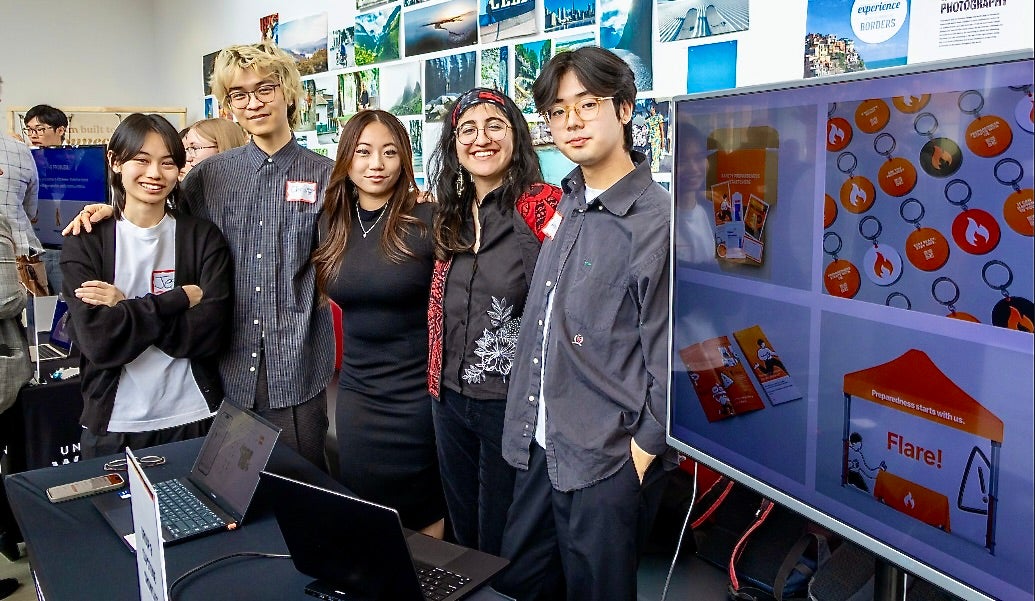
This insight came from personal experience. “As university students, our team saw firsthand how optimism bias undermines engagement with emergency preparedness.” During a summer term, the team learned of an emergency on campus. Some had friends who were directly affected, and others were unaware that anything had happened. “We spoke directly with peers who admitted to ignoring drills and alerts because emergencies felt too abstract or rare to be relevant.”
“That disconnect stuck with us. We realized that safety on campus often feels like a given. An unspoken part of being in a forward-thinking academic environment. But that very assumption creates a blind spot,” the team shared.
They discovered this bias leads to low engagement with emergency systems, poor preparedness, and fragmented trust, especially on university campuses.
Initially, the team focused their solution on awareness and communication to build community, as their stakeholder interviews suggested, students “didn’t see anyone else around them care, which demotivated them to care.”
After further analysis of their survey data, they found that students who had received prior safety training were far more prepared and accurate in emergency responses. To create a prepared community, the team reported that “instead of ignoring that gap, we reframed our entire service journey to seamlessly integrate engaging and reflexive training moments."
The team’s ability to integrate feedback, pivot, and refine their solution ultimately led them to success in the Service Design Challenge.
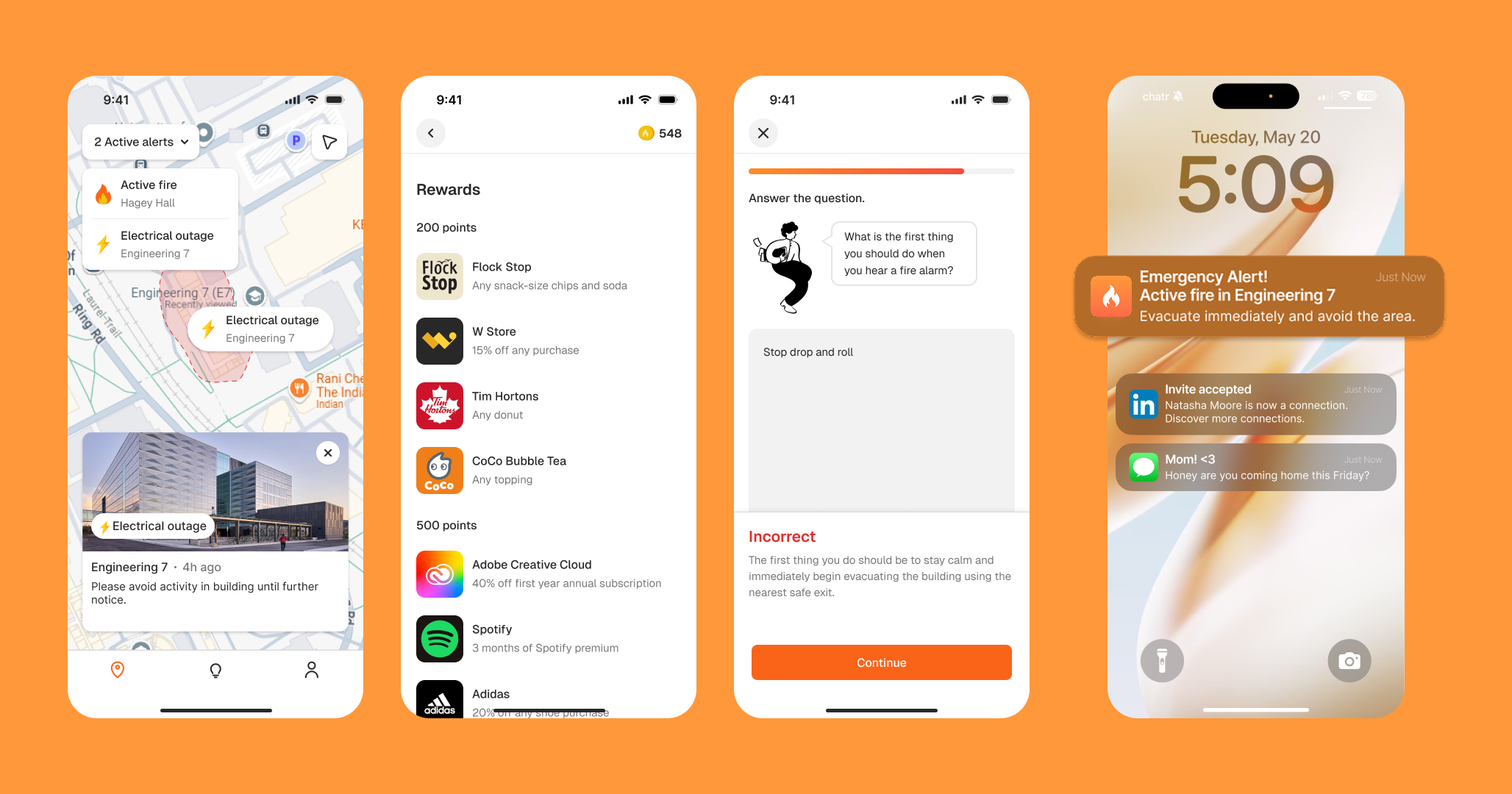
In their prototype, Flare, users engage in common safety protocols and on-campus awareness through gamified interactive modules, receiving points toward completion. From there, customized policies and real-time alerts could be integrated for clear action in emergent situations.
"We were genuinely impressed with Flare’s creative approach to campus safety. The team has turned a commonly overlooked topic into a playful and practical service. Its integration of gamification and stakeholder feedback showcases a strong understanding of real-world systems and user engagement,” noted the Challenge jury statement.
As new Waterloo alumni, Team Flare is celebrating their well-deserved award while participating in an 8-week design incubation with IBM. Their success reminds us all that safety is a habit we build together.
While Team Flare’s solution effectively highlights the importance of changing optimism bias to create a culture of preparedness, Regroup Mobile is the University of Waterloo’s sole emergency notification system. Download Regroup Mobile
Banner design by Noah Pratt.