A full circle moment for Ontario Envirothon enthusiasts
Two Waterloo students reflect on how an environmentally themed academic competition offers budding environmental leaders a chance to explore education and career paths in the natural sciences
When Ben Woodward (BES '24) and Ella Williamson joined their respective high school Ontario Envirothon teams it wasn’t part of some master plan to get into environmental sciences, but rather because passionate teachers encouraged them to sign up. Yet, those early steps into fieldwork were transformational.
Run by Forests Canada in partnership with universities and organizations across the province, Ontario Envirothon is a unique, environmentally themed academic competition that offers budding environmental leaders a chance to explore education and career paths in the natural sciences. For the past eight years, the University of Waterloo has been a proud partner and hosted the competition.
For many students like Woodward and Williamson, being exposed to hands-on experiences with forests, soils, wildlife and aquatic ecosystems were life changing.
“It really opened up my world in Grade 9,” says Woodward. “I liked nature, but I didn't really know how to describe anything about it. I participated all four years of high school, and I got to go to the provincials twice. I made a lot of good friends through that from all over the province.”
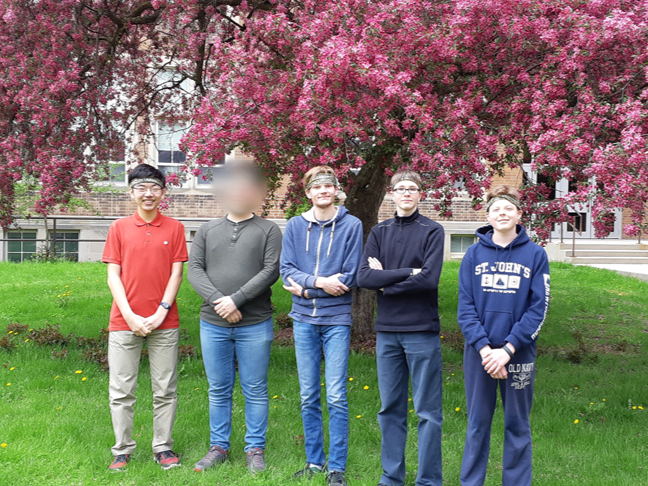
Ben Woodward (middle) with his high school Ontario Envirothon team. From left to right, the team members are Thomas Li, [redacted], Ben Woodward, Nikita Serikov, and Matthew Woodward (my brother). Thomas and Matthew attended the University of Waterloo.
This early exposure to environmental sciences led both students to study at the University of Waterloo’s Faculty of Environment, where they quickly realized how much the program had prepared them to succeed in higher education.
“My first field course, ENVS 200 – Field Ecology, I couldn’t believe I knew this stuff because I went to Envirothon,” says Willaimson. “I knew how to identify trees and how to use some of the equipment. It was crazy how helpful it was in university, and I am grateful for it every day.”
Today, Williamson is a fourth-year student with a passion for conservation and restoration fieldwork. When she secured a co-op position with the Ecology Lab, she began volunteering with the regional and provincial events.

Williamson volunteering as a presentation judge at the 2024 Ontario Envirothon Provincial Competition on campus.
“It was really full circle going from learning how to use the soil measurement instruments to teaching other students how to do it and reassuring them that they are doing great,” she says.
Like Williamson, Woodward has also been an avid volunteer, often helping with the aquatics category and acting as a presentation judge. After graduating from the Department of Geography and Environmental Management, he is now completing graduate studies in the Faculty of Science focusing on coastal change and erosion in the context of climate impacts. He credits Ontario Envirothon as a major steppingstone.
“I really believe in these academic competitions. They’re low cost, equitable, and let students distinguish themselves on university applications. Envirothon is a big reason I earned an entrance scholarship.”
Eager to get future generations excited about the environment, Woodward hopes to become a teacher in the future and has recently been accepted into teacher’s college while Williamson’s goal is to be working in the field. In the meantime, both are excited by the prospect of the competition returning to Waterloo given the campus’ access to an impressive range of natural features, such as Laurel Creek which winds through what were once agricultural fields and the urban forest.
With so many landscapes clustered together, students can walk from the competition stations in a matter of minutes, eliminating the need for buses or remote field sites.
Then, to top it all off, there’s the Ecology Lab, a defining feature of the Faculty of Environment and a one-stop resource supporting lab and field activities, courses, projects and outreach initiatives like Ontario Envirothon.
“Obviously they have lots of samples,” says Woodward. “If we're doing a training day for the regional Envirothon, we can show students all kinds of different benthic invertebrates, tree samples and their library of guidebooks. It's a very rare collection of super high-quality resources on ecology and environmental studies.”
All of this will be available to 525 students at both the regional and provincial competitions this spring and is the latest in Waterloo’s effort to be a leader in sustainability research and education where the Faculty of Environment is a catalyst for environmental innovation, solutions and talent developed with the world, for the world.
Photo Credit: Forests Canada, Ben Woodward and Ella Williamson.