Automating robotic solar construction and maintenance
Swap Robotics is transforming outdoor work with automation, sustainability and clean energy innovation
Before autonomous robots and machines became trendy, Swap Robotics was ahead of the curve — developing cutting-edge technology with a mission to create net-positive environmental sustainability impacts.
As the world increasingly transitions to solar energy, one of the biggest challenges lies in the harsh, inhospitable conditions workers face when installing solar panels across thousands of acres. When temperatures often soar above 40 degrees Celsiusc, and the job demands lifting 90-pound solar modules above workers’ heads to mount them on racking systems, the work is not only physically grueling but also raises safety concerns.
“Swap Robotics offers a solution by making the job far less exhausting while boosting productivity,” says Tim Lichti (BA ’14), CEO and co-founder. “Our technology is essentially a force multiplier.”
Lichti, who has a passion for blending business and technology, had already built multiple companies generating six-figure revenues, but shares that he was searching for something deeper — something mission-driven.
“Clean energy was always really inspiring to me,” he says. “But I was also looking to solve a problem … and I thought robotics and automation would help to unlock solutions 10 times better than current methods. That belief led to the creation of Swap.”
He explains that the opportunity to blend smart business with impactful technology while contributing positively to the environment felt less like a career and more like a calling.
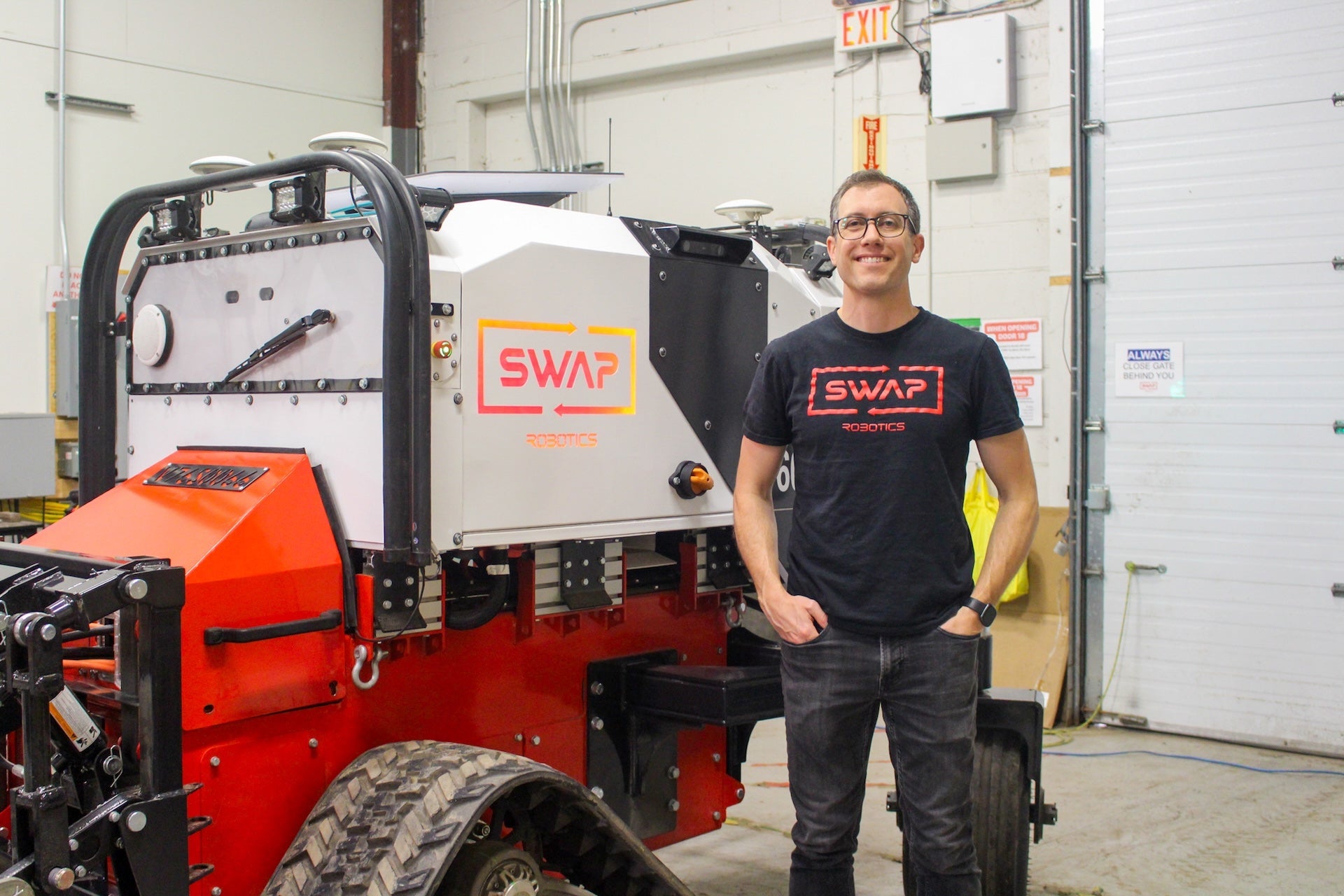
Lichti stands beside a Swap Robotics machine.
Swap Robotics emerged as a Velocity startup in 2019 to become a leader in utility-scale solar robotics. Today, dozens of its robots have been deployed across Canada and the U.S., helping accelerate the clean energy transition by making solar more affordable and scalable.
To date, the company has raised more than $15 million USD from major players in the solar industry and holds several patents for pioneering solutions in the field. These innovations have positioned Swap Robotics as a first mover in solving some of the most pressing challenges in solar installation and maintenance.
Reflecting on his time at the University of Waterloo, Lichti credits Velocity — the University’s centre of entrepreneurship — for helping Swap Robotics take flight.
“The access to space, resources and being surrounded by other tech entrepreneurs was an instrumental part of our journey,” he shares.
Looking ahead, Swap Robotics aims to expand globally, with a vision to make outdoor work equipment more sustainable across all continents, redefining what’s possible in clean energy infrastructure.