Skip to main Skip to footer
University of Waterloo
  • Admissions
  • About Waterloo
  • Faculties & academics
  • Offices & services
  • Support Waterloo
  • COVID-19
Search
  • Home
  • 1974-75 Waterloo Warriors Mens Basketball season
  • AI Workshop Fall 2024
  • Real Research
  • The Sultans of String musical performance
  • Admissions
  • About Waterloo
  • Faculties & academics
  • Offices & services
  • Support Waterloo
  • COVID-19
Waterloo News
Hollinger boxes in Waterloo's archives
February 10, 2026

Recovering Black legacies in Waterloo’s past

Discover the meticulous work that uncovered Black stories on campus and preserved them for the future 

Diane Choi stands in the Columbia Ice Fields rink stands while wearing COC gear
February 2, 2026

Co-op student gets the chance to support Canadian Olympic athletes

Sport and Recreation Management student Diane Choi embarks on co-op term with the Canadian Olympic Committee 

An illustration in the style of some African art, of two hands grasping each other
February 2, 2026

Celebrating Black History Month 2026

A message from the President and Vice-Chancellor

Geometric shapes representing the five Global Futures elements
January 19, 2026

2026 Global Futures: Innovation Update

Defying convention to shape our global futures

QNC Lab
January 12, 2026

Waterloo’s IP model sparks global research commercialization recognition

New Zealand adopts researcher-centric principles after studying Waterloo’s pioneering approach to IP ownership 

Yuying Li, Professor at the Cheriton School of Computer Science, University of Waterloo
February 12, 2013

Waterloo computer scientist warns banks and investment firms to expect the unexpected

Yuying Li designs algorithms and creates strategies to help avoid losses in an unpredictable economy.

Shirley Tang
February 12, 2013

Improving lives at nano-scale

Invisible to the naked eye, nanotechnology is being combined with biotechnology to achieve medical advances such as the early detection of life-threatening diseases through a simple device, similar to a glucometer, for example. Shirley Tang and her team believe that the primary goal of their research should be to help improve lives through these scientific breakthroughs.

Jatin Nathwani - Video
February 12, 2013

Is your future electric?

Waterloo researcher is leading the charge to create technologies and policies that will support an electrified energy future.

Michele Mosca
February 12, 2013

On the frontiers of global information security

The impact of quantum information processing on the world of cryptography will be broad and deep. Developing the next generation of cryptographic structures, structures that will be secure in a world with quantum technologies, is absolutely essential to robust global information security in the future.

Raymond Laflamme
February 12, 2013

The quest for the quantum “holy grail”

Harnessing the power of the quantum realm is paving the way for a new breed of computers with tremendous processing power. Today's computers encode, store and manipulate information using bits - zero or one. Quantum bits, or qubits, have the remarkable property of being in a "superposition" of zero and one. In other words, they can be in both simultaneously. This characteristic, and other quantum phenomena, offer a much richer environment for processing information and allows us to develop devices that will drastically outperform today's computing and communication technology.

Bernard Glick
February 12, 2013

Feeding Earth's growing population

Microbes that help plants grow in harsh conditions will help feed Earth’s growing population. It’s an affordable solution for both the developed and developing worlds, where farmers have already begun successful implementation of this technology.

Chris Eliasmith
February 12, 2013

How to build a brain

Chris Eliasmith’s team at the Centre for Theoretical Neuroscience has built Spaun, the world’s largest simulation of a functioning brain.  Spaun is able to shift between diverse tasks — from copying human handwriting to finding hidden patterns in a list of numbers. Understanding the intricate connections between 2.5 million simulated neurons will lead to better understanding of how changes in the brain affect changes to behaviour.

Melanie Campbell
February 12, 2013

An early test for Alzheimer's disease

Melanie Campbell sees the eyes as a window to the brain, where the presence of amyloid beta proteins in the neural layers of the retina may lead to an early and definitive test for Alzheimer’s disease. 

Avery Broderick
February 12, 2013

Shining a light on black holes

As a member of the Event Horizon Telescope team, Avery Broderick is helping to unravel the mysterious nature and behaviour of black holes, from the properties of the "event horizon" to how some can launch the energetic jets of matter and radiation that shape their host galaxies.

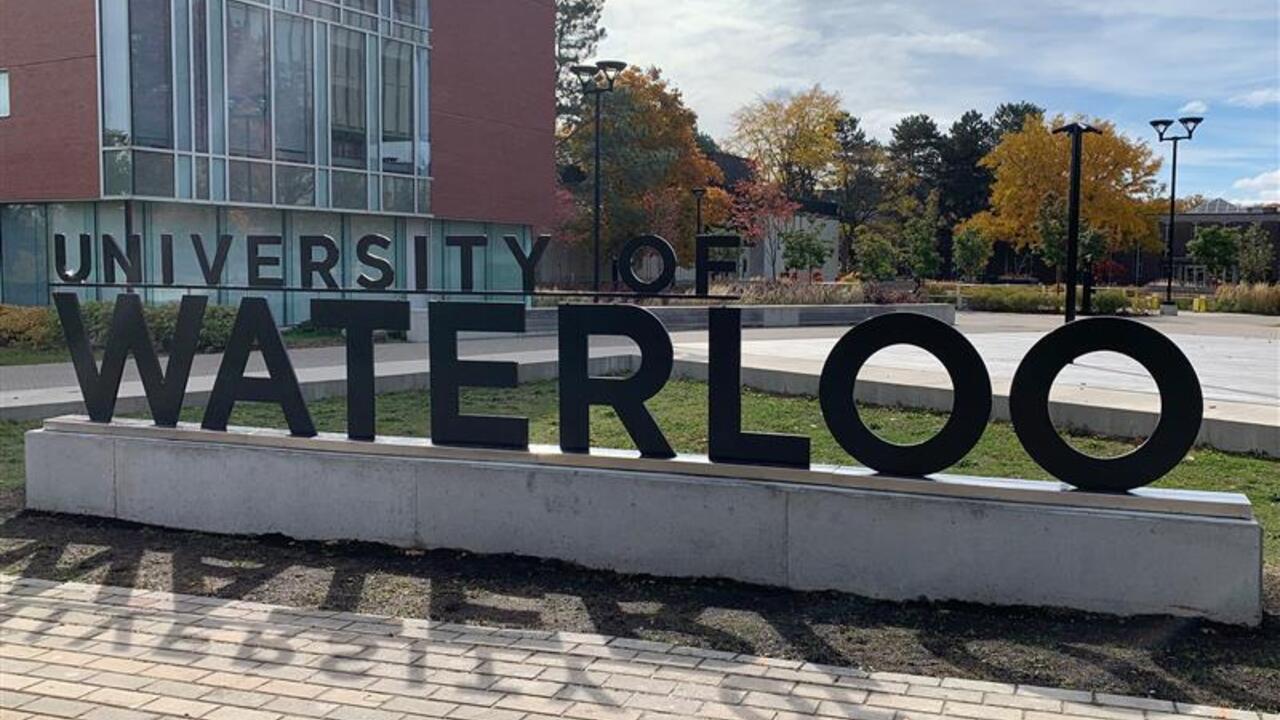
Waterloo University sign
February 11, 2013

Strategic research projects at Waterloo receive federal funding

A research project is among the innovative initiatives at the University of Waterloo that received major funding.

Black History month
February 8, 2013

Reflect on the reality of the African-Canadian experience, says prof.

Black History Month is both a reflection on and celebration of black culture

University of Waterloo sign
February 8, 2013

University closed due to weather

The University of Waterloo is closed today (Friday, February 8) due to poor weather conditions. All campuses, including Kitchener, Stratford, and Cambridge, are closed

  • Load more
  • Share via Facebook
  • Share via Twitter
  • Share via Google+
  • Share via LinkedIn
  • Share via Email
  • TOP
  • Share
Waterloo news

Find an expert

Contact Media Relations


University of Waterloo
43.471468
-80.544205
200 University Avenue West
Waterloo, ON, Canada  N2L 3G1
+1 519 888 4567
  • Contact Waterloo
  • Maps & Directions
  • WatSAFE
  • Accessibility
  • Privacy
  • Copyright
  • Media
  • Careers
  • Feedback
@uwaterloo social directory

The University of Waterloo acknowledges that much of our work takes place on the traditional territory of the Neutral, Anishinaabeg, and Haudenosaunee peoples. Our main campus is situated on the Haldimand Tract, the land granted to the Six Nations that includes six miles on each side of the Grand River. Our active work toward reconciliation takes place across our campuses through research, learning, teaching, and community building, and is co-ordinated within the Office of Indigenous Relations.