Improving the bottom-line (and the impact on the environment) one robot at a time
Velocity company is building the playbook for deploying autonomous robots across Canada
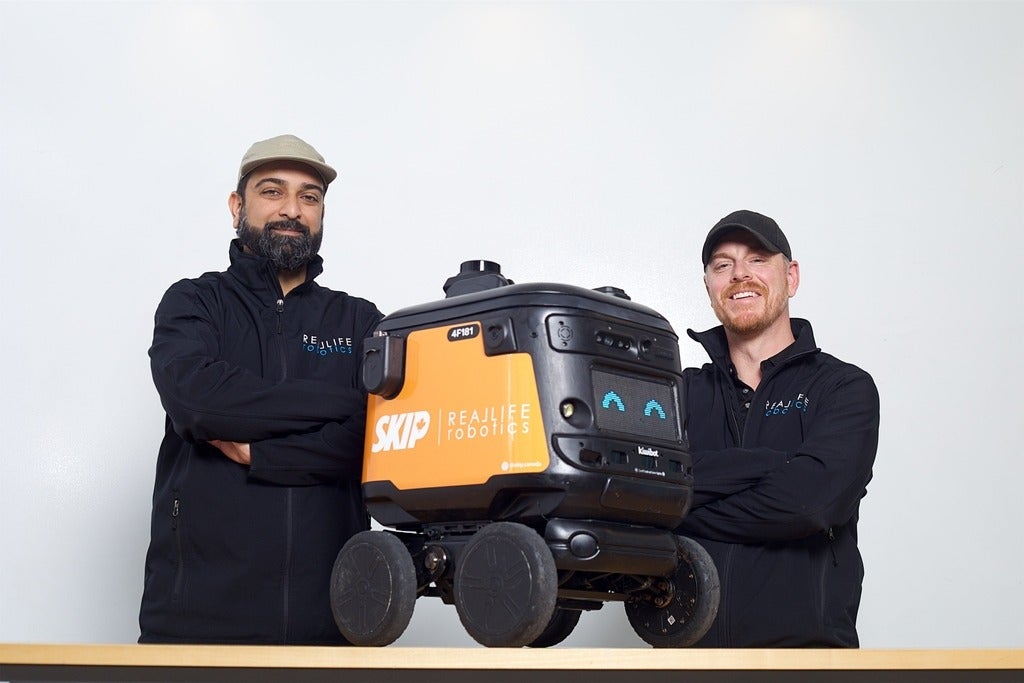
An orange, four-wheeled robot navigates a busy sidewalk in Markham, bringing a restaurant-ordered meal to a customer, as part of a pilot program led by Real Life Robotics in partnership with Skip. Real Life Robotics is the first and only in Canada approved for a municipal sidewalk delivery operation, but its aspirations are much larger.
Real Life Robotics is a Velocity company and continues to leverage its connections to the University of Waterloo as it establishes itself within the Canadian robotics market.
Waterloo has the largest and most active group of robotics and automation researchers in Canada. More than 45 faculty members conduct research across more than a dozen advanced robotics topics from factory automation to cognitive robotics.
Describing itself as a provider of last-mile delivery and automation through its AI-driven platform, Real Life Robotics hopes to bring robotics to the masses. Whether supporting small businesses or larger organizations, the aim is to create a seamless integration of robots. Their solutions address labour market shortages, lower costs for businesses and are a more environmentally sustainable delivery option with lower carbon emissions than traditional vehicles.
“We make autonomy accessible for non-technical organizations,” says Cameron Waite (BA
’04), CEO of Real Life Robotics. “We focus on integrating robotics into industries such as restaurants, retail, hospital, pharmacy as well as warehouses, and even zoos.”Waite says the company has benefited from its close ties to the University beyond Velocity including recruiting engineers and programmers and hiring a steady stream of co-op students.
“Waterloo is a robotics’ hub from the University to local industry,” says Sharif Virani, head of growth at Real Life Robotics. “It really empowers a company like ours to be in the middle of such an innovative landscape.”
Working alongside clients, Real Life Robotics helps identify what might be the most ideal robotic solution for an operation then navigates the complexities of bringing together the hardware and software within one unified source.
“We build our orchestration layers to help client take that complex journey and make it really straightforward, simple and scalable,” Virani says. “We partner with organizations like Skip, who are being highly innovative as the first Canadian entity, large Canadian enterprise organization, who's bringing this technology to the real-world streets to help their clients grow and benefit from lower cost delivery.”
The pilot in Markham also includes global robotics platform Robot.com (formerly Kiwibot), Rogers and the Remington Group, which supports smart city integration.
According to Virano, the next step is taking their data and results to other municipalities and clients across the country who are interesting in this sort of technology.
“We are essentially building the playbook for the deployment of these technologies across the country,” Waite says. “We’re proud to bring a Waterloo solution to Canadian businesses and support them in being more competitive and sustainable.”